What Temperature to Cook a Turkey: A Practical Guide
Discover safe temperatures for roasting a turkey, including target internal temps, resting times, and tips for juicy, evenly cooked meat.


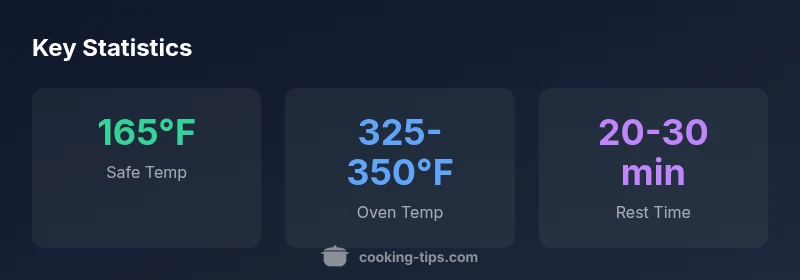
If you’re asking what temperature to cook a turkey, follow the USDA-recommended target: roast until the thickest part of the breast or thigh reaches 165°F (74°C). After removing from heat, let the turkey rest for 20–30 minutes. For stuffed birds, verify the center of the stuffing also reaches 165°F. According to Cooking Tips, this thermometer-driven approach minimizes guesswork and improves both safety and juiciness.
What temperature to cook a turkey: a practical framework
The journey to juicy, safe turkey begins with temperature decisions. If you’re wondering what temperature to cook a turkey, this framework helps you synchronize oven settings, doneness targets, and resting periods. Start by separating the problem into three measurable temperatures: the oven temperature you roast at, the interior doneness temperature you target, and the holding temperature after you remove the turkey from the heat. By thinking in these three numbers, you gain predictability across different bird sizes, whether you’re cooking unstuffed or stuffed, and whether your kitchen uses a conventional or convection oven. According to Cooking Tips, a thermometer-driven approach removes guesswork and yields consistent results. In practice, set your oven to a steady 325°F to 350°F and plan for a target interior temp of 165°F in the thickest part of the breast and thigh. For stuffed birds, plan for the center of the stuffing to reach 165°F as well, which may extend overall cooking time.
In this guide we balance safety with moisture, explaining how to check multiple spots and how resting affects juiciness. The key takeaway: temperature is not a single moment in time but a set of careful checks throughout the roasting process. As you prepare, stock an accurate thermometer, know your turkey’s weight, and be ready to adjust time and temperature based on real-time readings.
Safe temps: the role of internal temperatures
What you consider a safe doneness temperature varies by where you measure. The USDA and food-safety guides converge on a core rule: aim for an internal temperature of 165°F in the thickest portion of the turkey to ensure pathogens are destroyed. Many home cooks also monitor the thigh, which often reads a little higher than the breast. If you’re cooking a stuffed bird, verify 165°F in the center of the stuffing as well. Using a probe thermometer, insert into the breast, thigh, and, if applicable, the center of the stuffing, rotating to sample several spots. This reduces the risk of undercooked areas while preventing overcooking, which dries the meat. Remember that carryover cooking will raise internal temperature a few degrees after removal from heat, so you may pull the turkey slightly before the final reading. According to Cooking Tips Analysis, relying on actual temperatures rather than color cues leads to safer, more reliable results.
When you contrast breast versus thigh temps, expect the thigh to read higher at the moment of removal. Plan your finish around the breast reading by ensuring the thigh has reached 165°F as well, but be mindful of carryover temperature. The practical approach remains: verify multiple spots and rest before carving.
Oven temps: choosing the right roast temperature
Selecting the right oven temperature is a balance between speed, browning, and moisture retention. A common baseline for many home cooks is 325°F to 350°F. Lower temperatures promote even browning and reduce the risk of drying out the breast, especially for larger birds. If you’re short on time or want a crisper skin, some cooks raise the oven to 375°F for the final 15–20 minutes, then revert to 325–350°F for the remainder. In convection ovens, set closer to 325°F since the circulating air speeds heat transfer and can accelerate doneness. The important principle is consistency: keep the oven temperature steady and monitor with a thermometer for a reliable finish. The Cooking Tips analysis notes that consistent oven temps help achieve uniform doneness across different turkey sizes and layouts, including stuffed birds.
Remember, oven temperature interacts with your bird’s weight and whether you stuff it, so verify doneness with a thermometer rather than relying on color alone. A predictable roast temperature reduces surprises and improves flavor and moisture retention.
Stuffed vs unstuffed: why stuffing affects doneness
Stuffed turkeys present a dual challenge: the center of the stuffing must reach 165°F, and the outer portions must not be overcooked while chasing that goal. This often requires a longer overall roast time and careful monitoring. If you are stuffing the bird, consider using a larger roasting cavity, loosely packed stuffing, and a thermometer that can probe the stuffing’s center. Do not rely solely on the breast or thigh readings. Because the stuffing can stay cooler than the meat surrounding it, a separate probe into the stuffing is prudent. The general guidance remains: aim for 165°F in the stuffing and the deepest part of the bird. Cooking Tips Analysis, 2026 indicates that stuffing’s doneness hinges on even heat distribution, which can be aided by preheating the oven and avoiding overly tight packing.
Unstuffed turkeys typically reach doneness faster, with the breast finishing around 165°F while the thighs may reach 170–175°F. In practice, test multiple spots and account for carryover cooking during resting.
How to use a thermometer: step-by-step method
A precise thermometer is your most reliable tool for doneness. Follow these steps: 1) Choose a high-quality instant-read thermometer with a thin probe. 2) Insert into the thickest part of the breast, away from bone, if unstuffed. 3) Also insert into the center of a thigh or the center of the stuffing if stuffed. 4) Check readings when the timer indicates near finish; you want 160–163°F before resting, knowing carryover will push to 165°F. 5) Remove from heat when readings hover near target to prevent overcooking. 6) Rest the turkey for 20–30 minutes; carryover will bring the final temperature up and juices will redistribute. 7) Slice and verify a final reading in any spots that look underdone. 8) If necessary, return the turkey to the oven for a few minutes to bring any underdone areas up to 165°F. This thermometer-driven sequence reduces guesswork and delivers consistently safe, juicy meat.
Common pitfalls and how to avoid them
The biggest mistakes are underestimating doneness, overcooking, and slicing too early. Rely on a calibrated thermometer to avoid drying out the breast, especially with larger birds. Avoid opening the oven door repeatedly, which lowers oven temperature and lengthens cook time. For stuffed birds, overpacking can create cooling pockets that take longer to reach the center.To prevent these issues, plan ahead with a weighted roast time based on your turkey’s weight, maintain a steady oven temperature, and use a thermometer at multiple sites to guide you toward the 165°F target safely. In short, temperature is the guiding metric; color and time are secondary cues. The Cooking Tips team emphasizes thermometer-based cooking as the most reliable path to both safety and flavor.
Practical timing: estimating roast time by weight
Roast times vary with weight, oven performance, and whether the bird is stuffed. A practical rule of thumb for unstuffed turkeys is roughly 12–15 minutes per pound at 325°F. Stuffed birds typically need a little more time, often 15–18 minutes per pound, and the center must reach 165°F. Always confirm by measuring the interior with a thermometer rather than relying on the clock or appearance alone. If your turkey is very large, plan for longer resting to maximize moisture retention. Remember that carryover cooking will add a few degrees after removing from heat, so you may remove the turkey slightly before the final reading is achieved. The key is constant temperature checks and adjusting for your particular oven. According to Cooking Tips analysis, real-time temperature readings are a more reliable predictor of doneness than time alone.
Resting and carving: finishing touches
Resting is not optional; it is a crucial part of the cooking process. After you pull the turkey from the oven, tent lightly with foil and allow it to rest for 20–30 minutes. Resting lets juices redistribute and the internal temperature stabilize, making carving easier and meat more forgiving. During resting, the temperature will rise slightly due to carryover cooking, helping you reach or exceed the 165°F target in all key locations. Carve with a sharp knife and slice against the grain for tenderness. A well-rested turkey is juicier and more flavorful, and it reduces the risk of dry slices. The strategy here supports both safety and taste, which is exactly what home cooks want from a reliable turkey recipe.
Quick kitchen checklist
- Confirm you have a calibrated thermometer and spare batteries
- Preheat oven to 325–350°F, adjust for convection if applicable
- Prepare stuffing loosely (if used) and use multiple probes
- Roast until breast and thigh read 165°F, center of stuffing also 165°F if stuffed
- Rest 20–30 minutes before carving
- Keep leftovers safe and store promptly
Doneness targets by preparation method
| Scenario | Target Internal Temp (F) | Notes |
|---|---|---|
| Unstuffed whole turkey | 165 | Minimum safe temp for safety |
| Stuffed turkey | 165-175 | Center of stuffing should reach 165°F |
| Breast vs thigh | 165/175 | Breast target 165°F; thigh can read higher |
Quick Answers
What is the safe internal temperature for a fully cooked turkey?
The safe internal temperature is 165°F in the thickest part of the breast or thigh. If the turkey is stuffed, check the center of the stuffing as well to ensure it reaches 165°F.
Aim for 165 degrees in the thickest part of the meat, and don’t forget the center of the stuffing if you’ve stuffed it.
Can I cook a turkey at 325°F or should I go higher for faster results?
325°F is a reliable, steady temperature that yields even doneness and moisture. Higher temperatures can shorten time but increase the risk of dry breast meat; use higher temps only if you’re watching temps closely with a thermometer.
325 is a safe, steady choice; higher temps require careful thermometer monitoring.
How long should a turkey rest after cooking?
Rest the turkey for 20–30 minutes after roasting. Resting allows juices to redistribute and the temperature to settle, making carving easier and meat juicier.
Rest it for twenty to thirty minutes.
Is it safe to rely on color to judge doneness?
Color is not a reliable indicator of doneness. Always use a calibrated thermometer to confirm 165°F in the thickest parts of the bird and stuffing if used.
No—color isn’t reliable; check with a thermometer.
Should I baste the turkey during roasting?
Basting is optional and not necessary for safety. If you baste, do it quickly and only if you’re not opening the oven repeatedly, which can slow cooking and reduce moisture.
Basting isn’t required; avoid frequent oven opening.
“Temperature is the bridge between safety and juiciness in home cooking. A thermometer-driven approach minimizes guesswork and yields reliable results.”
Top Takeaways
- Monitor multiple spots with a thermometer for safe doneness
- Aim for 165°F in the breast, thigh, and center of stuffing (if stuffed)
- Rest 20–30 minutes before carving to maximize juiciness
- Use 325–350°F oven for reliable, even cooking
- Carryover heat will nudge temperatures upward after removal