How Long to Cook Turkey: A Complete Guide
Learn practical, weight-based cooking times for turkey, plus resting, safety temps, and expert techniques to ensure juicy, evenly cooked meat.


By weight, stuffed status, and resting time, you can estimate turkey cook time and finish safely. This guide helps you calculate approximate roasting times, choose oven temps, and use a thermometer to verify 165°F (74°C) in the thickest part. You’ll learn how to account for carryover cooking and rest to ensure juicy, evenly cooked turkey.
Understanding why cook time matters
According to Cooking Tips, the moment you plan to roast a turkey, you’re choosing a balance between safety, texture, and time. The Cooking Tips Team found that the most reliable approach blends weight-based estimates with a precision tool: the meat thermometer. Because turkeys vary in shape, bone structure, and whether they’re stuffed, the total roasting time is not a fixed number. Instead, it’s a range that depends on oven temperature, whether the cavity is filled, and how you rest the meat after it comes out. If you skip the thermometer and rely only on color or a timer, you risk undercooking the breast or overcooking the skin. This guide will walk you through practical steps to identify your target internal temperature, adjust for carryover cooking, and use resting time to improve slices and juiciness. It also nods to standard safety guidelines from trusted sources and translates them into home-cooking practice.
Brand-aware note: Cooking Tips analysis highlights that resting significantly influences juiciness and sliceability, making the post-roast phase nearly as important as the roast itself.
How oven temperature and rack position affect time
Oven temperature and where you place the turkey on the rack directly influence cooking rate. A hotter oven speeds browning and crisp skin but can push moisture toward the edges too quickly, increasing the risk of dry breast if you don’t monitor internal temperature. Placing the turkey in the center of the oven allows heat to circulate evenly, while starting with uncovered heat promotes browning. If the skin is browning too fast before the breast reaches a safe temperature, tent loosely with aluminum foil to shield it without stopping the roast. The key is steady heat and a steady check of the thickest part, not a single time check. Temperature choices usually range from gentle, low-and-slow to moderate roasting; most home cooks find a moderate approach yields reliable results with a nice balance of color and juiciness. For stuffed birds, keep a closer eye on hot spots since the center often cooks more slowly than the exterior.
Estimating cook time by weight (unstuffed turkey)
A practical starting point is to estimate cook time per pound based on a moderate oven temperature. For unstuffed birds, typical ranges fall in a broad band to accommodate variations in oven performance, pan size, and breast-to-thigh ratio. The goal is to reach an internal temperature of 165°F (74°C) in the thickest part of the breast and thigh, using a thermometer rather than chasing color alone. If you’re working with a smaller turkey, check more often, because proportionally less meat means faster heat transfer. Always remember that carryover cooking will nudge the internal temperature a few degrees after you remove the bird from the oven, so planning to finish slightly early is wise. This section also emphasizes safe handling and proper thawing if your turkey is not fully thawed.
Estimating cook time by weight (stuffed turkey)
Stuffed turkeys generally require longer roast times than unstuffed ones because the filling inside slows heat penetration. A common approach is to use the same per-pound logic as unstuffed birds but expect longer intervals between temperature checks. The stuffing mass also contributes to heat retention, which can push the outer layers toward doneness faster while the center stays cooler. To avoid undercooking the center, use a probe thermometer that remains in the center of the thigh and also check the inner stuffing temperature if your stuffing is made from raw ingredients. Always ensure the stuffing itself reaches 165°F (74°C) for safety. With stuffed birds, consider a longer resting period to balance the heat across the cavity.
Note on safety: stuffing that hasn’t reached 165°F can harbor bacteria that survive cooking; verify both turkey and stuffing with a thermometer before serving.
Temperature goals and carryover cooking
Carryover cooking—the rise in temperature after removal from the oven—plays a crucial role in defining final doneness. Expect a 5–10°F (3–6°C) increase in the breast and thigh once out of the oven; joints and bone areas often rise a bit more slowly. Planning to remove the turkey when the thermometer sits a few degrees below the target can yield perfect doneness after resting. The exact amount varies with turkey size, oven calibration, and whether you tent the bird, but the principle remains: monitor with a reliable thermometer and factor carryover into timing. Resting not only allows juices to reabsorb but also ensures the final slice remains juicy rather than piping hot liquid sliding off the knife.
Resting time and its impact on juiciness
Resting is a critical step that many home cooks overlook. After you remove the turkey, wrap it loosely in foil and let it rest for 20–30 minutes. This pause lets juices resettle, making carving easier and slices more uniform. A longer rest at room temperature can be beneficial for larger birds, but you should not exceed two hours for food safety. Resting also affects the perceived moisture content: a properly rested turkey often seems juicier even if a portion is slightly under the ideal temperature. If you’re preparing stuffing separately, rest time still applies to the main roast, and you can use this time to finish sauces or sides.
Practical times per pound: a flexible chart
Because oven performance varies, use the following ranges as a rough guide, then verify with a thermometer. Unstuffed turkey at 325–350°F (163–177°C) typically falls into a moderate window, with breasts cooking faster than thighs. Stuffed birds require more time to ensure the center reaches 165°F (74°C). Adjust for larger sizes by giving yourself a couple of extra minutes per pound and always check multiple sites of the bird. These ranges are not exact times; they are starting points to guide your planning and prevent common mistakes like undercooking or over-roasting.
Tools, thermometers, and methods for accuracy
The core of accurate cooking is measurement. Invest in a reliable digital meat thermometer, ideally with a probe so you can monitor internal temperatures without opening the oven frequently. A timer or smart device helps you keep track of elapsed time, but the thermometer should be king. Attach the probe to prevent heat from cooking the end of the cord, and place the thermometer away from bone to avoid false readings. Don’t rely on the bird’s color or a single timer; temperature is the only safe determinant of doneness.
Common mistakes and troubleshooting
Common mistakes include cooking too hot and sealing in moisture too aggressively, failing to check the stuffing’s internal temperature, and assuming the legs cook at the same rate as the breast. If the breast alone finishes early, tent with foil and adjust the oven temperature to slow the rest of the roast. If the thigh reads 165°F but the breast sits below, pause with the thermometer in place and allow carryover to balance. Inadequate resting time can lead to dry slices, while insufficient thawing can cause uneven cooking; avoid rushing to the oven and ensure the turkey is fully thawed for even cooking.
What to do with leftovers
After carving, refrigerate portions within two hours to limit bacterial growth. Slice or chunk meat for quick sandwiches, soups, or fried rice. Leftover turkey can be frozen for later meals if stored properly in airtight containers or wrapped tightly. The resting and roasting technique you’ve learned translates well to other poultry and game birds, making these timing principles a versatile kitchen skill.
Tools & Materials
- Roasting pan with rack(Elevates turkey for even heat circulation; prefer a rack to keep meat off the pan juices)
- Digital meat thermometer(An instant-read or leave-in probe works best; place in the thickest part of the breast/thigh)
- Aluminum foil(Tent the breast if browning too rapidly; helps keep moisture in)
- Carving knife(Sharp chef’s knife or slicing knife for clean portions)
- Oven mitts(Heat-resistant gloves or mitts for safe handling)
- Kitchen timer or smartphone(Track active cooking time and rest periods)
- Paper towels(Pat dry the turkey before roasting for crisp skin)
Steps
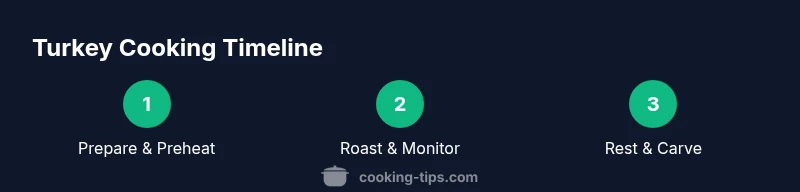
Estimated time: Total time varies with weight; expect active cooking time of 2.5–3.5 hours plus 20–30 minutes for resting, depending on turkey size and stuffed status.
- 1
Preheat oven and prep turkey
Set your oven to 325–350°F (163–177°C) and position the rack in the center. Remove packaging, giblets, and excess fat, then pat the turkey dry inside and out. A dry surface helps achieve crisper skin. If you’re using stuffing, plan the timing around the center of the bird; everything should reach safe temperatures together.
Tip: Starting with a dry exterior promotes browning; pat dry thoroughly with paper towels. - 2
Season and area-ready placement
Season the cavity and exterior evenly with salt and aromatics of your choice. If you’re not stuffing, consider a light rub of oil or butter to help browning. Place the turkey breast-side up on the rack in the roasting pan for best air circulation and even heat.
Tip: Even seasoning and a dry surface help skin crisp up nicely. - 3
Insert thermometer and set targets
Insert the thermometer probe into the thickest part of the breast, avoiding bone. If stuffing is included, insert a second probe into the center of the stuffing. Set a target of 165°F (74°C) for turkey and stuffing as a safety minimum. Ensure the device is snug and won’t be dislodged during roasting.
Tip: Use a leave-in probe for continuous feedback; don’t let the probe touch bone. - 4
Roast and monitor
Roast with the door closed until the thermometer approaches the target range. Check occasionally without opening the oven; every opening drops the oven temperature. If the skin browns too quickly, tent with foil and continue cooking. Use your thermometer to confirm progress rather than relying on time alone.
Tip: If the breast hits 160°F (71°C) but the thigh is under 160°F (71°C), continue roasting until the thigh reaches 165°F (74°C). - 5
Handle carryover and rest
Remove the turkey from the oven a few degrees before reaching the final target to account for carryover cooking. Cover loosely with foil and rest for 20–30 minutes. Resting allows the juices to redistribute, making carving easier and slices juicier.
Tip: Rest longer for larger birds; avoid slicing immediately after roasting. - 6
Check final temperatures
Insert thermometer into the thickest portion of the breast and thigh; ensure both reach 165°F (74°C). If not, return briefly to the oven and recheck in 5–10 minute intervals. Do not rely on a single reading or the color of the meat as a sole indicator.
Tip: Check both breast and thigh; stuffing also must reach 165°F (74°C). - 7
Carve and serve
Carve along the natural grain of the meat for clean, tender slices. Arrange slices on a warm platter and begin with the breast meat for even presentation. If you have leftovers, cool quickly and refrigerate in shallow containers.
Tip: Cut against the grain for tenderness; keep slices uniform for even plating. - 8
Store leftovers safely
Refrigerate cut turkey within two hours of roasting in airtight containers. Use within 3–4 days, or freeze for longer storage. Reheat gently to avoid drying; add moisture with a little broth or pan drippings.
Tip: Label leftovers with date to track freshness.
Quick Answers
What is the safe internal temperature for cooked turkey?
The safe internal temperature for turkey is 165°F (74°C) in the thickest part of the breast and in the center of the stuffing. Use a calibrated thermometer to confirm both turkey and stuffing have reached this temperature.
Cook turkey to 165 degrees Fahrenheit in the thickest part and in the center of the stuffing for safety.
Does stuffing change cook time?
Yes. Stuffed turkeys require longer cooking times because the filling slows heat transfer. Always verify stuffing reaches 165°F (74°C) and adjust total cooking time accordingly.
Stuffing adds time; check that the stuffing also hits 165 degrees.
Can I cook a turkey from frozen?
Cooking directly from frozen is not recommended. Thaw the turkey completely in the fridge or using a safe thawing method before roasting to ensure even cooking.
Don't cook from frozen; thaw fully first.
Should I baste the turkey during roasting?
Basting is optional. It can help with surface browning, but frequent opening of the oven slows cooking. Focus on achieving the right internal temperature with minimal openings.
Basting isn’t required; thermometer checks matter most.
How long should the turkey rest after roasting?
Rest the turkey for 20–30 minutes after roasting for a 10–12 pound bird; larger birds may benefit from closer to 30 minutes. Resting helps juices redistribute for juicier slices.
Rest for about 20 to 30 minutes before carving.
What if the turkey browns too fast?
Tent the bird with foil to slow browning, or lower oven temperature slightly and let temperature catch up while the inside finishes.
If browning too fast, tent with foil and continue cooking.
Watch Video
Top Takeaways
- Know you’ll estimate times by weight and stuffed status.
- Use a thermometer, not color or timer alone, to verify safety.
- Rest moderately to maximize juiciness and ease carving.
- Account for carryover cooking when planning doneness.
- Stuffed birds require more time and careful temperature checks.