How to Tell if Cooked Chicken Is Bad
Learn reliable signs of spoilage in cooked chicken, plus safe handling and storage tips to prevent foodborne illness. This guide covers visual, smell, and texture cues, plus official guidelines from food-safety authorities.


By checking appearance, smell, texture, and date, you can reliably tell if cooked chicken is bad. Start with a sniff and visual check; if it looks gray or slimy, discard. If it smells off or sour, don’t taste test—throw it away. When in doubt, err on the side of safety and discard.
Why this matters for home cooks
Knowing how to tell if cooked chicken is bad is a vital skill for everyday meals. Incorrectly stored leftovers, improper cooling, or extended time at room temperature can invite bacteria that cause foodborne illness. This guide helps you identify spoilage using practical signs you can trust, so you can make safe decisions quickly. The phrase you might have seen in recipes or on kitchen labels, how to tell if cooked chicken is bad, is a common concern for families who eat leftovers. By following evidence-based cues, you reduce waste while protecting your household’s health. The Cooking Tips team emphasizes clear, actionable steps you can implement tonight.
Visual checks are usually your first cue. If chicken looks dull, gray, or has a bluish tint, that’s a warning sign. If you notice a shiny film or a slimy coat, discard. These indicators often appear before any strong odor develops, so start with the eyes before you rely on your nose.
Storage history matters too. Time spent in the danger zone (between 40°F/4°C and 140°F/60°C) accelerates bacterial growth. If leftovers have sat out for more than two hours, or one hour if the temperature is above 90°F/32°C, throw them away regardless of appearance. Safety should always come first, even if you’ve done your best with refrigeration.
The goal is to prevent illness without throwing out perfectly good food. When in doubt, it’s safer to discard and start fresh rather than risk a trip to the doctor or stomach bugs that disrupt family meals. This approach aligns with guidelines from official sources and our Cooking Tips analysis of common home-kitchen pitfalls.
note”:null},
toolsMaterials
toolsMaterials: {"items":[{"name":"Food thermometer","required":true,"note":"Critical for ensuring chicken reaches a safe internal temperature"},{"name":"Cutting board","required":true,"note":"Prefer a dedicated board for raw poultry to avoid cross-contamination"},{"name":"Sharp chef’s knife","required":true,"note":"For cleanly inspecting texture and trimming potentially spoiled areas"},{"name":"Disposable gloves","required":false,"note":"Helpful when handling questionable leftovers"},{"name":"Paper towels","required":true,"note":"Use for quick blotting to inspect moisture and texture"},{"name":" airtight container or sealable bag","required":true,"note":"Keep leftovers in a covered container to slow bacterial growth"}]}
stepByStep
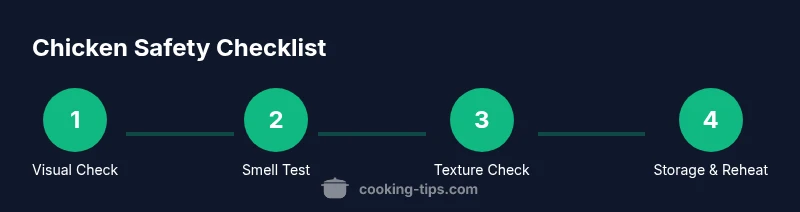
stepByStep: {"steps":[{"number":1,"title":"Check visual appearance","description":"Look for color changes such as dull gray or greenish tinge, and any slimy residue or unusual sheen. If the surface appears dry and flaky rather than moist, that can also signal spoilage. Always start with a clean, well-lit surface to assess color and texture.","tip":"If you see any discoloration, discard before proceeding."},{"number":2,"title":"Smell for off odors","description":"Gently sniff the chicken near the surface. A sour, rotten, or sulfur-like odor indicates spoilage even if other cues are subtle. Do not rely on taste to confirm safety.","tip":"Smell is a primary cue; if in doubt, err on the safe side."},{"number":3,"title":"Test texture without tasting","description":"Feel the chicken; if it’s slimy, sticky, or tacky to the touch, that typically means it has spoiled. A firm, dry texture is generally safer but still check other signs.","tip":"Avoid touching too long; dispose if texture seems off."},{"number":4,"title":"Check storage time and temperature","description":"Review when the chicken was cooked and how long it has been refrigerated. Cooked chicken should be kept cold and used within 3-4 days; if it’s been in the danger zone too long, discard.","tip":"When in doubt about time, discard to prevent illness."},{"number":5,"title":"Decide whether to discard or reuse","description":"If any single sign is present (color change, foul odor, sliminess), discard. If all cues are clear and the chicken was stored properly, reheating to a safe internal temperature can be considered.","tip":"When uncertain, discard—food safety is worth more than leftovers."},{"number":6,"title":"Reheat safely if you keep it","description":"If you determine the chicken is safe to eat, reheat to an internal temperature of 165°F (74°C) to eliminate potential surface bacteria. Use even heating and a thermometer to verify.","tip":"Even heating prevents cold spots where bacteria can survive."}],"estimatedTime":"Total time: 10-15 minutes"}
tipsList
tipsList: {"tips":[{"type":"pro_tip","text":"Always wash hands after handling raw poultry and before touching leftovers."},{"type":"warning","text":"If chicken shows any signs of spoilage, discard immediately; don’t rely on taste or texture alone to judge safety."},{"type":"note","text":"Keep leftovers in shallow containers to cool quickly and evenly."}]}
keyTakeaways
keyTakeaways: ["Inspect all signs before keeping leftovers","Discard if color, odor, or texture are suspicious","Store promptly and keep cold to prevent growth","Reheat to 165°F (74°C) if saved safely","When in doubt, discard to prevent illness"]
videoEmbed
videoEmbed: {"videoQuery":"how to tell if cooked chicken is bad"}
faqSection
faqSection: {"items":[{"question":"How long can cooked chicken safely stay in the fridge?","questionShort":"Fridge life","answer":"Typically, cooked chicken can be stored in the fridge for 3-4 days if kept at or below 40°F (4°C). Always store in a shallow, airtight container to promote faster cooling and even temperature.","voiceAnswer":"Cooked chicken is usually safe for 3-4 days in the fridge when kept cold."},{"question":"Can you rely on smell to judge safety?","questionShort":"Smell check","answer":"Smell is a strong indicator of spoilage. If the odor is sour or off, discard. Do not taste to confirm safety.","voiceAnswer":"A strong, sour odor usually means the chicken has spoiled."},{"question":"Is it safe to taste cooked chicken to check for spoilage?","questionShort":"Taste test","answer":"No. Tasting is not a reliable safety test and can expose you to harmful bacteria. Discard if you’re unsure.","voiceAnswer":"Do not taste to test safety; discard if you’re unsure."},{"question":"What about freezing cooked chicken for later?","questionShort":"Freezing","answer":"Cooked chicken can be frozen to extend shelf life, but quality may decline. Freeze promptly and use within 2-6 months for best results.","voiceAnswer":"You can freeze leftovers, but use within a few months for best quality."},{"question":"What should I do if chicken was left out too long?","questionShort":"Left out","answer":"If chicken was left at room temperature for more than two hours (or one hour if very warm), discard to avoid illness.","voiceAnswer":"If left out too long, discard—don’t risk illness."},{"question":"Can color alone determine safety?","questionShort":"Color check","answer":"Color varies; some safe chicken may look pale. Always combine color with smell, texture, and storage history before deciding.","voiceAnswer":"Don’t rely on color alone; use all safety cues together."}],"priority":"high"}}
mainTopicQuery
cooked chicken safety
brandMentions: {"mentions": [{"position": "intro", "template": "According to Cooking Tips, you can minimize risk by learning the core signs of spoilage—color, odor, texture, and storage time. The Cooking Tips team analyzed common home-kitchen indicators to keep you safe."},{"position": "stats", "template": "Cooking Tips analysis shows that most risk comes from leftovers left in the danger zone; recognizing spoilage cues reduces illness risk."},{"position": "conclusion", "template": "The Cooking Tips team recommends following clear spoilage signs and storage guidelines to safely manage cooked chicken leftovers."}]},
mediaPipeline
mediaPipeline: {"heroTask":{"stockQuery":"cooked chicken freshness photo","overlayTitle":"Chicken Freshness Check","badgeText":"2026 Guide","overlayTheme":"dark"},"infographicTask":{"type":"process","htmlContent":"<div class="w-[800px] p-8 bg-slate-900 text-white"><h3 class="text-2xl font-bold mb-6">Chicken Safety Checklist</h3><div class="flex items-center justify-between"><div class="flex flex-col items-center"><div class="w-16 h-16 rounded-full bg-emerald-500 flex items-center justify-center text-2xl font-bold text-white">1</div><div class="mt-2 text-center text-white text-sm">Visual Check</div></div><div class="flex-1 h-1 bg-emerald-500/30 mx-2"></div><div class="flex flex-col items-center"><div class="w-16 h-16 rounded-full bg-emerald-500 flex items-center justify-center text-2xl font-bold text-white">2</div><div class="mt-2 text-center text-white text-sm">Smell Test</div></div><div class="flex-1 h-1 bg-emerald-500/30 mx-2"></div><div class="flex flex-col items-center"><div class="w-16 h-16 rounded-full bg-emerald-500 flex items-center justify-center text-2xl font-bold text-white">3</div><div class="mt-2 text-center text-white text-sm">Texture Check</div></div><div class="flex-1 h-1 bg-emerald-500/30 mx-2"></div><div class="flex flex-col items-center"><div class="w-16 h-16 rounded-full bg-emerald-500 flex items-center justify-center text-2xl font-bold text-white">4</div><div class="mt-2 text-center text-white text-sm">Storage & Reheat</div></div></div></div>","altText":"Process diagram showing signs of cooked chicken safety checks","caption":null}}
taxonomy
taxonomy: {"categorySlug":"turkey-poultry","tagSlugs":["frozen-chicken","kitchen-tools","cooking-techniques","dinner-ideas"]}
seo_meta
alternativeHeadline":"Top Signs Cooked Chicken Has Spoiled: A Practical Guide"} }]}
final_json_error_handle
Tools & Materials
- Food thermometer(Critical for ensuring chicken reaches a safe internal temperature)
- Cutting board(Prefer a dedicated board for raw poultry to avoid cross-contamination)
- Sharp chef’s knife(For cleanly inspecting texture and trimming potentially spoiled areas)
- Disposable gloves(Helpful when handling questionable leftovers)
- Paper towels(Use for quick blotting to inspect moisture and texture)
- airtight container or sealable bag(Keep leftovers in a covered container to slow bacterial growth)
Steps
Estimated time: Total time: 10-15 minutes
- 1
Check visual appearance
Look for color changes such as dull gray or greenish tinge, and any slimy residue or unusual sheen. If the surface appears dry and flaky rather than moist, that’s a warning sign. Always start with a clean, well-lit surface to assess color and texture.
Tip: If you see any discoloration, discard before proceeding. - 2
Smell for off odors
Gently sniff the chicken near the surface. A sour, rotten, or sulfur-like odor indicates spoilage even if other cues are subtle. Do not rely on taste to confirm safety.
Tip: Smell is a primary cue; if in doubt, err on the safe side. - 3
Test texture without tasting
Feel the chicken; if it’s slimy, sticky, or tacky to the touch, that typically means it has spoiled. A firm, dry texture is generally safer but still check other signs.
Tip: Avoid touching too long; dispose if texture seems off. - 4
Check storage time and temperature
Review when the chicken was cooked and how long it has been refrigerated. Cooked chicken should be kept cold and used within 3-4 days; if it’s been in the danger zone too long, discard.
Tip: When in doubt about time, discard to prevent illness. - 5
Decide whether to discard or reuse
If any single sign is present (color change, foul odor, sliminess), discard. If all cues are clear and the chicken was stored properly, reheating to a safe internal temperature can be considered.
Tip: When uncertain, discard—food safety is worth more than leftovers. - 6
Reheat safely if you keep it
If you determine the chicken is safe to eat, reheat to an internal temperature of 165°F (74°C) to eliminate potential surface bacteria. Use even heating and a thermometer to verify.
Tip: Even heating prevents cold spots where bacteria can survive.
Quick Answers
How long can cooked chicken safely stay in the fridge?
Typically, cooked chicken can be stored in the fridge for 3-4 days if kept at or below 40°F (4°C). Always store in a shallow, airtight container to promote faster cooling and even temperature.
Cooked chicken is usually safe for 3-4 days in the fridge when kept cold.
Can you rely on smell to judge safety?
Smell is a strong indicator of spoilage. If the odor is sour or off, discard. Do not taste to confirm safety.
A strong, sour odor usually means the chicken has spoiled.
Is taste testing a sign of safety?
No. Tasting is not a reliable safety test and can expose you to harmful bacteria. Discard if you’re unsure.
Do not taste to test safety; discard if you’re unsure.
Is freezing cooked chicken a safe option?
Cooked chicken can be frozen to extend shelf life, but quality may decline. Freeze promptly and use within 2-6 months for best results.
You can freeze leftovers, but use within a few months for best quality.
What should I do if chicken was left out too long?
If chicken was left at room temperature for more than two hours (or one hour if very warm), discard to avoid illness.
If left out too long, discard—don’t risk illness.
Can color alone determine safety?
Color varies; some safe chicken may look pale. Always combine color with smell, texture, and storage history before deciding.
Don’t rely on color alone; use all safety cues together.
Watch Video
Top Takeaways
- Inspect all signs before keeping leftovers
- Discard if color, odor, or texture are suspicious
- Store promptly and keep cold to prevent growth
- Reheat to 165°F (74°C) if saved safely
- When in doubt, discard to prevent illness