When to Cook Chicken: Safe Timelines and Doneness
A comprehensive guide on when to cook chicken, safe internal temperatures, doneness checks, resting, and leftovers for reliable home cooking.


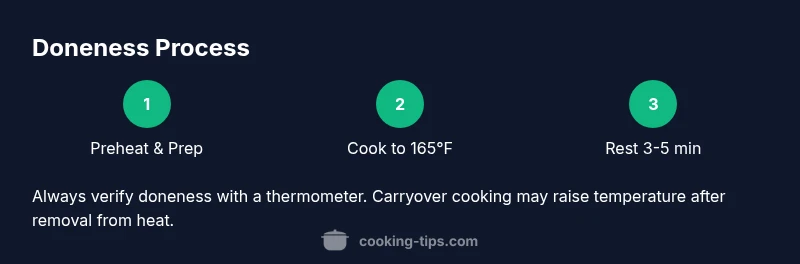
Chicken should always reach an internal temperature of 165°F (74°C) for safety, across all cuts. Use a calibrated thermometer, inserting into the thickest part away from bone, and allow a brief rest of 3–5 minutes to finish cooking. Times vary by method and cut, so rely on temperature rather than color.
Why timing matters for chicken safety and texture
According to Cooking Tips, timing is the silent partner to safety and juiciness when cooking chicken. If you pull poultry off the heat too early, harmful bacteria can survive, and you’ll miss the chance to rest and redistribute juices. If you wait too long, the meat may become tough and dry, even if it looks perfectly cooked on the outside. The objective is to hit the safe internal temperature quickly and allow carryover cooking to finish the job. In practice, that means planning your steps, choosing a cooking method appropriate to the cut, and using a thermometer rather than relying on color or guesswork. By following a clear doneness target and a rest period, home cooks can consistently achieve moist, flavorful chicken. The rest period also helps moisten the meat as residual heat completes the final rise in temperature.
This section lays the groundwork for safe cooking, explains why temp accuracy matters, and sets expectations for how different methods affect timing. You’ll see how carryover cooking changes your final reading and how thickness, bone, and skin influence heat transfer. With these principles, you can adapt to thighs, breasts, wings, and whole birds without second-guessing your readiness.
Safe internal temperature targets by cut
The USDA recommends a final internal temperature of 165°F (74°C) for all poultry, including breasts, thighs, wings, and whole birds. This is the standard target to ensure bacteria are killed and the meat is safe to eat. Because carryover cooking continues after you remove heat, you may see a final temp rise of a few degrees. Use a calibrated thermometer to check the thickest part, near the bone but not touching it. For bone-in pieces, allow a little extra time, but resist the temptation to cut into the meat to test; thermometer check is the only reliable method. If you are unsure about a cut, check with two readings in different spots to confirm consistency. Remember that resting after removing heat helps the final temperature settle evenly and reduces moisture loss, regardless of the cut.
How to measure doneness precisely (thermometer technique)
Invest in an accurate digital instant-read thermometer. Before cooking, sanitize the probe and ensure it is clean reflecting the current environment. Insert the thermometer into the thickest part of the chicken, avoiding bone, and wait a few seconds for a stable reading. Do not rely on color or juice clarity alone, as these indicators can be misleading. For larger pieces, check multiple spots to ensure uniform doneness. When you remove the meat from heat, plan for carryover cooking: the temperature can rise a few degrees during rest, so you may pull slightly early to land at 165°F.
Cooking methods and approximate timelines
Different methods yield different results, but the safety rule remains the same: reach 165°F in the thickest part and then rest. Oven roasting or baking at moderate to hot temperatures can cook breasts quickly, while thighs may take longer due to higher fat content and bone proximity. Pan-searing creates a crispy exterior, then a short finish in the oven or on a gentle simmer to finish through. Grilling works well for boneless, skinless cuts and bone-in pieces alike, offering flavorful browning without overcooking. Poaching is a gentle method that preserves moisture, especially for lean breasts. Regardless of method, verify doneness with a thermometer to 165°F and consider a final rest to lock in juiciness.
Resting, carryover cooking, and moisture management
Resting is essential for moisture retention and even temperature distribution. After cooking, tent the chicken lightly with foil and let it rest for 3–5 minutes (longer for larger pieces). This pause allows carryover cooking to complete and juices to reabsorb, which improves slicing and mouthfeel. Avoid slicing immediately; slicing prematurely lets juices escape and can result in a drier bite. Proper resting also minimizes the temptation to cut into the meat to check doneness, which disrupts texture. Finally, practice mindful moisture management by patting surfaces dry before searing or roasting to promote even browning and prevent steaming the meat.
Practical planning: thawing, marinating, and meal prep
Plan ahead to ensure chicken is safe from storage to serving. Thaw frozen chicken in the refrigerator, ideally overnight, to avoid rapid temperature changes. Marinating should occur in the fridge; if you reuse marinade as a sauce, bring it to a boil to kill any surface bacteria. Store cooked chicken in shallow containers to cool quickly and refrigerate promptly. When reheating leftovers, heat to steaming hot and verify the internal temperature again with a thermometer. These practices help you maximize flavor while maintaining safety throughout the cooking process.
Tools & Materials
- Digital instant-read thermometer(Essential for accurate doneness checks.)
- Oven-safe meat thermometer (optional)(Helpful for large roasts; not a substitute for quick checks.)
- Cutting board(Non-porous surface; separate board for raw poultry.)
- Sharp knife(For portioning after resting.)
- Tongs and spatula(For handling meat with minimal juice loss.)
Steps
Estimated time: 60-120 minutes
- 1
Choose and prep your cooking method
Select an appropriate method (oven, pan-sear, grill, or poach) based on the cut and desired texture. Gather a thermometer, board, and utensils, and preheat equipment as needed. Preparing in advance reduces last-minute guesswork and helps manage timing.
Tip: Preheating the oven or pan ensures even heat distribution from the start. - 2
Prepare the thermometer and chicken
Sanitize the thermometer and inspect the chicken for any irregularities. Bring the meat to even size and shape if possible to promote uniform cooking. If using a whole chicken, check the cavity and pat dry for better browning.
Tip: Avoid touching bone with the thermometer probe to get an accurate reading. - 3
Start cooking and monitor
Place the chicken on the heat source and begin timing. Insert the thermometer into the thickest part, avoiding bone, and check readings at regular intervals. If you’re using multiple pieces, rotate or rearrange for even heat exposure.
Tip: Don’t rely on color; temperature is the reliable indicator of doneness. - 4
Verify doneness and plan carryover
When the thermometer reads 165°F (74°C) at the thickest point, remove from heat. Expect a brief rise in temperature during rest; plan to pull slightly before reaching final temp if you want a precise result.
Tip: Prepare a covered resting area to keep heat in without steaming the meat. - 5
Rest the chicken
Let the meat rest for 3-5 minutes after cooking. Resting allows juices to redistribute, improving juiciness. Use this time to cover the pan loosely with foil or set on a clean cutting board.
Tip: Resting is as important as the cooking itself for best texture. - 6
Slice, store, and reuse safely
Slice against the grain for tenderness, then serve or portion for storage. Refrigerate promptly in shallow containers and reheat to steaming hot before eating again. If you used marinade as sauce, boil it first to ensure safety.
Tip: Label leftovers with date to track freshness.
Quick Answers
Is pink chicken safe to eat?
No. Chicken should reach an internal temperature of 165°F (74°C) to be safely cooked, and color alone is not a reliable indicator.
No. Chickens must reach 165 degrees internal temperature to be safe, color isn't a reliable cue.
What is the best way to check doneness?
Use a calibrated digital thermometer and insert into the thickest part away from bone. Confirm the reading is 165°F (74°C) before removing from heat.
Use a thermometer to check for 165 degrees in the thickest part.
Do bone-in and boneless chicken require different times?
All poultry should reach 165°F internally. Bone-in cuts may require a bit more time due to bone heat transfer, but a thermometer will guide you accurately.
Bone-in cuts can take a bit longer, but still use a thermometer for 165°F.
How should leftovers be stored?
Store cooked chicken in shallow containers in the fridge promptly and reheat to steaming hot before eating again. Consume within a few days.
Refrigerate promptly and reheat to steaming hot before eating.
Can I reuse marinade as a sauce?
If you intend to reuse marinade on cooked chicken, boil it first to kill any surface bacteria before serving.
Boil marinade if you plan to reuse it as a sauce.
Is color or juice clarity a reliable doneness cue?
No. Temperature is the only reliable indicator; color and juices can vary with cooking method and meat thickness.
Color isn’t reliable; rely on a thermometer to reach 165°F.
Watch Video
Top Takeaways
- Check internal temperature with a thermometer for safety.
- Rest meat after cooking to maintain juiciness and finish carryover cooking.
- 165°F (74°C) is the standard final temperature for all poultry.
- Choose method and thickness-aware timelines; always verify with temperature.