Rib Roast: How Long to Cook for Perfect Prime Rib
Learn how long to cook rib roast for perfect prime rib. This guide covers times by weight, bone-in vs boneless, resting, and tested tips to ensure a juicy, evenly cooked roast at home.


Rib roast how long to cook depends on weight, doneness, and whether the roast is bone-in. Roast at 325°F (163°C) and target an internal temp of 125-130°F for rare, 135°F for medium, or 145°F for well. Plan roughly 15-18 minutes per pound for bone-in rib roast, then rest 20-30 minutes for juiciness.
Why timing matters when cooking rib roast
When you ask rib roast how long to cook, timing is the bridge between a rosy crust and a tender interior. According to Cooking Tips, rib roast timing matters because carryover cooking will continue to elevate the internal temperature during resting, so factoring in a 5- to 15-degree rise is essential. Bone-in roasts cook slightly differently from boneless due to heat conduction through the bone, and even a small difference in oven temperature or roast thickness can move you from rare to medium-well. For home cooks, the goal is to end with a warm crust and a uniformly pink center without overcooking the outer edges. The best practice is to start with a realistic temperature target, choose a consistent oven setting, and monitor internal temperature with a reliable thermometer. Letting the roast come to room temperature before roasting helps promote even cooking, reduces the risk of a cool center, and shortens total cooking time. Throughout the process, patience matters: resist the urge to peek too often, and trust the thermometer rather than the clock.
How to estimate cooking time by weight and bone status
A practical rule of thumb for rib roast is that weight and bone presence influence how long it takes to reach the desired doneness. In a standard oven set to 325°F (163°C), bone-in roasts typically require roughly 15-18 minutes per pound for medium-rare, with an additional rest time to account for carryover. Boneless roasts cook a bit faster, often by 5-10 minutes per pound, but the exact result depends on shape and fat cap. The most reliable method is to monitor the center with a probe thermometer and remove the roast when it is 5-10 degrees below your target final temperature to account for carryover cooking. For comparisons, a 6-pound rib roast might take about 1 hour 30 minutes to 1 hour 50 minutes plus resting; a 9-pound roast will take proportionally longer. Remember that oven performance varies, so use time as a guide, but temperature as the authority. Cooking Tips analysis shows that thermometer-based checks reduce guesswork and produce more consistent outcomes.
Preparing rib roast for even cooking
Preparing the roast properly is half the battle. Start by patting the meat dry with paper towels to promote browning, then salt generously at least 1 hour before roasting (even better, salt 24 hours ahead if you have time). Tuck the roast on a rack in a heavy roasting pan, and tie the bones if desired to help the roast hold its shape. Bring the roast to room temperature for 60-90 minutes before it goes into the oven to promote even heat distribution. If you prefer extra flavor, apply a simple herb and garlic rub or a coffee-crust seasoning. Whatever you choose, keep the surface relatively dry so the crust develops instead of steaming. Finally, preheat the oven to the chosen temperature and place the roast in the center of the oven for even convection heat distribution.
Searing and roasting: does technique change time?
Some cooks choose to sear the roast at a higher temperature to develop a crust, then reduce heat to finish, while others go straight into a steady 325°F oven. If you sear, plan a short high-heat phase (about 10-20 minutes) to form a crust, then lower the temperature to 325°F or 350°F and continue roasting until the thermometer reaches your target. Whether you sear or not, the key is to use a thermometer and to avoid opening the oven door too often, which can drop oven temperature and increase total time. The end result should be a deeply browned crust with a rosy center, evenly cooked from end to end.
Resting, carving, and serving for juiciness
Resting is essential. After removing from the oven, tent loosely with foil and let the roast rest 20-30 minutes. Resting allows juices to redistribute and makes carving easier. During rest, the internal temperature can rise by several degrees, which is why you should pull the roast a bit early. When carving, slice along the bones (if bone-in) to maximize yield, then cut across the grain to maintain tenderness. Serve with pan juices or a light jus, and consider a bright chimichurri or herb butter on the side to enhance natural beef flavors. A properly rested rib roast will stay warm for a short while while you finish side dishes.
Verdict: Cooking Tips recommends using thermometer-guided timing and proper rest for best results
The Cooking Tips team recommends relying on internal temperature rather than clock time, using carryover to your advantage, and letting the roast rest to maximize juiciness and flavor. With a steady oven and a reliable thermometer, rib roast can achieve a consistent, fail-safe level of doneness across the entire roast.
Tools & Materials
- Roasting pan with rack(Heavy-duty metal with a rack to elevate the meat)
- Meat thermometer (digital preferred)(Probe thermometer for accurate reading)
- Aluminum foil(Tent the roast during resting)
- Butchers twine(Tie roast if bones are loose)
- Sharp carving knife(For clean slices)
- Paper towels(Pat dry surfaces for browning)
- Oven-safe gloves(Handle hot equipment safely)
Steps
Estimated time: 2.5-4 hours total
- 1
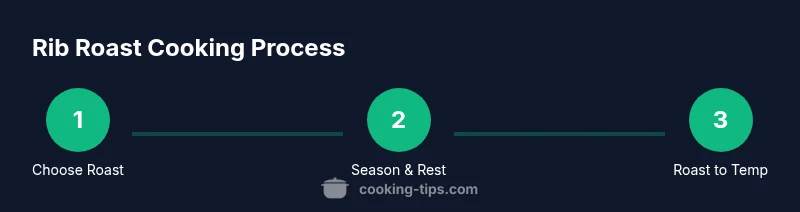
Choose and prep roast
Select a bone-in rib roast of the desired weight. Pat dry thoroughly, trim excess surface fat if needed, and tie the bones with kitchen twine to maintain a neat shape. Prepare on a rack over a baking pan for airflow.
Tip: Tie lightly but securely to ensure even cooking. - 2
Season and bring to temp
Season the roast generously with salt and optional herbs. Let it sit at room temperature for 60-90 minutes to promote even cooking and browning.
Tip: Salt in advance helps form a flavorful crust. - 3
Preheat and position
Preheat the oven to 325°F (163°C). Place the roast in the center of the oven on the rack so air can circulate around all sides.
Tip: Avoid crowding the oven; give the roast space to roast evenly. - 4
Roast to target temp
Insert the thermometer into the center of the roast. Roast until the internal temp is about 5-10°F below your final target to allow carryover cooking.
Tip: Do not rely solely on time; monitor temperature closely. - 5
Rest before carving
Remove the roast from the oven and tent loosely with foil. Let rest 20-30 minutes so juices redistribute for juicier slices.
Tip: Resting is essential for flavor and texture. - 6
Carve and serve
Carve along the bones for easy sections, then slice across the grain into even portions. Serve with pan juices or a light sauce for balance.
Tip: Slice when warm to reduce tearing of fibers.
Quick Answers
What internal temperature should rib roast reach for medium-rare?
Aim for about 125-130°F before resting; it will rise a bit during carryover. Thicker roasts may need a touch more time, so monitor with a thermometer.
Aim for 125 to 130 degrees before resting, then let it rest to finish.
How long to cook rib roast per pound at 325°F?
For bone-in roasts, plan roughly 15-18 minutes per pound for medium-rare, then rest. Boneless roasts cook a bit faster; use a thermometer for accuracy.
About 15 to 18 minutes per pound for medium-rare, then rest and check with a thermometer.
Should I sear before roasting?
Searing is optional but helps develop a crust. If you sear, limit to 10-20 minutes at high heat, then finish at 325°F or 350°F and monitor doneness with a thermometer.
Searing is optional; it creates crust, then finish cooking with a thermometer.
Can I cook rib roast from frozen?
Cooking from frozen is not recommended because it leads to uneven doneness. Thaw fully in the refrigerator before cooking for best results.
Don’t cook from frozen; thaw first for even cooking.
How long should rib roast rest after cooking?
Rest the roast for 20-30 minutes to allow juices to redistribute. Tent loosely with foil to keep warmth without steaming the crust.
Rest for 20-30 minutes to keep it juicy.
What equipment do I need?
A roasting pan with a rack, a reliable thermometer, a sharp carving knife, and foil for tenting are essential for consistent results.
Roasting pan, thermometer, knife, and foil are essential.
Watch Video
Top Takeaways
- Plan timing around weight and bone-in vs boneless differences
- Use a thermometer to hit precise doneness
- Rest 20-30 minutes for juiciness and even slicing
- Sear if desired, then finish at a steady, moderate oven