Prime Rib Cook Time: A Practical Guide
Master prime rib cook time with weight- and doneness-based guidance, resting strategies, and practical tips from Cooking Tips to ensure a juicy, evenly cooked roast.


Prime rib cook time varies with weight and desired doneness. For a typical roast, roast at 325°F to finish around 120-135°F internal temperature, about 12-20 minutes per pound, followed by a 15-20 minute rest. Adjust by 2–3 minutes per pound for hotter ovens or a quick sear. A calibrated thermometer yields the most reliable guide.
Understanding prime rib cook time
Timing a prime rib roast is a practical skill that balances science and kitchen sense. The prime rib cook time is not a single fixed number; it depends on the roast's weight, whether it's bone-in or boneless, the oven's temperature, and your target doneness. According to Cooking Tips, the most reliable approach is to track internal temperature with a calibrated thermometer and plan for a rest that lets juices redistribute. A typical starting point for a bone-in roast is roughly 12-20 minutes per pound at a moderate oven, followed by resting. The nuance comes from pre-sear, whether you are cooking with an uncovered roast or tented, and how you handle carryover cooking after removing from heat. In practice, cooks should set a target internal temperature, monitor as the roast nears that mark, then remove from heat to rest and finish carries with residual heat.
Factors that influence cook time
Several variables influence the actual prime rib cook time. Weight distribution changes heat penetration, bone-in roasts heat differently than boneless cuts, and appliance performance varies. Oven accuracy matters; a 25°F difference can swing cook times by 10–20 minutes per roast. Beef quality and fat distribution affect heat transfer and carryover cooking. Finally, whether you use a sear, and if you start with a cold or room-temperature roast, collectively shift the total time. The Cooking Tips approach emphasizes consistency, thermometer-targeted doneness, and planned resting to compensate for carryover heat.
Step-by-step guide to roasting prime rib
- Choose a roast of appropriate weight and bone status (bone-in roasts yield denser heat transfer). 2) Bring the roast to room temperature for 1–2 hours, pat dry, and season generously with salt and herbs. 3) Preheat to 450°F for a brief sear (optional) to form a crust, then reduce to 325°F. 4) Insert an accurate meat thermometer into the center of the thickest portion. 5) Roast until the thermometer reaches 120–135°F depending on desired doneness, then remove and let rest. 6) Tent loosely with foil during resting for 15–20 minutes. 7) Carve and serve immediately for best texture. By using a thermometer and a planned rest, you minimize guesswork and maximize juiciness.
Temperature, doneness, and timing by weight
The commonly cited approach is: cook around 12–20 minutes per pound at 325°F, then rest to let carryover heat finish. For rare doneness, target 120–125°F; for medium-rare, 130–135°F; for medium, 140–145°F. If you start with a quick 10-minute higher-heat sear, reduce the subsequent per-pound time by a small margin to avoid overcooking. Use the thermometer as the final arbiter, rather than clock time alone. Remember that larger roasts require more total carryover, so expect a longer resting window.
Resting, carving, and serving to maximize juiciness
Resting is not a luxury; it is essential to redistribute juices and stabilize textures. After removing from the oven, loosely tent the roast and rest for 15–20 minutes. During this period, the internal temperature will rise by about 5–10°F, an effect called carryover cooking. Carve against the grain for tenderness and serve with pan juices or a simple au jus. A properly rested prime rib roast yields a juicier bite and more uniform doneness from edge to center.
Common mistakes and practical tips
Common mistakes include under-seasoning, cooking too cold, and over-relying on time rather than thermometer readings. Practical tips: season well and let salt penetrate; ensure the roast is evenly shaped for uniform cooking; avoid opening the oven door repeatedly; use a remote thermometer if possible; plan a buffer rest in your timeline. These adjustments help achieve consistent prime rib cook time results and easier carving.
Quick-reference timing cheat sheet
- Bone-in roast, 8 lb: target 4–6 in the center; thermometer reads 125°F for rare. - Boneless roast, 6 lb: aim for 125–130°F for rare, 130–135°F for medium-rare. - Always finish with a 15–20 minute rest at room temperature before carving. For best results, rely on a calibrated thermometer rather than clock time alone.
Practical example and final checklist
To illustrate, a 6 lb bone-in prime rib roast roasted at 325°F is typically cooked around 14–18 minutes per pound to finish near 125–130°F, then rested for 15–20 minutes. Check the thermometer early and be prepared to pull slightly early if carryover will push past the target. Final steps: rest, tent, carve, and serve with pan juices or a simple gravy. This approach reflects Cooking Tips’ evidence-based guidance for reliable prime rib cook times.
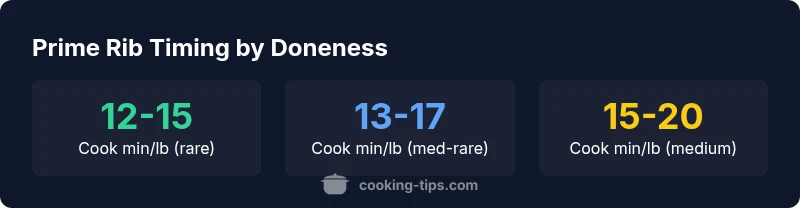
Estimated prime rib cook times by doneness
| Doneness | Target Temp | Estimated Cook Time per Pound (roasting at 325°F) |
|---|---|---|
| Rare | 120-125°F | 12-15 minutes |
| Medium-rare | 130-135°F | 13-17 minutes |
| Medium | 140-145°F | 15-20 minutes |
Quick Answers
What is the best temperature for roasting prime rib?
Roasting at 325°F provides even cooking for most prime rib cuts. If you prefer a faster crust, you can start hotter for a brief sear, then drop to 325°F. Use a thermometer to guide doneness rather than relying solely on time.
Roast at 325°F for even cooking, and use a thermometer to guide doneness.
How long should a prime rib rest before carving?
Rest the roast for 15 to 20 minutes after taking it out of the oven. Resting lets juices redistribute and finishes carryover cooking, making carving easier and the meat juicier.
Rest for 15 to 20 minutes after roasting to keep juices in.
Should I sear prime rib before roasting?
Searing creates a crust and can enhance flavor. It’s optional; if you choose to sear, keep the oven temperature high briefly, then reduce to 325°F for the main roast.
Sear for crust if you like, then continue at 325°F.
How do I calculate total cook time based on roast weight?
Multiply the per-pound cook time range by the roast weight, then plan for carryover and resting. Always verify final doneness with a thermometer rather than relying on time alone.
Multiply per-pound time by weight and check with a thermometer.
Can I use a meat thermometer or rely on the oven timer?
A thermometer is the most reliable tool for prime rib. Timers provide a rough guide but doneness is defined by internal temperature, not an exact minute.
Use a thermometer for accuracy; timers are supplemental.
Is carryover cooking significant for prime rib?
Yes. Prime rib continues to cook after removal from the oven, typically raising 5–10°F. Plan for this when targeting final doneness.
Expect 5–10°F rise after removing from heat.
What weight range is typical for home prime rib roasts?
Most home roasts fall in the 4–8 lb range. Adjust times by weight and monitor doneness with a thermometer for best results.
Common roasts are 4–8 lb; monitor with a thermometer.
“Precise timing comes down to target internal temperature and a consistent rest plan. A calibrated thermometer is your best tool for prime rib success.”
Top Takeaways
- Plan cook time around weight and target doneness
- Use a thermometer for reliable results
- Rest 15-20 minutes before carving
- Adjust times for sear and oven variance
- Carryover cooking matters more than clock time