How Long to Cook Prime Rib: Timing Guide for Perfect Doneness
A practical, data-driven guide to prime rib timing. Learn weight-based cook times, doneness targets, resting guidance, and step-by-step methods for consistently juicy results.


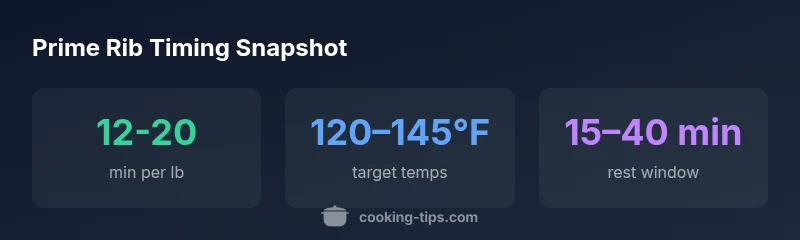
On average, prime rib cooking times run about 12 to 20 minutes per pound at 325°F, depending on desired doneness. Plan for a 15 to 30 minute rest after pulling from the oven. Use a meat thermometer to hit roughly 120–125°F for rare, 130–135°F for medium-rare, and 140–145°F for medium before resting.
Understanding prime rib anatomy and why cooking time matters
Prime rib, or rib roast, is best understood by its bone-in versus boneless form and by the roast’s size. The bones act as heat conductors and can slightly alter the cooking rate, so bone-in roasts often finish a touch later per pound than boneless versions when measured by internal temperature. The size of the roast also matters because larger roasts heat more slowly toward center temperatures. For reliable results, define an end temperature target before you begin and monitor with a reliable instant-read thermometer. According to Cooking Tips, precision begins with the plan and continues through the thermometer readings, not guesswork. A well-timed roast should reach an even doneness from edge to center, with a gentle gradient that yields a juicy center and a browned crust on the exterior.
How to estimate cook time by weight and desired doneness
The simplest approach is weight-based planning, complemented by a thermometer to confirm actual doneness. A common home-roast guideline is to plan roughly 12 to 20 minutes per pound at 325°F, adjusting for your oven’s true temperature and the roast’s shape. Doneness targets help you interpret thermometer readings: rare (120–125°F), medium-rare (130–135°F), and medium (140–145°F) after resting. Remember that carryover cooking can raise the final internal temperature by 5–10°F while resting, so you can pull the roast a touch early to account for it. For a typical 6–8 lb roast, this means allowing for a total cook time of about 1.75–2.5 hours, plus a rest of 15–30 minutes.
Temperature and time: recommended ranges and method types
Two common methods balance speed and evenness: a high-heat sear followed by a moderate roast, or a low-and-slow roast from the start. The high-heat method creates a robust crust and finishes with a predictable interior, but it requires careful monitoring to avoid overcooking the outer layers. The low-and-slow approach reduces the risk of overcooking the exterior, especially for larger roasts, but extends total time. Either way, a thermometer should guide you. The central principle is to move the meat toward its target temperature and let carryover do the rest.
Step-by-step timing plan: high-heat sear then gentle roast
- Preheat oven to the chosen starting temperature (usually 450°F for a sear). 2) Sear the roast for 15–20 minutes if using the high-heat method. 3) Reduce oven to 325°F and continue roasting until the internal temperature reaches, or approaches, the target by 5–10°F. 4) Remove from heat and rest 15–30 minutes tented loosely with foil. 5) Slice and serve immediately for optimal juiciness. This approach minimizes guesswork and leverages carryover cooking to reach the final doneness.
Common mistakes and how to avoid them
Mistakes to avoid include relying on time alone, not using a thermometer, and skipping the resting period. Also important is letting the roast come to room temperature before cooking, which promotes even cooking. If your oven runs hot or cool, adjust times by 5–15 minutes per pound and confirm with a thermometer. Start with a plan, then verify with readings as you go.
Resting, slicing, and serving prime rib for best results
Resting allows juices to redistribute, improving slicing and tenderness. Keep the roast loosely tented for 15–30 minutes depending on size. Slice against the grain in medium-thick slices to optimize texture. If you want a uniform crust at serving, you can briefly re-crisp the outer layer in a hot pan or under a broiler for 1–2 minutes per side just before serving. Consistency comes from measurement, not guesswork.
Practical example: planning an 8-pound roast from start to finish
For an 8-pound prime rib at 325°F, expect roughly 2.0–2.5 hours of roasting plus a 20–30 minute rest. Begin with a 15–20 minute sear at 450°F if you desire a deep crust, then lower to 325°F and roast until the thermometer hits 125–130°F for medium-rare. Rest 20–30 minutes before carving. Adjust up or down by 5–10 minutes per pound based on your oven and roast shape.
Ingredient preparation and equipment: thermometer, pan, racks
Key tools include a reliable digital thermometer (preferably a probe that stays in during roasting), a sturdy roasting pan, and a rack to lift the meat off the pan. A meat thermometer is essential to avoid under- or over-cooking. Prepping the roast with a simple rub of salt, pepper, and optional aromatics (garlic, rosemary) enhances crust and flavor. Good planning and the right gear reduce guesswork and improve consistency.
Planning for bone-in vs boneless: differences and pitfalls
Bone-in roasts can take longer per pound and often require slightly different timing because the bone conducts heat differently. If you’re substituting boneless for bone-in, monitor the internal temperature and consider reducing the total time by 5–10 minutes per roast weight to account for the absence of bone heat conduction. Either way, vigilance with a thermometer ensures you hit your target doneness without guesswork.
Timing guidance by roast size
| Roast Size | Estimated Total Time | Target Doneness Temp | Rest Time |
|---|---|---|---|
| 4-6 pounds | 1.5-2 hours | Rare 120-125°F; Medium-rare 130-135°F | 15-30 minutes |
| 6-8 pounds | 1.75-2.5 hours | Rare 120-125°F; Medium-rare 130-135°F | 15-30 minutes |
| 8-12 pounds | 2.25-3 hours | Rare 120-125°F; Medium-rare 130-135°F | 20-40 minutes |
Quick Answers
What is the effect of bone-in versus boneless on cooking time?
Bone-in roasts can finish slightly later per pound because the bone conducts heat differently. Monitor internal temperature and plan for a small, gradual rise in cook time. A thermometer is the reliable way to know when it’s done.
Bone-in may take a bit longer per pound; use a thermometer to confirm doneness.
Can prime rib be cooked at a lower temperature all the way through?
Yes, you can cook prime rib low and slow to promote even doneness, but it increases total time. Use a thermometer and expect longer cooking and resting periods.
You can cook it low and slow, just monitor temps closely.
What’s the best way to measure doneness without guesswork?
A reliable digital thermometer is essential. Check the thermometer at the thickest part of the roast and factor in carryover. Visual cues are helpful, but temperature accuracy wins.
Use a thermometer—trust the reading over any visual cue.
Should prime rib come to room temperature before cooking?
Yes. Let the roast stand at room temperature for 2–3 hours for smaller cuts or 3–4 hours for larger roasts to promote even cooking.
Yes—allow it to come to room temperature before roasting.
How long should prime rib rest after cooking?
Rest for 15–30 minutes for small roasts and up to 40 minutes for larger ones. Resting helps juices redistribute and improves slicing.
Rest it 15 to 30 minutes before slicing.
“Precision in temperature control and proper resting are the linchpins of a juicy, evenly cooked prime rib. Let the thermometer guide you, and trust carryover cooking to finish the job.”
Top Takeaways
- Start with a precise target temp and thermometer.
- Choose high-heat sear then roast or a low-and-slow method.
- Account for bone-in vs boneless timing differences.
- Rest the roast before slicing to preserve juiciness.
- Document temperatures to finish exactly as planned.