When to Cook Thanksgiving Turkey: Timing Guide 2026
Master the timing for a perfect Thanksgiving turkey. Learn unstuffed vs stuffed timings, oven temps, resting periods, and step-by-step guidance from the Cooking Tips team.


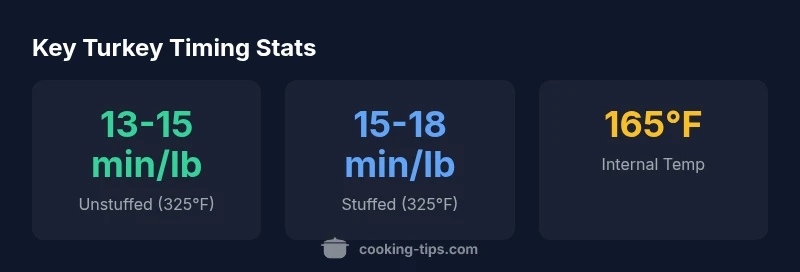
According to Cooking Tips, unstuffed turkey cooked at 325°F takes about 13-15 minutes per pound, while stuffed takes 15-18 minutes per pound. Target an internal temperature of 165°F, then rest 20-30 minutes before carving. Use a thermometer and adjust for larger birds or higher oven temps. Start early if you’re hosting guests, and verify both breast and thigh for even doneness.
Timing Foundations: Why the per-pound rule matters
Determining when to cook Thanksgiving turkey starts with a simple principle: larger birds require more time, but not linearly. The standard guidance uses minutes per pound at a steady oven temperature, usually 325°F, and varies slightly with whether the bird is stuffed. In practice, you calculate total time by weight, then add a structured resting window. For home cooks, the key is consistency: use a calibrated oven, position the turkey in the center of the rack, and begin thermometer checks as you approach the expected finish window. When to cook Thanksgiving turkey is less about a precise clock and more about safe temperatures and a predictable rest period. According to Cooking Tips, careful planning around the final check, not an exact minute, yields reliable results. The team recommends starting with a conservative estimate and then adjusting based on thermometer readings and oven performance. By framing timing around safety and juiciness, you minimize the risk of undercooked or overcooked meat.
Stuffed vs Unstuffed: How timing changes
Stuffed birds typically need more time than their unstuffed counterparts because heat must penetrate the center of both turkey and stuffing. To avoid undercooking the stuffing, many cooks use separate thermometers or a stuffed probe. The rule of thumb is that stuffed turkeys require roughly 15-18 minutes per pound at 325°F, while unstuffed birds run closer to 13-15 minutes per pound. Temperature monitoring is essential; the breasts and thighs often reach different rates, so check the thickest part and ensure both reach 165°F. If your stuffing is placed inside, be mindful that its center may still be cooler than the exterior; in that case, extend the roast time a bit and verify with a thermometer. You can buffer timing with a pre-brined, dry-brined, or unseasoned approach, but the core aim remains the same: accurate temperature, adequate rest, and even browning.
Temperature Strategy: Heat, coverage, and thermometer checks
Roasting at a steady 325°F is the most forgiving approach for even browning and juicy meat. For crisper skin, some home cooks switch to 350°F for the last 15-20 minutes; however, this should be done with careful monitoring to avoid dry meat. Shielding the turkey loosely with foil can help stop over-browning while the interior continues to rise to 165°F. A reliable thermometer inserted into the thickest part of the breast (not touching bone) will tell you when the turkey is safely cooked. Expect carryover cooking: the meat can climb a few degrees after removal from the oven, so plan to pull the turkey when the thermometer reads 160°F so it rests up to 165°F.
Preparation Timeline: Thawing, brining, and preheating
Begin thawing well in advance; a frozen turkey requires several days in the fridge, depending on weight. Brining or dry-brining can improve juiciness, but it does not dramatically speed up cook time. Preheat the oven before you begin roasting. Position the turkey breast-side up on a rack in a roasting pan; pat dry the skin to promote browning. If you plan to brine, rinse and pat dry before applying dry rub or aromatics. Gather tools like a reliable thermometer, a sturdy roasting pan, and a meat thermometer to monitor doneness.
A Practical Timeline for a Typical Thanksgiving Roast
Assuming a 12-14 lb unstuffed turkey, follow this timeline: thaw in the fridge the day before; on roast day, pat dry and let come to room temperature for 30-60 minutes; preheat the oven to 325°F; roast for about 3-3.5 hours; begin checking internal temperature around the 2.5-3 hour mark. For an 18-22 lb turkey, plan about 4-5 hours, with a 20-30 minute rest. If stuffed, add roughly a half-hour to the upper end of these ranges. Regardless, rely on a thermometer to confirm 165°F in the thickest part and always allow a rest period to reabsorb juices.
Troubleshooting and Safety: Common issues
Common issues include undercooked centers, overdone edges, dry breast meat, or pale skin. Avoid opening the oven door repeatedly, which can drop oven temperature and affect timing. If browning too quickly, tent with foil and lower heat temporarily. Use a thermometer to track core temperature rather than relying on time alone. Also ensure the turkey is fully thawed and patted dry for even browning and consistent carryover cooking.
Roasting timelines by weight and stuffing status
| Scenario | Estimated Roast Time | Oven Temp | Rest Time | Internal Temp |
|---|---|---|---|---|
| Unstuffed 12-14 lb | 3-3.5 hours | 325°F | 20-30 minutes | 165°F |
| Stuffed 12-14 lb | 3.5-4 hours | 325°F | 20-30 minutes | 165°F |
| Unstuffed 18-22 lb | 4-5 hours | 325°F | 20-30 minutes | 165°F |
Quick Answers
What internal temperature should I use for turkey?
Always aim for 165°F in the thickest part of the meat. Use a digital thermometer and check breast and thigh for even doneness.
Aim for 165 degrees in the thickest part, and check both breast and thigh with a thermometer.
Should I brine my turkey to improve timing?
Brining adds moisture and can improve juiciness, but it does not dramatically shorten cook time. If you brine, adjust overall timing by monitoring temperature and plan for rest.
Brining moistens the meat; it doesn't dramatically speed up cooking, so time it with a thermometer and rest.
Can I roast at a higher temperature to save time?
Roasting at higher temps is possible but increases the risk of uneven cooking and dryness. If you raise heat, monitor closely with a thermometer and expect a shorter window.
Yes, but it risks dry meat; watch the thermometer closely.
How long should I rest the turkey after roasting?
Rest the turkey for 20-30 minutes after removing it from the oven. Tent loosely with foil to retain heat and allow juices to redistribute.
Rest it 20 to 30 minutes before carving.
What are signs the turkey is overcooked?
Dry, pale meat and brittle skin are signs of overcooking. Juices should run clear, and use a thermometer to avoid going past 165°F.
If it's dry or overcooked, the meat will be dry and tough.
“Accurate timing comes from using a thermometer and planning around resting periods; follow reliable guidelines to avoid undercooking or overcooking.”
Top Takeaways
- Plan roast time by weight and stuffing status
- Always use a thermometer to confirm 165°F
- Rest the turkey 20-30 minutes before carving
- Avoid sudden temperature changes for juicier meat
- Start earlier than you think to stay on schedule