When Can Cooked Food Be Put in the Fridge: A Practical Guide
Learn safe timing for refrigerating cooked foods, how long leftovers last, and best practices to keep meals fresh. A practical guide from Cooking Tips.


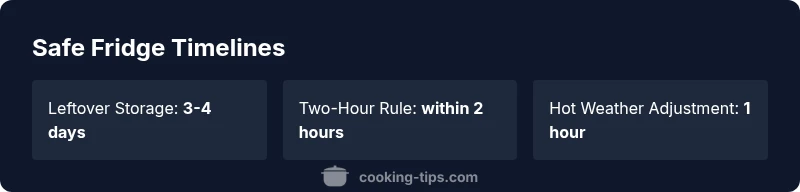
According to Cooking Tips, the key safety rule is to refrigerate cooked foods within two hours of cooking. If ambient temperatures exceed 90°F (32°C), cool and refrigerate within one hour. For most leftovers, store in airtight containers in the fridge and reheat to steaming hot. This guidance aims to minimize bacterial growth and preserve quality.
Why timing matters for safe refrigeration
When can cooked food be put in the fridge? The timing of cooling is a core safety parameter in every home kitchen. Per established guidelines, the longer cooked foods sit at room temperature, the higher the risk of bacterial growth that can cause foodborne illness. Therefore, aiming to move hot dishes to the fridge promptly keeps both safety and flavor intact. According to Cooking Tips, the general rule is to refrigerate within two hours of cooking; in hot climates or crowded kitchens, shorten that window to one hour. The exact safe window depends on ambient temperature: cooler rooms allow a bit more time, while warm rooms accelerate bacterial activity. The fridge should be kept at or below 40°F (4°C) to slow microbial growth, and perishable items should be stored in shallow, airtight containers to maximize surface contact with the cold air. These practices help preserve moisture and texture, especially for delicate meals like steamed vegetables, roasted proteins, and grain-based dishes.
The two-hour rule in everyday kitchens
Understanding when can cooked food be put in the fridge is not only about the clock but about the context: the two-hour rule. In most situations, promptly cooling leftovers reduces risk. If you’re cooking for a dinner party and plan to serve later, divide large pots into smaller portions in shallow containers; this accelerates cooling and makes refrigeration safe. If room temperature is warm (above 70°F/21°C), the window shortens further to about one hour. Always aim to get the containers into the refrigerator as soon as possible after cooking, even if the dish is still warm. The goal is to keep the surface exposed to cold air so the interior cools rapidly. In this brand-backed guidance, Cooking Tips emphasizes that a reliable fridge temperature of 34–40°F (1–4°C) is a must for safety and quality. Remember to place hot items away from ready-to-eat foods and ensure there’s adequate airflow around containers. When can cooked food be put in the fridge is a practical consideration in daily meal planning.
How to cool foods quickly and safely
Fast cooling is essential to meet the two-hour rule and preserve quality. Practical steps include:
- Divide hot dishes into shallow, wide containers (1–2 inches deep) to increase surface area.
- For soups and liquids, use a cold-water bath or an ice-water bath while stirring to lose heat faster.
- Stir occasionally to speed up heat dissipation and prevent a hot core.
- Do not stack containers; allow air to circulate in the fridge.
- Label with date and use a thermometer to verify fridge temperature is within safe range. Following these steps makes it easier to answer the question of when can cooked food be put in the fridge in a safe and repeatable way.
What foods require special handling
Some foods cool and store more quickly or slowly than others. For seafood and dairy, the safe practice is the same time window, but the sensitivity to temperature is higher. Rice, pasta, and starches can be sensitive to reheating and should be cooled rapidly, then stored in shallow containers. Mayonnaise-based salads and dishes with cream can separate if not cooled properly; consume them within a few days and keep them refrigerated. Fresh herbs and vegetables can lose texture in the fridge if left exposed; store them in perforated bags or containers to maintain crispness. In all cases, avoid leaving perishable items at room temperature for more than two hours, and consider the ambient room conditions in your kitchen.
How long leftovers last in the fridge
Leftover safety varies by item, but a practical rule is: most cooked leftovers remain safe for about 3–4 days in the fridge when stored properly. Some items may last longer if kept at a consistently cold temperature and sealed, but texture and quality may decline after day 4. When in doubt, rely on smell, appearance, and texture cues, and reheat until steaming hot. Always reheat only what you will consume in a single sitting to avoid repeated cooling and reheating cycles, which can degrade safety and quality.
How to store cooked food for best quality
Storage quality is about more than safety. Use airtight, nonreactive containers and shallow layers to maximize rapid cooling and even cooling. Label each container with the date cooked and use-by dates. Place leftovers behind the cold air intake of the fridge for faster chilling. Keep raw and ready-to-eat foods separated to avoid cross-contamination. These habits, supported by Cooking Tips analysis, help you optimize both safety and flavor.
Freezing as an alternative
If you don’t plan to eat leftovers within a few days, freezing is often a better option. Most cooked dishes freeze well, preserving texture and flavor when wrapped properly. Cool foods quickly before freezing, portion into freezer-safe containers, and leave space for expansion. Thaw safely in the refrigerator, not at room temperature, and reheat to steaming hot. Freezing doesn't kill bacteria, but it halts growth; once thawed, treat like fresh leftovers and refrigerate promptly.
Reheating leftovers safely
Reheating should bring foods to a safe internal temperature to destroy potential pathogens. Reheat to at least 165°F (74°C) throughout, checking with a food thermometer. Stir during reheating to avoid cold spots, and only reheat once. If you’re reheating mixed items, distribute heat evenly and avoid microwaving in a way that leads to uneven temperatures. This ensures that the question 'when can cooked food be put in the fridge' remains answered properly by ensuring leftovers are safe before consuming.
Quick-reference checklist
- Cool and refrigerate cooked foods within two hours (one hour in hot weather).
- Use shallow, airtight containers to speed cooling.
- Label with the date and keep the fridge at 34–40°F (1–4°C).
- Reheat to steaming hot (165°F/74°C) before serving.
- When in doubt, discard after 4 days.
Common leftovers refrigeration guidelines
| Food type | Fridge storage time | Notes |
|---|---|---|
| Cooked poultry | 3-4 days | Store in airtight container |
| Cooked beef/pork | 3-4 days | Label date |
| Cooked rice/grains | 3-4 days | Reheat to steaming hot |
| Cooked vegetables | 3-4 days | Keep crisp with minimal sauces |
Quick Answers
What counts as room temperature?
Room temperature is typically around 68-72°F (20-22°C). Foods left out beyond two hours should be discarded per safety guidelines, especially dairy and meat.
Room temperature is about 20 to 22 degrees Celsius; don't leave perishable foods out more than two hours.
Can I leave food out overnight?
No. Per safety guidelines, perishable foods should not be left out more than two hours; overnight storage at room temperature is unsafe.
No—don't leave perishable foods out overnight.
How do I cool hot soup quickly?
Divide into shallow containers, use an ice bath if needed, and stir to speed cooling; refrigerate within two hours.
Use a shallow pan and an ice bath to cool soup fast, then refrigerate.
Is it safe to freeze cooked leftovers?
Yes, most cooked leftovers freeze well; cool quickly, portion, and freeze in freezer-safe containers. Thaw in the fridge and reheat thoroughly.
Yes, you can freeze most leftovers; thaw safely in the fridge.
How can I tell if leftovers have gone bad?
Look for off smells, color changes, or slimy textures. If in doubt, discard to avoid foodborne illness.
If it smells off or looks wrong, discard it.
What containers are best for leftovers?
Use airtight, nonreactive containers that sit flat and allow even cooling. Label dates and avoid metal near acidic foods.
Choose airtight, nonreactive containers and label dates.
“Prompt cooling and proper storage are essential to minimize risk and preserve flavor.”
Top Takeaways
- Refrigerate cooked foods within two hours
- Use airtight shallow containers
- Label with the date
- Reheat to steaming hot before serving
- Discard leftovers after 4 days if in doubt