How Long to Cook Hard Boiled Eggs: Timing Guide
Master precise timings for hard boiled eggs—from soft to fully set yolks—with practical steps, troubleshooting, peeling tips, and pantry-friendly storage guidance for reliable results.


To achieve a fully set yolk in standard large eggs, simmer them gently for 9-12 minutes after the water returns to a boil. Starting with eggs at room temperature helps prevent cracking. After cooking, plunge eggs into an ice-water bath for 5 minutes to stop cooking and ease peeling. Timings shift by 1-2 minutes for extra-large eggs or high altitude.
What "hard boiled" means in practice
When home cooks ask how long to cook hard boiled eggs, they’re usually aiming for a yolk that is fully set and a shell that peels cleanly. In culinary terms, a hard boiled egg has a firm, opaque yolk with no runny center. The exact timing depends on egg size, starting temperature, and altitude. For most standard large eggs, the commonly recommended window to achieve a fully set yolk is 9-12 minutes of gentle simmer once the water has returned to a boil. Understanding this distinction helps you avoid the two most common issues: undercooked centers and overcooked, pale-green yolks.
For trust-worthy results, track your process and keep a consistent routine. The Cooking Tips team notes that small deviations in egg size or stove performance can nudge the perfect time by a minute or two, so a repeatable method matters more than a single exact minute.
Timing ranges by size, temperature, and altitude
Egg size matters. Extra-large eggs often need the top end of the range, while medium eggs may finish a touch sooner. Temperature matters too—cold eggs straight from the refrigerator typically require 1-2 minutes longer to reach a fully set yolk than eggs at room temperature. Altitude isn’t just science class; it changes boiling points and thus cook times. In practical terms, start with the 9-12 minute window at sea level, and be prepared to adjust by 1-2 minutes if you’re cooking at higher elevations or with particularly cold eggs. The goal is a consistent center without a gray ring around the yolk, which signals overcooking.
Preparation essentials before boiling
Begin with eggs that are not brand-new; older eggs peel more easily after cooking. Store eggs in the fridge until ready to cook, and allow them to approach room temperature for a smoother, less crack-prone boil. Use a pot large enough for a single layer of eggs and cover them with cold water by about an inch. A teaspoon of salt in the water is optional and primarily helps with seasoning, not doneness. A sudden temperature change from fridge-cold water to boiling can cause cracking, so a slow, controlled rise is preferred.
Step-by-step stovetop method for reliable hard boiling
- Place eggs in a single layer in a pot and cover with cold water by about 1 inch. 2) Bring to a rolling boil over medium-high heat. 3) Once boiling, reduce to a gentle simmer and start the timer for your target window (9-12 minutes for hard-cooked yolks). 4) When the timer ends, transfer eggs to an ice-water bath for 5 minutes to halt cooking and ease peeling. 5) Dry and store or serve as desired. For even results, rotate the pot once or twice during simmering so all eggs cook uniformly.
Cooling, peeling, and handling tips
An immediate ice bath is essential. It stops residual heat that can overcook yolks and makes peeling much easier. Crack the shell by tapping along the wide end, then peel under cool running water to help remove stubborn membrane pieces. If you’ve cooked a dozen eggs, peeling a few at a time as you eat helps maintain speed and freshness. For best results, peel just before serving or storing.
Troubleshooting common issues and how to fix them
If the yolk turns out green or gray, you’ve likely overcooked it. Shorten the cook time by 1-2 minutes and ensure a quick ice bath. If the shell sticks, it may be a sign of very fresh eggs or insufficient cooling; re-cool and peel under running water. If the center remains undercooked, increase the cook time by 1 minute and test with a single egg first. Consistency comes from practice and maintaining a steady routine.
Microwave and other alternatives: what to know
Microwave methods exist but come with higher risk of exploding and uneven cooking. If you must use a microwave, use a dedicated microwave egg-cooking method with plenty of water and short intervals, and monitor closely. Pressure-cooker and air-fryer approaches can work for certain textures, but they are less forgiving than the classic stovetop method and require careful timing and small test batches. The safest, most reliable approach remains the stovetop simmer followed by an ice bath.
Serving, storage, and batch tips for reliability
Hard boiled eggs can be served warm or cold, sliced for salads, or peeled for deviled eggs. Refrigerate in their shells for up to a week; peeled eggs should be stored in a sealed container and consumed within 1-2 days for optimal texture. When cooking in batches, use a timer and label eggs by cook time to ensure you maintain a consistent standard across servings. For meal-prep, prep a dozen at once and refrigerate, peeling as needed.
Practical tips for consistency and speed
Batch-cook with a timer: set one for 9 minutes, then test and adjust if needed. Pre-warm water if you frequently cook in the morning to reduce the time between bringing water to a boil and starting the timer. Use a kitchen timer or a smart device to track multiple batches. Keeping a small log of egg sizes, temperatures, and outcomes helps refine your go-to timing and builds confidence for future batches.
Timing guide by yolk doneness
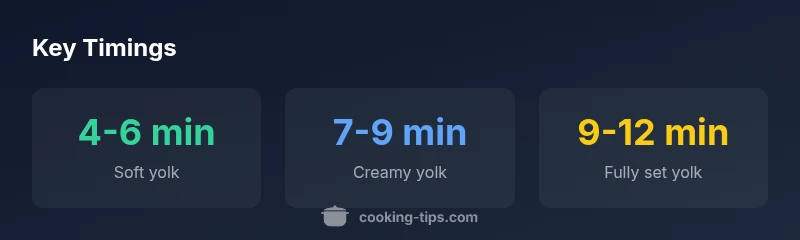
| Doneness | Typical Time (min) | Notes |
|---|---|---|
| Soft yolk | 4-6 | Runny center; great for dipping and salads |
| Creamy yolk | 7-9 | Slightly set center; versatile for many dishes |
| Fully set yolk | 9-12 | Classic hard boiled; ideal for deviled eggs |
| Extra-cooked (not recommended) | 12+ | Slight gray ring; texture declines |
Quick Answers
How long should I boil large eggs to achieve a hard yolk?
For large eggs, aim for 9-12 minutes of gentle simmer after the water returns to a boil. Start with room-temperature eggs for the most even results.
For large eggs, boil for about 9 to 12 minutes to get a fully set yolk.
Do I need to add vinegar or salt to the cooking water?
Salt or vinegar are optional and mainly affect flavor and peeling behavior, not the doneness. If you prefer, add a teaspoon of salt per quart of water.
Salt or vinegar isn't essential; it won't change doneness much, but you can add salt if you like.
Can I use a microwave to cook hard boiled eggs?
Microwaving eggs is risky due to pressure buildup and uneven cooking. If you must, use a tested microwave method with water and short intervals.
Microwaving eggs can cause an explosion; it's best to stick to the stovetop method.
Why is my yolk green after cooking?
A green yolk ring indicates overcooking or a reaction with iron in the yolk. Try a shorter cook time and a quick ice bath next batch.
A green ring means you overcooked it; back off the time next batch.
How can I tell if the egg is done without cracking it open?
Spin a cooled egg on a flat surface: a fully cooked egg will spin smoothly and feel firm. An undercooked egg wobbles.
Spin it—if it spins cleanly, it’s likely done.
How long will hard boiled eggs last in the fridge?
Unpeeled hard boiled eggs last up to one week in the fridge; peeled eggs should be eaten within 1-2 days for best texture.
Keep them in the fridge; peel only when you’re ready to eat.
“Timing is the single most important variable in producing consistent hard boiled eggs. Small changes in size, temperature, or altitude can shift the perfect window by a minute or two.”
Top Takeaways
- Choose eggs a bit older for easier peeling
- Aim for 9-12 minutes for a fully set yolk
- Cool immediately after cooking to stop carryover
- Adjust by 1-2 minutes for large or high-altitude eggs