When to Cook Turkey: A Practical Timing Guide
Learn exactly when to cook turkey for holidays or weeknights. This guide covers thawing timelines, roast temperatures, resting times, and safe serving guidance from Cooking Tips.


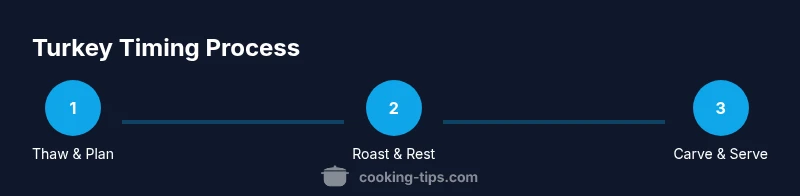
To cook turkey at its best, plan ahead with thawing, weight-based roast times, and a target final temperature of 165°F (74°C). Start thawing early, estimate cook time by weight, and remember that resting after roasting improves juiciness. Whether the bird is stuffed or unstuffed, use a thermometer to verify doneness.
Why timing matters when cooking turkey
Timing is the secret to juicy, evenly cooked turkey. Whether you're feeding a holiday crowd or a quiet Sunday dinner, the way you plan thawing, roasting, and resting determines tenderness and safety. According to Cooking Tips, accurate timing reduces carryover cooking and helps you coordinate oven space with side dishes. A turkey that goes in at the right moment will reach a safe internal temperature without drying out. In this guide we explore the factors that influence timing, including weight, whether the bird is stuffed, and your oven's temperament. We’ll also explain the difference between hot spots in the oven, resting time, and how carryover cooking can finish the job after you pull the pan. By understanding these elements, home cooks can achieve reliable results and reduce last-minute stress in busy kitchens.
Planning and thawing: the early steps
The planning phase sets the stage for a smooth cook. Start by selecting the right turkey size for your crowd and your oven capacity. Then map out thawing, roasting, and resting days so you’re not scrambling at the last minute. According to Cooking Tips, a well-structured plan reduces stress and helps you avoid safety risks associated with improper thawing. Keep a simple timetable that notes when the turkey will enter the fridge, when you’ll preheat the oven, and when you’ll take the pan out to rest. If you’re cooking for a family of eight or more, consider a larger bird or two smaller ones to stagger roasting and ensure even heat exposure. Having a written plan also helps you coordinate side dishes and dessert without oven conflicts. Planning ahead also reduces the risk of underestimating defrost time, which is a common mistake home cooks make when timing a feast.
Thawing timelines and methods
Thawing is the first critical step, and doing it safely ensures a uniform roast. In general, plan fridge thawing for roughly 24 hours per 4–5 pounds of turkey. If time is tight, you can use a cold-water method: submerge the turkey in its packaging in cold water, changing the water every 30 minutes; estimate about 30–60 minutes per pound. Never thaw at room temperature, as surface heat can invite bacteria growth. After thawing, pat the skin dry with paper towels to promote even browning. If you’re starting from frozen, begin thawing several days in advance and keep the bird refrigerated until you’re ready to roast. An organized thawing plan helps you maintain safe temperatures throughout the process, protecting both flavor and safety.
Brining, seasoning, and resting windows
Brining or dry brining can boost moisture retention and skin crispness, but it also adds planning time. A simple dry-brine (salt and aromatics) overnight in the fridge can yield superb juiciness without extra liquid. If you choose wet brine, ensure it’s properly rinsed and dried before roasting to avoid steaming the skin. Regardless of your method, aim to let the turkey come to near room temperature for 30–60 minutes before roasting to promote even cooking. After roasting, allow the meat to rest on a warm tray, tented loosely with foil, for 20–40 minutes. Resting helps redistribute juices and yields a moister slice; skipping this step often results in a wetter pan and drier slices. The resting window is a critical part of timing, not an afterthought.
Calculating roast times by weight
Roast times are highly dependent on whether the bird is stuffed and on your oven’s performance. A common rule is unstuffed turkeys take roughly 13–15 minutes per pound at 325–350°F, while stuffed birds may require about 20–25 minutes per pound. These are approximate ranges; always verify with a thermometer for safety. If you’re cooking two different birds, stagger the start times so the oven isn’t overcrowded, and consider rotating the pan for even browning. For larger birds, plan extra time and expect longer resting periods to keep slices juicy. Weight-based planning helps you set realistic start times for a centerpiece meal and coordinates smoothly with side dishes.
Safe temps: internal temperature and carryover cooking
The safe final internal temperature for turkey is 165°F (74°C) in the thickest part of the breast and thigh, as recommended by major food safety authorities. Keep in mind carryover cooking can raise the internal temp by a few degrees after removing from the oven, so you might pull the pan slightly before the target is reached. Use a calibrated instant-read thermometer to monitor multiple spots: breast, thigh, and wishbone area if present. If you see large temperature gradients, let the bird rest longer before carving. Always recheck the thermometer after resting to confirm that the entire bird has reached a safe temperature.
Practical day-of cooking schedule with examples
A well-planned day-of schedule reduces stress and ensures a timely meal. For a 12–14 lb unstuffed turkey, preheat to 325°F and roast for about 3 to 3.5 hours; rest for 20–40 minutes before carving. For a 16–20 lb bird, plan roughly 3.75 to 4.75 hours with similar resting times; adjust if the breast browns too quickly by tenting with foil. If using stuffing, add time, and ensure the stuffing reaches 165°F as well. Prepare sides during the roasting phase to avoid oven conflicts, and use a timer to track both cooking and resting windows. With this approach, you’ll have a confident, repeatable process that yields consistently delicious results.
Authority sources
For further guidance on turkey safety and timing, refer to these authoritative sources:
- https://www.fsis.usda.gov/food-safety/safe-food-handling-and-cooking-temperatures/turkey
- https://www.cdc.gov/foodsafety/index.html
- https://extension.illinois.edu/foodsafety
Tools & Materials
- roasting pan with rack(Large enough for your turkey; rack elevates meat for even heat)
- instant-read thermometer (probe)(Check breast and thigh temps separately)
- oven thermometer(To verify oven temperature accuracy)
- aluminum foil(For tenting during resting or browning control)
- kitchen twine(Optional for trussing)
- cutting board and sharp knife(Carving station)
- timer or smartphone(Track roasting and resting intervals)
- paper towels(Pat turkey dry before roasting)
- basting brush(Optional for applying butter/oil for crisp skin)
Steps
Estimated time: Total time: approximately 3 hours 45 minutes (roasting plus resting, not including thaw time)
- 1
Choose turkey size and plan timing
Select a turkey size based on your guest count and the available oven space. Create a high-level schedule that includes thawing, preheating, roasting windows, and resting periods. This planning step sets realistic expectations for total time and coordination with sides.
Tip: Write down the planned start time and keep a margin for variations in oven performance. - 2
Thaw safely and plan ahead
If frozen, defrost in the refrigerator for several days, roughly 24 hours for every 4–5 pounds. For quicker thawing, use a cold-water method with regular water changes and a clean container. Do not thaw at room temperature.
Tip: Place the turkey in a tray to capture drips and prevent cross-contamination. - 3
Prepare roast setup and preheat
Pat the turkey dry, season, and place on the rack in the roasting pan. Preheat the oven to 325°F (165°C) and position the rack so the breast sits in the center of the oven for even heat.
Tip: If the breast browns too fast, tent with foil after 30–45 minutes. - 4
Roast to target temp and monitor
Roast until the thermometer in the breast reads around 160–162°F (71–72°C) and the thigh near 170–175°F (77–79°C). Remember carryover cooking will raise temps a few degrees after removal.
Tip: Check temps in multiple spots for accuracy; don’t rely on a single reading. - 5
Rest before carving
Transfer the turkey to a cutting board and tent loosely with foil for 20–40 minutes. Resting redistributes juices and improves slice quality.
Tip: A longer rest at room temperature is okay if the meal isn’t ready yet; keep it covered loosely. - 6
Carve, serve, and store leftovers
Carve with the grain for tender slices. Serve promptly or refrigerate leftovers within two hours to maintain safety.
Tip: Portion and label containers to simplify reheating later.
Quick Answers
When is the best time to start cooking a turkey for a holiday meal?
Start thawing days ahead, plan roasting with a thermometer, and allow time for resting. A clear schedule helps ensure the turkey reaches safe temperature without rushing.
Start thawing early, roast with a thermometer, and allow time to rest before serving.
How long does it take to thaw a frozen turkey?
Thawing times vary by weight, but a common guideline is about 24 hours per 4–5 pounds in the refrigerator. If using the cold-water method, plan 30–60 minutes per pound with water changes.
Thaw in the fridge about a day for every few pounds, or use cold water in shorter blocks with regular water changes.
What internal temperature should I roast a turkey to?
Roast until the thickest part of the breast and thigh reach 165°F (74°C). Account for carryover cooking by removing from heat a few degrees early.
Aim for 165 degrees at the thickest parts, then rest to account for carryover cooking.
Should I stuff the turkey, and how does that affect timing?
Stuffed birds take longer to cook. If you do stuff, verify that the center of the stuffing also reaches 165°F. For easier timing, roast unstuffed and bake stuffing separately.
Stuffing adds time; check that the stuffing hits 165 degrees too, or bake separately.
What are common signs that turkey is undercooked or overcooked?
Undercooked turkey may be pale and jelly-like in the center; overcooked meat is dry and crumbly. Use a thermometer to confirm 165°F at the thickest parts.
Check with a thermometer to avoid undercooked or overcooked turkey.
Can I speed up cooking by spatchcocking or convection?
Spatchcocking or convection can reduce total cooking time and promote even browning, but monitor temperatures closely to avoid overcooking.
Yes, spatchcocking or convection can save time; monitor temps closely.
Watch Video
Top Takeaways
- Plan thawing well in advance
- Roast to 165°F with carryover in mind
- Rest before carving for juiciness
- Adjust timing for stuffed vs unstuffed
- Use a thermometer for accuracy