What Temperature Should Salmon Be When Cooked?
Learn the safe internal temperature for salmon, with USDA guidance and practical thermometer tips. This guide covers method-specific temps, resting, and common pitfalls for reliable doneness.


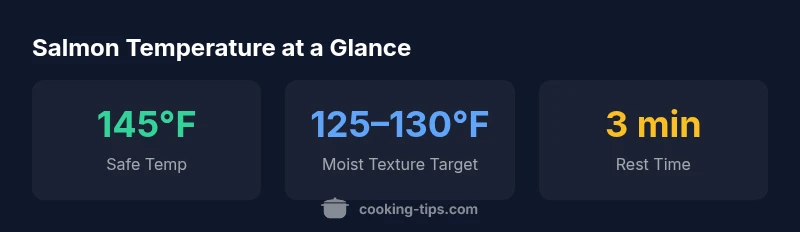
What should cooked salmon temp be? The standard safety guideline from USDA is 145°F (63°C) in the thickest part of the fillet, followed by a short rest. Many cooks prefer 125–130°F for a moister, medium-rare texture. Use a digital thermometer for accuracy, then plate and rest for 3 minutes.
Why the Right Salmon Temperature Matters
Salmon cooks quickly and its exact doneness depends on thickness, fat content, and cooking method. When you ask what should cooked salmon temp be, you are balancing safety with texture. According to Cooking Tips, knowing the target temperature helps you avoid dry, chalky bites while ensuring the center reaches a safe level. In practice, many home cooks start with the USDA's safety guideline of 145°F (63°C) in the thickest part, then adjust downward for a moister finish if they are comfortable with a slightly lower safety margin. You should also account for carryover heat during resting, which can raise the internal temp by a few degrees. By choosing a precise temperature, you can tailor salmon texture from flaky to velvety, depending on preference and method.
Safety vs Texture: Finding the Balance
The tension between safety and texture is most evident when salmon fillets vary in thickness or when you’re cooking from frozen. The USDA’s 145°F guideline prioritizes food safety, preventing bacterial growth and ensuring a firm, opaque center. However, professional cooks and many home chefs aim for a lower finish—typically around 125–130°F—to preserve moisture and achieve a soft, medium-rare bite. This approach requires strict adherence to cleanliness, fresh fish, and rapid cooling if not served immediately. In practice, you’ll often find a compromise: start checking at the lower end of the range and remove from heat once the thermometer hits your target, then allow carryover heat to finish the job.
Measuring Temperature Accurately: Tools and Techniques
Accuracy matters more than timing when it comes to doneness. Invest in a reliable digital instant-read thermometer and calibrate it periodically. Insert the probe into the thickest part of the fillet, away from bone, skin, or gaps. Read quickly and record the exact temperature. If you’re cooking multiple fillets, measure the hottest spot to ensure the entire batch meets your target. For best results, remove from heat just before reaching the final temperature; the rest will bring the center up to the desired doneness.
Temperature Guidelines by Cooking Method
Different methods yield different heat exposure and moisture retention. Here is practical guidance you can apply:
- Oven finish: Target 145°F (63°C) in the center of the thickest part; rest 3 minutes.
- Pan-sear + finish in oven: Start with a sear to 135–140°F (57–60°C) then transfer to a preheated oven to finish; rest 3–5 minutes.
- Grill: Aim for 140–145°F (60–63°C) with indirect heat to avoid scorching; rest 3 minutes. If the fillet is thick, move to cooler zones to finish evenly.
- Sashimi-style or very fresh sashimi-grade salmon: Some chefs serve below 145°F, but this carries safety considerations and should be reserved for high-quality, sashimi-grade fish and proper handling.
Resting and Carryover Heat: Why It Matters
Resting is not merely letting the fish cool slightly; carryover heat continues to cook the salmon after you remove it from heat. A well-timed rest of about 3 minutes allows juices to redistribute and the internal temperature to settle. If you pull the salmon off at 142°F (61°C) for a target of 145°F, the resting process may push it over the final mark. The key is to monitor with a thermometer and remove just a touch before the final desired temp, accounting for carryover heat.
Common Mistakes to Avoid
Avoid overcooking by relying on time alone—time is a guide, not a guarantee. Do not skip thermometer checks or rely on color alone, which can be deceptive due to variations in fat content. Letting the fish rest is essential; skipping it can result in a less juicy texture. Finally, ensure your fish is thawed evenly if frozen and not partially frozen, as uneven thickness creates hot and cold pockets that trick a thermometer.
Quick Recipe Checklist: Safe Salmon Temps in Practice
- Always pat dry before cooking to promote even heat transfer.
- Use a calibrated digital thermometer; insert into the thickest part.
- Start checking early and use carryover heat to your advantage.
- Rest 3 minutes after removing from heat to finish doneness.
Temperature targets by cooking method
| Method Type | Target Temp (F) | Rest Time |
|---|---|---|
| Oven finish | 145 | 3 |
| Pan-sear + finish in oven | 135-140 | 3-5 |
| Grill | 140-145 | 3 |
Quick Answers
What is the safe internal temperature for salmon?
USDA recommends 145°F (63°C) at the thickest part of the fillet, measured with a thermometer. This minimizes pathogens and ensures a safe, opaque center.
Safe temp is 145 degrees Fahrenheit; use a thermometer for accuracy.
Can I cook salmon to a lower temp for more moisture?
Some chefs target 125–130°F for a moister, medium-rare texture. This carries a higher safety risk if not handled properly, so proceed with caution and source quality fish.
Chefs sometimes target 125–130°F, but it reduces safety margin.
Is a thermometer essential for doneness?
Yes. A thermometer provides an objective measurement that color or size cannot reliably indicate.
Yes, use a thermometer for accurate doneness.
How thick should the fillet be for accurate temp readings?
Check the center of the thickest part; if portions vary in thickness, measure at the thickest area and adjust accordingly.
Check the center of the thickest part.
Should I rest the salmon after cooking?
Yes, resting for about 3 minutes allows carryover heat to finish the process and improves juiciness.
Rest it for about 3 minutes.
How do I calibrate my thermometer?
Follow the manufacturer's instructions or test with ice-water to ensure accuracy before use.
Calibrate in ice water or per instructions.
“Temperature is the most reliable measure of doneness for salmon. Rely on a thermometer rather than color or time alone to ensure both safety and ideal texture.”
Top Takeaways
- Target 145°F for safety, then rest.
- 125–130°F offers a moister, medium-rare texture for some diners.
- Carryover heat can raise temp by 3–5°F after removal.
- Choose method-specific temps to balance texture and safety.
- Always verify with a calibrated thermometer.