How Much Cooked Rice Is a Serving? A Practical Guide
Learn how to portion cooked rice accurately for sides and meals, with practical guidelines for white, brown, and specialty rices, plus meal-planning tips that fit everyday eating patterns.


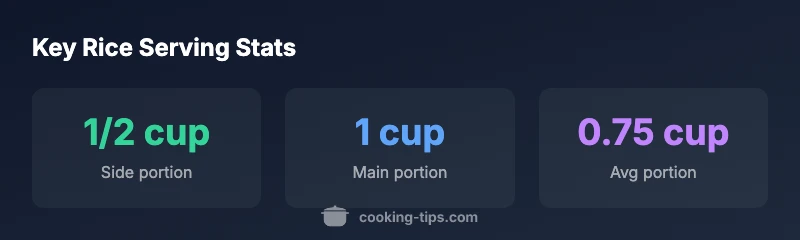
Cooked rice portions typically range from one-half cup for a side dish to one cup for a main course, depending on appetite and meal composition. For mixed meals, start with about three-quarters of a cup per person and adjust based on protein, vegetables, and dietary needs. This guide from Cooking Tips helps you portion rice consistently in everyday meals.
Understanding Serving Sizes for Rice
How much cooked rice is a serving? The simplest way to think about it is in volume: half a cup as a common side portion, and one cup when rice is the main feature of a dish. The exact size depends on the meal context, your dietary goals, and the type of rice you're cooking. According to Cooking Tips, portioning rice accurately helps with meal balance, calorie control, and faster plate assembly. Across cuisines, portions adapt to protein and vegetables, but starting with these baselines gives you a reliable framework for most everyday meals. In practical cooking terms, consider your audience: a busy family dinner might lean toward the larger end, while a light lunch or a meal prep bowl might stay closer to a half cup.
The concept of a serving extends beyond a single measurement. It’s about consistency across meals and cooking methods. If you’re tracking macros or calories, using a consistent serving size makes it easier to estimate intake over a week. Remember that rice is a carbohydrate-rich staple that pairs with many proteins and vegetables, so the serving size you choose should align with overall plate balance and daily goals. The goal is not to rigidly dictate every meal, but to establish a repeatable baseline you can adjust as needed.
For different rice dishes, you might see slight variation. A fluffy side of cooked white rice still centers around the 1/2 cup mark, while a stir-fry bowl with proteins and vegetables might comfortably land near 3/4 to 1 cup. The Cooking Tips team emphasizes flexibility: use data-driven baselines, then adapt to hunger, activity level, and meal context.
How to Measure a Serving Accurately
Measuring a serving of cooked rice precisely is easiest with standard tools. Start with a 1/2-cup measuring cup for sides and a 1-cup cup for main portions. If you cook rice in bulk, portion after cooking so you’re always serving a consistent amount. A kitchen scale can be a helpful backup: weigh a typical serving in grams (for example, about 90–125 g for a half-cup portion and 180–225 g for a one-cup portion, depending on the rice type and how compactly it’s packed).
Tips for accuracy:
- Fluff the rice with a fork before measuring to avoid compacted clumps that skew volume.
- Use the same cup or scale each time to reduce measurement error.
- If you’re meal prepping, portion rice into individual containers when it’s still warm to prevent over-consolidation.
If you’re unsure about a portion, start smaller and adjust upward at the next meal. The goal is consistency across meals, not perfection in every single serving.
To reconcile cooked volume with dietary targets, consider pairing rice with protein and vegetables that provide fiber and micronutrients, balancing the plate while keeping portions realistic.
Practical Guidelines by Rice Type
Rice isn’t a one-size-fits-all ingredient. White, brown, and specialty rices like basmati or jasmine can yield slightly different volumes per cup cooked due to differences in hull and bran fiber. In general terms:
- White rice tends to be softer and fluffier; a half-cup side portion is a common baseline.
- Brown rice, with its intact bran layer, may feel fuller and yield a similar or slightly larger cooked volume per cup dry, so adjust downward if you’re balancing fiber intake.
- Parboiled and other treated rices can behave a bit differently in both texture and swelling; use the package guidance as your starting point.
For meal planning, remember that the same dry amount can produce a range of cooked volumes based on cooking method and the specific rice variety. The Cooking Tips analysis notes that yield variability matters most when you’re cooking for multiple people with diverse appetites. Use the baselines for consistency, then tune according to the rice you’re using.
Visual Cues and Portioning Methods
When you’re serving rice to a group, visual cues help you stay consistent without a scale. A practical approach is to use the following approximations:
- Side dish: a compact half-cup mound that sits about the size of a small ice cream scoop.
- Main dish: a heap about the size of a tennis ball, roughly one cup in volume when fluffy.
For quick checks, imagine a small cupped hand full of cooked rice equals about 1/2 cup. A generous handful might approach 2/3–3/4 cup for a higher-volume dish. These cues aren’t exact measurements, but they’re reliable for everyday cooking and help you keep portions balanced across meals.
If you’re teaching kids or planning for athletes, you’ll often adjust up or down by 1/4 cup based on energy needs. The goal is to maintain consistency from meal to meal while staying within your dietary targets.
Meal Planning Scenarios and Adjustments
Meal planning benefits from clear portioning rules. For a typical dinner plate with protein, vegetables, and a starch:
- Side-starch balance: start with 1/2 cup cooked rice per serving if the protein portion is moderate and vegetables fill half the plate.
- Protein-forward meals: consider 3/4 cup to 1 cup cooked rice per person to ensure the starch supports the protein without crowding the plate.
Batch-cooking rice is convenient for busy weeks. Cook a larger batch, then portion into individual containers for quick lunches or dinners. Store in the refrigerator for up to 4–5 days or freeze for longer-term meals. When reheating, add a splash of water and fluff to restore texture. The key is consistency and ease of use in weeknight cooking.
Common Mistakes and How to Fix Them
Common mistakes include cooking too much rice without planning, not rinsing rice before cooking, and serving rice while it’s still packed and compact. To fix:
- Rinse rice until the water runs clear to remove surface starch that can lead to gummy grains.
- Measure portions before or after cooking and use the same method each time.
- If rice dries out during reheating, add a splash of water and fluff with a fork to restore texture.
- Don’t overlook fiber and protein balance; pairing rice with vegetables and lean proteins helps control overall portion perception.
By avoiding these pitfalls, you’ll keep portions predictable and meals satisfying.
Putting It All Together: Quick Reference Chart
Here’s a compact reference you can rely on at a glance:
- Side serving: 1/2 cup cooked.
- Main serving: 1 cup cooked.
- For mixed meals: start ~3/4 cup and adjust to appetite.
- Rice type matters: adjust slightly for brown vs white rice due to texture and fiber.
- Batch-cooked rice: portion, cool quickly, refrigerate or freeze as needed.
This quick reference aligns with the broader guidelines discussed above and supports consistent meal planning.
Rice serving size by meal type
| Aspect | Typical serving (cooked) | Notes |
|---|---|---|
| Side dish | "1/2 cup" | Common portion alongside proteins |
| Main dish | "1 cup" | Hearty serving for main course |
Quick Answers
How much cooked rice is a serving for a side dish?
A standard side serving is about 1/2 cup cooked rice. This serves as a reliable baseline for most meals and can be scaled up if the rest of the plate is light on protein or vegetables.
A side serving is usually about half a cup; adjust if you’re pairing with a lighter protein or more vegetables.
Does rice yield differ by white vs brown rice?
Yes, the cooked volume per cup dry can vary slightly by rice type. Brown rice often requires similar cooking time but may yield a slightly larger cooked volume due to fiber content; use the same baselines and adjust by texture preference.
Brown rice can yield a bit more cooked volume due to fiber; start with the same baseline and tweak for texture.
How do I measure cooked rice accurately for multiple people?
Use a 1/2 cup for sides and 1 cup for mains when portions are being planned for several people. For accuracy, weigh portions or use the same measurement cup consistently.
Use standard measuring cups, or weigh portions to keep portions equal across servings.
Can I batch-cook rice and portion it for meals?
Yes. Cook rice in a larger batch, then portion into individual containers. Refrigerate for 4–5 days or freeze for longer storage, reheating with a splash of water.
Batch-cook, then portion for quick meals; refrigerate or freeze as needed.
What about other rice varieties like sushi rice or basmati?
Serving sizes are similar, but water absorption times and texture differ. Use package guidelines as a starting point and adjust based on your preference for stickiness or fluffiness.
Other varieties vary in texture; follow the package but adjust to your preferred grain feel.
How should I store cooked rice safely?
Cool rice quickly, store in airtight containers in the refrigerator, and reheat until steaming hot. Use within 4–5 days for best quality.
Cool quickly, store airtight in the fridge, reheat until steaming.
“Portioning cooked rice is about balancing hunger, nutrition, and plate composition; use the baselines and adjust by appetite and context.”
Top Takeaways
- Start with 1/2 cup for sides and 1 cup for mains.
- Adjust portions based on protein and vegetables on the plate.
- Rice type influences texture and volume; brown rice may yield slightly more cooked volume.
- Cooking Tips recommends consistent baselines and flexible adjustments for variety in meals.