How Big of a Pot to Cook Rice: A Practical Guide
Learn how to choose the right pot size for cooking rice, with practical rice-to-water ratios, tips for white and brown varieties, and steps to prevent boil-overs and undercooked grains.


Choosing the right pot size is a foundational step to cooking rice well. The goal is to give the grains room to expand, allow steam to circulate, and prevent boil-overs. By matching pot capacity to your batch and using sensible rice-to-water ratios, you’ll get fluffy, evenly cooked rice with minimal fuss. This guide explains how to size your pot for any amount of rice you plan to cook.
Why pot size matters for cooking rice
Choosing the right pot size is a foundational step in cooking rice that many home cooks overlook. When you ask how big of a pot to cook rice, the answer isn’t just about fitting a lid; it’s about giving the grains room to expand, letting steam circulate, and preventing boil-overs. The Cooking Tips team emphasizes that a pot with suitable capacity and a wide, stable base can affect texture, evenness, and the ease of handling a hot pot. With the right size, you’ll see fluffy grains where each kernel is distinct rather than clumped. In short, pot size sets the stage for consistency across batches. According to Cooking Tips, pot size also influences steam distribution and absorption, which matters whether you’re cooking white, brown, or specialty rice varieties.
How to determine pot capacity for your batch
The starting point for sizing is your batch. Begin with how many cups of raw rice you plan to cook, then estimate the total volume you’ll need after absorption and expansion. A good rule of thumb is to choose a pot that leaves several inches of headspace above the rice-water mixture to safely accommodate foaming and swelling. If you’re cooking a small 1–2 cup batch of white rice, a compact pot with a capacity around 4–5 cups works well. For larger batches, say 3–4 cups of rice, aim for a pot in the 6–8 cup range or larger. These ranges help prevent spillover while giving steam room for even cooking. Remember, headspace isn’t just air—it's space for simmering liquid to reduce without overflowing. By prioritizing headroom, you’ll reduce the risk of scorching and ensure even heat contact across the rice.
Rice-to-water ratios and pot capacity
Rice cooking relies on reliable ratios, but pot size still matters. For most white rice varieties, a common starting point is roughly a 1:2 ratio of rice to water, while brown rice often needs more water and longer simmering. The exact numbers depend on the rice type and your stove, but the key is to choose a pot large enough that the water can simmer without boiling over and without crowding the grains. If your pot is too small, you’ll see boiling foams push through the lid or sticky, uneven grains. Conversely, a pot that’s too large can heat unevenly and waste energy. The recommended approach is to pick a pot whose interior is roughly twice the total cooked volume, giving ample headspace for absorption and steam.
Rice varieties and pot size considerations
Different rice varieties behave differently in the same pot. Long-grain white rice tends to stay lighter and benefits from a slightly looser environment, while short-grain varieties compact more easily and can benefit from a bit more space to prevent clumping. Brown rice, red rice, and wild rice usually require more water and longer cooking times, which means a larger pot helps prevent sticking and allows uniform heat distribution. If you’re mixing rice types in one pot, size up to accommodate the densest grain and the most water, then adjust cooking time and heat to finish all grains evenly. The overarching principle is: more dense or absorption-heavy rices need more room and more headspace for successful outcomes.
Material, lid, and shape: how they influence steam and heat
Pot material impacts heat distribution. Heavy-bottomed pots (like some Dutch ovens or cast-iron options) spread heat more evenly, reducing hot spots that can scorch or undercook rice at the edges. A tight-fitting lid traps steam, which is essential for even cooking and preventing foam from escaping. Round pots encourage more uniform heat circulation than tall, narrow designs, reducing the chance of unevenly cooked grains. If you routinely cook rice in a small apartment or on a single-burner setup, consider a pot with a heavy base and a solid, well-fitting lid to maximize steam retention and consistency, regardless of the rice type you’re preparing.
Measuring rice and water accurately for consistent results
Accuracy matters more often than you might think. Use a dedicated measuring cup for rice, then measure water with the same unit for consistency. Mistakes in measurement compound across the cooking process, especially when pot size is borderline for the batch. If you’re rinsing rice, count the rinses toward your batch size and water estimate, since the rinsing process removes surface starch that would otherwise alter absorption. For best results, consider using a kitchen scale for precision, especially when cooking large batches or combining multiple rice types. Finally, account for simmering loss by giving a small extra margin to your water amount, then adjust on future cooks based on the texture you observe.
Troubleshooting: avoid boil-overs and undercooked grains
Boil-overs are a common sign that your pot is too small or the heat is too high for the batch. If you notice rapid foaming, briefly lift the lid to release steam and lower the heat, then restore the lid to finish cooking. Under the wrong conditions, grains can cling or stay undercooked in the center. To avoid this, verify that you used enough headroom and that the lid seals well. If you’re consistently seeing uneven texture, consider transferring to a slightly larger pot for next time or allowing the rice to rest longer after cooking to finish absorbing moisture. Resting helps distribute moisture evenly so every grain reaches the proper tenderness.
Authoritative sources and practical references
For home cooks seeking research-backed guidance, several extension services and government resources offer general guidance about cooking grains and using appropriate cookware. While specific pot recommendations vary by stove and kitchen setup, these sources provide reliable foundations for rice cooking practices:
- https://extension.illinois.edu
- https://extension.oregonstate.edu
- https://www.usda.gov
Quick-reference sizing checklist
- Determine batch size in cups of raw rice and estimate total cooked volume.
- Choose a pot with ample headspace (roughly double the anticipated cooked volume).
- Prefer a heavy-bottom, wide pot with a tight-fitting lid for even cooking and steam retention.
- Measure rice and water accurately; rinse if desired to remove surface starch.
- Monitor heat to prevent boil-overs; adjust as needed and let the pot rest after cooking.
Authoritative sources
- USDA.gov guidelines on grain cooking and general kitchen technique.
- Extension services (edu domains) that discuss cookware and rice- cooking tips.
- Major public publications on safe and reliable cooking practices.
Tools & Materials
- Pot with lid(Heavy-bottom preferred; ensure lid fits tightly)
- Measuring cups for rice and water(Use the same unit for both measurements)
- Kitchen scale (optional)(Helpful for precise batches and multiple rice types)
- Strainer or sieve(Useful for rinsing rice before cooking)
- Stove or heat source(Adequate heat control to manage simmer)
- Timer(Tracks resting and simmer times)
Steps
Estimated time: 25-35 minutes
- 1
Estimate batch size and pot capacity
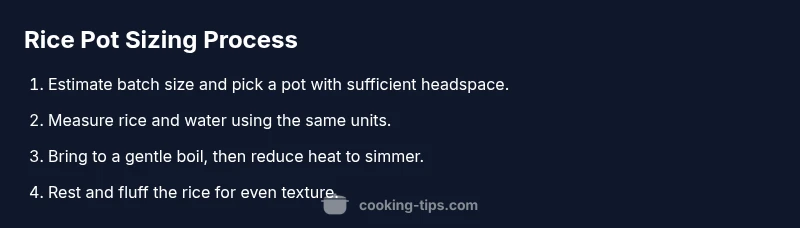
Decide how many cups of rice you’ll cook and pick a pot with sufficient headroom for swelling and steam. The goal is to avoid crowding the grains and to prevent boil-overs during the initial boil. If you’re unsure, opt for a pot that’s larger than your minimum needs.
Tip: When in doubt, choose a pot with at least double the cooked volume. - 2
Prepare the pot
Rinse the pot and check the lid for a tight seal. A sturdy, heavy-bottom pot distributes heat more evenly, which helps prevent scorching at the sides. If you have a clear lid, you can monitor simmer without lifting the lid too often.
Tip: Preheat the pot on a low flame for even heat distribution. - 3
Measure rice and water
Measure your rice and water precisely using your chosen units, then set the numbers side by side so you don’t misread them during transfer. Rinse rice if you prefer a cleaner texture and to remove surface starch; drain well before adding to water.
Tip: Consistency in measurement helps reproduce perfect rice across batches. - 4
Add ingredients to pot
Add rice to the pot, then pour the water in, ensuring the grains are submerged and the surface is level. Leave a small headspace, then cover. If you’re adding salt or aromatics, do so at this stage rather than later.
Tip: A little extra headspace reduces boil-over risk when the liquid comes to a rolling boil. - 5
Bring to a gentle boil
Place the pot on medium-high heat and bring the liquid to a gentle boil. Stir once to distribute the grains, then reduce heat to maintain a steady simmer. Do not lift the lid repeatedly; this can interrupt steam buildup.
Tip: Foaming is normal; if it rises too high, briefly vent the lid and reduce heat. - 6
Simmer until absorbed
Let the rice simmer until the liquid is mostly absorbed and the grains are tender. The time varies by rice type, but resist the urge to rush; overcooking makes grains mushy. Check the texture visually and feel slightly tender but firm near the center of grains.
Tip: If still slightly undercooked, cover and rest off the heat for a few minutes to finish absorbing moisture. - 7
Rest and fluff
Turn off heat and let the pot rest, covered, for several minutes. Fluff with a fork to separate grains and release steam. Resting ensures even moisture distribution, producing light, separate grains rather than a dense clump.
Tip: Use a gentle folding motion to avoid breaking grains. - 8
Evaluate and store
Taste-test a small portion to confirm tenderness and texture. If you’re cooking multiple batches, rinse and dry the pot between cooks to avoid transfer of flavors. Properly cooled rice can be stored or reheated with minimal loss of texture.
Tip: Store cooked rice in shallow containers to cool quickly and reheat evenly.
Quick Answers
How big of a pot do I need for 1 cup of rice?
For a single cup of uncooked rice, a small to medium pot with a capacity of about 4 cups generally works well, leaving space for simmering and foaming. This setup helps prevent boil-overs and ensures even heat distribution.
A 4-cup capacity pot is usually plenty for one cup of rice.
Does the pot shape matter for rice cooking?
Yes. Wide, shallow pots promote even heat distribution and quicker evaporation, while tall, narrow pots can trap steam unevenly. A broader base reduces hot spots and helps grains cook evenly.
A wide, shallow pot often cooks rice more evenly.
Can I cook rice in a pot with a narrow diameter?
You can, but you may risk uneven cooking or boil-overs if the liquid sits too high. If you must, compensate by lowering heat sooner and allowing more headspace.
A narrow pot can work, just adjust heat and headspace.
How do I prevent rice from sticking to the pot?
Choose a heavy-bottom pot, rinse and drain the rice well, and avoid excessive stirring once the liquid is at a simmer. Let the grains cook undisturbed for even moisture absorption.
Use a good pot and let it simmer without constant stirring.
Is a glass lid better for rice cooking?
A glass lid helps you monitor the simmer without lifting, which preserves steam. The key is a tight seal rather than the lid material.
A tight-fitting lid is more important than the lid material.
What if I overfill the pot?
Overfilling increases spill risk and can shorten the simmer period. Use a larger pot or reduce batch size to keep enough headroom for foamy rice.
Don’t fill too high; use a pot with more headspace.
Watch Video
Top Takeaways
- Choose a pot with ample headspace for your batch.
- Use reliable rice-to-water ratios and adjust for rice type.
- Select a heavy-bottom pot and a tight lid for even cooking.
- Resting after cooking yields fluffier grains.