What to Cook Quiche At in the Oven: A Practical Guide
Learn the ideal oven temperature, crust prep, custard ratios, fillings, and troubleshooting to bake perfect quiche every time. This guide from Cooking Tips walks you through timing, techniques, and serving ideas for reliable, delicious quiche outcomes.


Your quiche will bake best at a moderate oven and with a properly prepared crust. Start by heating the oven to 375°F (190°C) and blind-baking the crust if required. Whisk eggs with cream, fold in fillings, pour into the crust, and bake until the center is set and the edges are golden. Let it rest briefly before slicing.
Understanding quiche baking temperatures and timing
Quiche is a custard-based savory pie that relies on gentle, even heat to set the filling without curdling. The most reliable starting point for home cooks is a moderate oven temperature. If you’re asking what to cook quiche at in the oven, a practical default is 375°F (190°C). This setting provides enough heat to set the custard while allowing the crust to brown evenly without scorching. Cooking Tips recommends beginning with this baseline and adjusting based on crust type and filling density. For a balanced bake, place the rack in the middle of the oven to ensure even air circulation. Thick fillings or high cheese content may require a few extra minutes, while lighter fillings may finish sooner. The goal is a slightly wobbly center that firms as it rests. After removing the quiche, let it rest on a wire rack for 10–15 minutes to finish setting and to make slicing neater. If the crust browns too quickly while the center is still jiggly, return the quiche briefly for 5 more minutes, then recheck. Use these guidelines and rely on the custard’s set as the true doneness indicator.
At Cooking Tips, we emphasize consistency in oven performance. If your oven runs hot or cold, adjust by 25°F (15°C) in future batches and keep a thermometer inside the oven to monitor actual heat. This practice reduces undercooked centers or overly browned exteriors and improves repeatable results across multiple quiche variations.
For home cooks juggling fillings, consider density. A densely loaded quiche will need longer bake time; lighter fillings bake faster. When in doubt, cover the edges with foil to prevent over-browning while the center finishes setting. A well-prepared quiche includes a crust that holds its shape, a creamy custard, and fillings that don’t release a lot of moisture during baking.
Key takeaway: start with 375°F (190°C) and adjust based on crust type and filling density; use a middle rack and rest the quiche after baking to ensure a smooth, sliceable texture.
note": null
Tools & Materials
- Pie crust (homemade or store-bought)(9-inch crust; blind-bake as needed)
- Eggs, large(4 large eggs)
- Heavy cream or half-and-half(1 cup heavy cream or 1/2 cup cream + 1/2 cup milk)
- Shredded cheese(1 cup; Gruyère, cheddar, or feta work well)
- Fillings (vegetables, ham/bacon, precooked sausage)(About 1 cup total; precooked fillings recommended)
- Salt and pepper(To taste)
- Parchment paper and pie weights or dried beans(For blind-baking crust)
- Mixing bowls, whisk, measuring cups/spoons(For custard and fillings)
- Cooling rack(Rest quiche after baking)
Steps
Estimated time: 1 hour 15 minutes
- 1
Preheat oven and prep pan
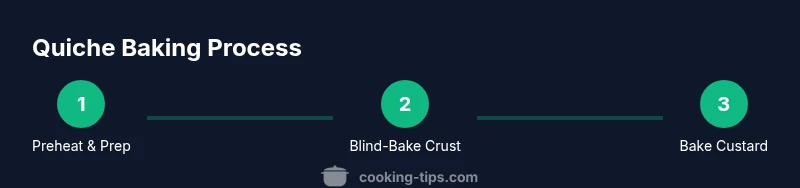
Preheat the oven to 375°F (190°C) with the rack in the middle. Lightly grease a 9-inch quiche dish or pie pan and have parchment and weights ready if you’re blind-baking.
Tip: Use a dedicated pie pan or quiche dish for an even bake. - 2
Blind-bake crust (if needed)
Line the crust with parchment, fill with pie weights or dried beans, and bake about 12 minutes until the edge starts to set. Remove weights and parchment and bake 2–4 more minutes if the bottom looks pale.
Tip: Blind-baking prevents a soggy bottom when filling releases moisture. - 3
Whisk custard base
In a bowl, whisk eggs with cream, salt, pepper, and optional nutmeg until fully combined and smooth.
Tip: Whisk thoroughly to avoid eggy lumps and ensure a silky custard. - 4
Arrange fillings in crust
Spread fillings evenly across the crust, aiming for a balanced distribution of vegetables, meat, and cheese.
Tip: Pre-cook vegetables to remove excess moisture. - 5
Combine and pour
Pour the custard over the fillings, allowing it to fill gaps without overflowing. Tap the pan gently to settle any bubbles.
Tip: Pour slowly to avoid shifting the fillings. - 6
Bake until set
Bake for 25–40 minutes, or until the center is just set and the edges are lightly browned. If the crust browns too quickly, cover the edges with foil.
Tip: Center should wobble slightly when moved but firm up as it rests. - 7
Rest and slice
Cool on a rack for 10–15 minutes before slicing to help the custard set and slices cleanly.
Tip: Using a sharp knife or a warm blade helps neat portions.
Quick Answers
What temperature should I bake quiche at?
A common starting point is 375°F (190°C). Adjust slightly based on crust and fillings; use middle rack for even heat.
Begin at 375 degrees and adjust as needed for your crust and fillings.
Should I blind-bake the crust?
If your crust is prone to sogginess, blind-bake it with parchment and weights before adding the custard.
Blind-baking helps prevent a soggy bottom.
How do I know when quiche is done?
The center should be set with a slight wobble; edges will be golden. Resting after baking helps finish setting.
Check for a just-set center and a golden edge.
Can I make quiche ahead of time?
Yes. Assemble and bake, then cool completely. Refrigerate and reheat gently in the oven before serving.
Quiche can be made ahead and reheated in the oven.
What fillings work best in quiche?
Choose fillings that release little moisture when cooked, like pre-cooked vegetables, cured meats, and well-drained cheeses.
Use fillings that stay firm and don’t add excess moisture.
Can I use milk instead of cream?
Yes, but milk will yield a lighter custard; for richer flavor, use a mix or add a bit of butter.
Milk makes it lighter; cream makes it richer.
Is reheating quiche safe in the microwave?
Reheating in the microwave is convenient but can cause uneven texture. The oven or toaster oven preserves crust better.
Oven reheating preserves texture better than microwaving.
How far in advance can I prepare quiche?
You can prepare fillings in advance and mix custard ingredients ahead of time to streamline assembly.
Prep fillings ahead to speed up the bake.
Watch Video
Top Takeaways
- Bake at 375°F (190°C) for reliable results.
- Blind-bake crust if moisture risk is high.
- Rest the quiche 10–15 minutes before serving.
- Fillings should be precooked and well-drained.
- Check doneness by the custard’s set, not color alone.