What Temperature to Cook Quiche: A Practical Guide
Discover the best temperature to bake quiche, plus timing, doneness tests, and pro tips from Cooking Tips. Master custardy fillings and flaky crusts with a steady, repeatable technique.


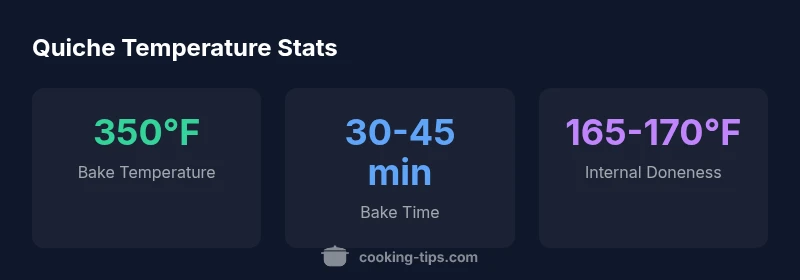
Quiche cooks best at 350°F (175°C). For a 9-inch pie, bake about 30-45 minutes until the center is set and the edges are lightly puffed. Use gentle heat to avoid curdling the custard, and when the knife test shows a clean edge with a slightly creamy center, remove from the oven. Let it rest 10 minutes before slicing.
The science behind quiche temperature
Egg proteins coagulate as they heat, and a steady, moderate temperature lets the custard set evenly without curdling. A too-hot oven can dry the surface and squeeze moisture from the filling, resulting in a rubbery texture. A cooler oven risks a center that remains jelly-like. For a classic quiche, the practical sweet spot is a steady bake at about 350°F (175°C), which promotes custard setting while the crust browns gently. According to Cooking Tips, understanding these dynamics helps home cooks achieve a creamy center and a stable crust. In our 2026 analysis, temperature stability emerges as the single most important variable for consistent quiche texture across different ovens.
Testing doneness without a thermometer
Most home cooks rely on texture and visual cues rather than gadgets. Look for a quiche whose surface is lightly puffed and the center has a gentle jiggle—an indicator of a firm custard just on the cusp of setting. The edges should be set and slightly pulled away from the pan. If you do use a thermometer, aim for about 165-170°F (74-77°C) in the center. After removing from the oven, let the quiche rest for at least 10 minutes; the residual heat will finish cooking the filling and help it set evenly.
Common temperature mistakes and how to fix them
Overbaking is the most common issue, producing a dry center and a too-dark crust. To fix, lower the oven temperature to 325-350°F (160-175°C) and shield the crust with foil if it browns too quickly. Underbaking happens when time is insufficient or the oven runs cool; give it a few extra minutes and monitor progress. Blind-baking the crust for 8-12 minutes before filling can prevent a soggy bottom, especially when you’re using moist vegetables or extra dairy. Rotate the pan halfway through to promote even browning, and consider a shallow tart pan for more uniform heat distribution.
Temperature guidance by quiche style
- Classic quiche Lorraine with cream and eggs generally bakes well at 350°F (175°C) for 30-40 minutes; target a center around 165-170°F.
- Veggie-heavy quiches containing moisture-rich fillings may need a longer bake or a brief pre-bake to reduce sogginess.
- Rich fillings with extra cheese or cream tolerate the same temperature but may brown quicker; shield crust edges if needed.
- If your crust browns too fast, lower the oven by 25°F (15°C) and finish on the center rack to balance crust color and filling set.
Step-by-step: from crust to custard
- Pre-bake the crust (blind bake) for 8-12 minutes to set the structure. 2) Whisk together eggs, dairy, salt, and seasonings until smooth. 3) Par-bake or lightly bake the crust with a barrier to prevent sogginess. 4) Pour the custard into the crust, distributing fillings evenly. 5) Bake at 350°F (175°C) for 30-40 minutes, until the center is set and the edges are lightly browned. 6) Remove and rest for 10 minutes before slicing for clean cuts. 7) Slice and serve at room temperature or warm.
Techniques for even baking in a home oven
Always preheat fully and place the quiche on the center rack for uniform heat. If your oven runs hot in spots, rotate the pan halfway through and consider using a baking sheet underneath to regulate bottom heat. An oven thermometer helps you verify actual temperature, as many home ovens deviate from the dial. For extra protection against over-browning, tent the crust with foil during the final 10 minutes if the center is still not set.
Food safety and make-ahead strategies
Eggs and dairy require proper handling. Bake quiche to an internal center temperature of 165-170°F (74-77°C) and refrigerate leftovers within two hours. Reheat slices to at least 165°F (74°C) before serving. Leftover quiche keeps well in the fridge for 3-4 days or can be frozen for up to 2 months. When reheating, cover to preserve moisture and warm evenly. For make-ahead meals, you can partially bake crusts and freeze them, then finish the bake after filling.
Practical kitchen checklist for perfect quiche
- Preheat to 350°F (175°C) and bake on the center rack.
- Blind bake the crust to prevent sogginess.
- Use 165-170°F (74-77°C) as the internal target for doneness.
- Let rest 10 minutes before slicing for clean cuts.
- Reheat leftovers to 165°F (74°C) when serving again.
Quiche temperature quick-reference
| Name | Value | Unit |
|---|---|---|
| Bake Temperature | 350 | °F (175°C) |
| Internal Doneness Target | 165-170 | °F (74-77°C) |
| Rest Time After Baking | 10 | minutes |
Quick Answers
What temperature should I bake quiche at?
Bake quiche at 350°F (175°C) for about 30-40 minutes, until the center is set and the edges are lightly browned. Use the knife or a thermometer as a doneness guide.
Bake at 350 degrees for about half an hour to forty minutes, until the center sets and the edges brown lightly.
Can I bake quiche at a higher temperature to speed up cooking?
A higher temperature risks uneven cooking and a dry center. If you must speed things, try 375°F (190°C) for a shorter time and monitor closely, or reduce by 25°F (15°C) and finish on center rack.
Higher heat can dry out the center. If you must speed things, watch closely and consider lowering the heat a bit and finishing on the center rack.
What do I do if the crust browns too quickly?
Tent the crust with foil or parchment, or lower the oven temperature by 25°F (15°C) and finish on the center rack to balance crust color with filling set.
If the crust browns too fast, cover it with foil and keep baking at a lower temperature until the center set.
How can I tell if quiche is done without a thermometer?
Look for a mostly set center with a slight jiggle and a lightly browned edge. The surface should be mostly firm and not wobbly.
If the center jiggles only a little and the edges are set, it’s likely done. Let it rest before serving.
Is it safe to eat quiche if the center is very soft?
No. The center should reach a safe temperature to ensure eggs are cooked. If it’s very soft, return to the oven in short intervals and re-test.
If the center is very soft, bake a bit longer and re-check until it’s firm.
“Temperature is the backbone of quiche texture: steady heat gives the custard time to set evenly without curdling, producing a creamy center and a golden crust.”
Top Takeaways
- Preheat to 350°F (175°C) for best results
- Bake 30-45 minutes, center set, edges lightly puffed
- Rest quiche 10 minutes before slicing
- Use a thermometer to verify doneness if desired
- Shield crust if it browns too quickly