What to cook chicken to: Safe temperatures and methods
Learn exact doneness targets for chicken, how to measure temps, and practical paths to 165°F safely. Covers breasts, thighs, and whole chicken with expert tips from Cooking Tips.


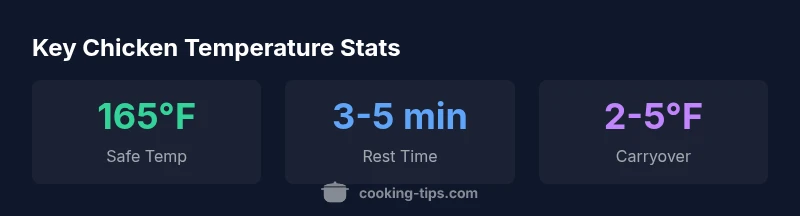
For safe, juicy chicken, cook to an internal temperature of 165°F (74°C). This target applies to breasts, thighs, and whole birds; use a thermometer to check the thickest part and account for carryover. Rest 3-5 minutes before slicing to keep juices in. If you’re asking what to cook chicken to, this is the benchmark you should plan around.
What to cook chicken to: Doneness targets and safety basics
If you're asking what to cook chicken to, the short answer is 165°F (74°C) for safety. That target applies across cuts and cooking methods, but your approach matters for texture and juiciness. In this Cooking Tips guide, we explain why this temperature matters, how to verify it with a thermometer, and how to plan your cooking sessions so your chicken is safe and delicious every time. For home cooks, it’s not enough to rely on color alone; the thickest part of the meat must reach the target, and you should consider carryover cooking after removing heat. By following a precise doneness plan, you minimize risk and maximize flavor. This is especially important for weeknight meals when quick decisions collide with safety standards.
Temperature safety foundations
Safety in cooking starts with understanding what the numbers mean. The official target for poultry is 165°F, which translates to 74°C. This means any part of the chicken — breast, thigh, or whole bird — must reach that temperature. Carryover cooking will raise the internal temperature by a few degrees after heat is removed, so you might pull the meat from heat slightly before 165°F if you plan to rest. To monitor accurately, use a calibrated digital probe thermometer inserted into the thickest portion, away from bone. Cross-contamination risks are reduced by cleaning and sanitizing surfaces and utensils between raw and cooked meat. Cooking Tips analysis, 2026, shows that precise thermometer use correlates with consistent doneness and juiciness.
How to measure doneness: thermometer techniques
A reliable thermometer is your best friend. Insert the probe into the thickest part, avoiding bone. For breasts, insert into the center; for thighs, insert near the center but away from the bone; for a whole bird, insert into the inner thigh near the joint that is not touching bone. Aim to read accurate temps; wait a few seconds for digital readouts; ensure that the probe remains in the meat during checking. If you’re cooking multiple pieces, measure the largest piece or the last piece to finish to confirm uniform doneness. Regular checks prevent under- or overcooking and support repeatable results.
Temperature targets by cut and method
The most common targets are straightforward:
- Breast (boneless): 165°F (74°C) – lean meat dries quickly, so accuracy matters.
- Breast (bone-in): 165°F (74°C) – the bone can affect heat distribution, so probe placement matters.
- Thigh (bone-in): 165°F (74°C) – dark meat tolerates heat well but still should reach safety temp.
- Whole chicken: 165°F (74°C) in the thickest part (inner thigh or the breast’s center) for even doneness.
Carryover during resting can add a few degrees, so plan to rest accordingly and verify final temps before slicing.
Cooking methods and how to reach the target temperature
Different cooking methods require different approaches to reach 165°F safely and efficiently. Roasting a whole chicken typically starts at 425°F (218°C) for the first 15-20 minutes to develop a crisp skin, then reduces to 350°F (177°C) to finish. Pan-searing followed by finishing in the oven creates a rapid initial sear while ensuring the center reaches 165°F. Grilling requires managing two heat zones to avoid hot spots. Poaching uses gentle simmering until the thermometer reads 165°F, and sous vide guarantees precise temperature control by cooking at 165°F for a set time. In all methods, use a thermometer and allow for a brief rest.
Common mistakes and how to fix
Many cooks rely on color or timer alone, which can mislead. Common mistakes include opening the oven too often, which drops heat and can extend cook time; not inserting the thermometer correctly and assuming doneness from appearance; and skipping the rest period, which leaves juices behind and results in dry meat. To fix these, insert the thermometer into the thickest part, monitor the temperature rather than time alone, and rest for 3-5 minutes to redistribute juices. Practicing with a single technique, then expanding to others, helps establish reliable doneness.
Quick-reference schedules for weeknight cooking
For busy evenings, a simple plan can keep doneness consistent. Roasting a whole chicken in a 425°F oven for 15-20 minutes, then finishing at 350°F for 25-35 minutes often yields 165°F in the thickest part. Individual pieces can be finished on the stove or under the broiler for a quick finish once the internal temp approaches 160°F, then tested to 165°F. If time is tight, sous vide at 165°F for 1-2 hours, followed by a quick sear for color and texture. Always rest before carving.
Conclusion: practical takeaways
Reaching 165°F as the standard doneness target keeps chicken safe while preserving flavor. Use a thermometer, check the thickest part, account for carryover, and rest briefly. By choosing the right method and following consistent steps, home cooks can produce reliably juicy, safe chicken every time.
Temperature targets by chicken cut
| Cut / Target Temp | Target Temp (F) | Target Temp (C) | Notes |
|---|---|---|---|
| Breast (boneless) | 165 | 74 | Lean meat; monitor closely |
| Breast (bone-in) | 165 | 74 | Bone impacts heat distribution |
| Thigh (bone-in) | 165 | 74 | Dark meat; more forgiving but still reach 165 |
| Whole chicken | 165 | 74 | Check inner thigh near joint |
Quick Answers
What is the safe internal temperature for chicken?
The internal temperature must reach 165°F (74°C) for safety, checked at the thickest part with a calibrated thermometer. Do not rely on color or timing alone, as both can be misleading.
Cook chicken to 165 degrees and check with a thermometer.
Do different cuts require different target temperatures?
No matter the cut, the recommended final temperature is 165°F to ensure safety. Some cuts may retain moisture slightly differently, but a thermometer confirms doneness.
All chicken parts should reach 165 degrees.
How long should chicken rest after cooking?
Rest the chicken for 3-5 minutes after cooking to allow juices to redistribute, improving juiciness and flavor distribution.
Let it rest a few minutes before slicing.
Is carryover cooking important for chicken?
Yes. Carryover can raise the internal temperature by 2-5°F after removal from heat. Plan to pull from heat slightly early and rest to hit 165°F precisely.
Carryover happens; plan for a small temp rise after cooking.
Should I worry about safety when cooking ground chicken?
Ground chicken should reach 165°F to ensure any bacteria are killed throughout, since grinding increases surface area exposed to heat.
Ground chicken must reach 165 degrees everywhere.
“Precise doneness is the key to juicy, safe chicken; rely on a thermometer rather than color or timing alone. A little carryover is normal, so plan rest time accordingly.”
Top Takeaways
- Cook chicken to 165°F for safety
- Use a thermometer at the thickest part
- Rest 3-5 minutes to retain juices
- Carryover can raise temp by 2-5°F; plan accordingly
- Choose cooking method that ensures even heating