How Long to Cook a Whole Chicken: Timelines and Tips
Learn practical timelines for cooking a whole chicken, from per-pound estimates to safe 165°F doneness, with resting tips, thermometer checks, and common pitfalls.


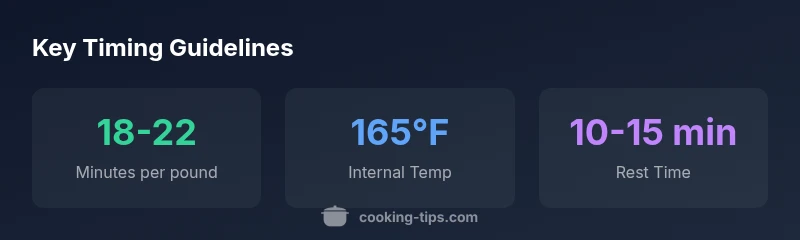
How long to cook a whole chicken depends on weight and heat. A practical rule is about 18-22 minutes per pound at 350°F, with a 10-15 minute rest after removing from the oven. Always verify doneness with a thermometer at 165°F (74°C). For a 4-pound bird, expect roughly 1 hour 15 minutes to 1 hour 40 minutes, depending on oven and setup.
How long to cook a whole chicken: timing basics
The central question for home cooks is simple: how long to cook a whole chicken while keeping the meat juicy and safe to eat. According to Cooking Tips, a sensible starting point is to plan around 18-22 minutes per pound when roasting at 350°F (177°C). This rule helps you estimate, but the final doneness is best confirmed with a meat thermometer. After removing from the oven, let the chicken rest for 10-15 minutes; carryover heat continues cooking the meat a bit, increasing tenderness. For a typical 4-pound bird, you’re looking at roughly 1 hour 15 minutes to 1 hour 40 minutes, but expect small variations based on your oven, pan, and whether the bird is stuffed or unstuffed. The key is safety and moisture, not chasing a strict clock.
Variables that affect cooking time
Several factors can shift the timing when you cook a whole chicken. Oven calibration and accuracy matter more than the label on the dial. A convection oven may reduce time by a few minutes per pound, while starting with a cold chicken will lengthen the total time. Stuffing adds significant mass and moisture considerations, often increasing overall time. Bone-in portions near the inside can take longer to heat through evenly compared to boneless sections. Altitude, pan material, and even the chicken’s initial temperature (frozen vs thawed) also influence the final timing.
Estimating time by weight: practical rules
Weight-based estimation is the most practical approach for home cooks. Start with the per-pound target, then adjust for stuffing and oven idiosyncrasies. If you’re uncertain about the exact weight, a quick kitchen scale gives a reliable starting point. As you gain experience, you’ll make faster adjustments by noting how your oven responds to different pans, racks, and preheating times. Remember to account for a final rest period to maximize juiciness.
Temperature, doneness, and resting
The safe internal temperature is the ultimate benchmark. Aim for 165°F (74°C) in the thickest part of the thigh and the breast. Do not rely on color alone; juices running clear can be misleading if the meat is underseasoned or unevenly cooked. Resting the bird for 10-15 minutes after removal allows juices to redistribute, improving moisture and flavor. Carryover cooking can push internal temps up by a few degrees, so you can pull the chicken slightly before 165°F if you’re confident in the resting period.
Step-by-step roast: a reliable method
- Preheat oven to 350°F (177°C) and position a rack in the center. 2) Pat the chicken dry with paper towels and season generously inside and out. 3) Truss the legs loosely and tuck the wings to promote even cooking. 4) Place the chicken on a rack over a roasting pan for even heat circulation. 5) Roast until the internal temperature reaches 165°F in the thigh. 6) Remove, tent with foil, and rest 10-15 minutes before carving for best juiciness.
Troubleshooting and quick adjustments
If the skin is browning too quickly, loosely tent the bird with foil and lower the oven temperature by 25°F for the remaining time. If you’re not reaching 165°F in the thighs, extend the roast by 5-10 minutes, then check again. For drier results, baste less or use a butter/herb rub with higher fat content. If you’re pressed for time, consider spatchcocking the chicken, which can shorten overall cooking time while promoting even doneness.
Timing guidance by weight and prep style
| Situation | Recommended Time | Notes |
|---|---|---|
| Unstuffed 3-4 lb chicken | 60-80 | Roast at 350°F; check internal 165°F; rest 10-15 |
| 5-7 lb chicken | 90-120 | Allow extra 15-20 minutes per pound if stuffed or oven variance |
Quick Answers
What is the recommended internal temperature for cooked chicken?
The safe internal temperature for cooked chicken is 165°F (74°C). Use a meat thermometer to verify; check both the thigh and breast for even doneness.
Cook chicken to 165°F and check with a thermometer for safety.
Does stuffing the chicken change cook time?
Yes. Stuffed chickens typically require more time than unstuffed ones because the center heats more slowly. Plan for an additional 15-30 minutes and verify with a thermometer.
Stuffing adds time; use a thermometer to confirm doneness.
Is it better to roast at 350°F or 425°F?
Roasting at 350°F provides even doneness and juicier meat for most birds. Higher temps can brown skin faster but risk uneven cooking if not monitored closely.
350°F is a safer default; adjust for skin color if needed.
Should I rinse the chicken before roasting?
No. Rinsing can spread bacteria and water down seasonings. Pat the bird dry and season generously for better crust.
Don’t rinse; pat dry and season well.
How can I tell when the chicken is done without a thermometer?
Juices should run clear and the legs should move freely. However, a thermometer is the most reliable method for safety.
Look for clear juices and loose joints, but use a thermometer if possible.
Can I cook whole chicken in an air fryer or microwave?
An air fryer works for smaller birds or portions, yielding crispy skin. A microwave is generally not recommended for even cooking of a whole chicken.
Air fryer works for small birds; microwave isn’t ideal for whole chickens.
“Timing a whole chicken hinges on safe temperature rather than fixed minutes; using a thermometer yields the most reliable results.”
Top Takeaways
- Calculate time by weight, then verify with a thermometer to 165°F.
- Rest the chicken 10-15 minutes before carving.
- Unstuffed chickens roast faster; stuffing adds time.
- Every oven varies; use thermometer and adjust.
- Plan 1.5 to 2 hours for larger birds.