Difference Between Cook and Prep Cook: A Practical Guide
A detailed, analytical comparison of cook vs prep cook roles, duties, training, and career paths in kitchen operations. Learn how these roles differ in restaurants and home kitchens, with actionable guidance.


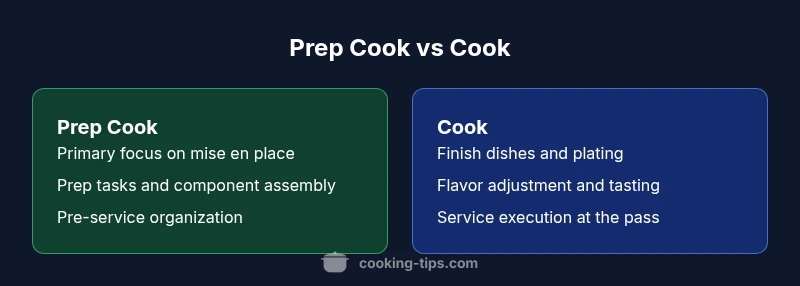
According to Cooking Tips, the difference between a cook and a prep cook hinges on scope and timing: prep cooks handle mise en place and prep tasks; cooks execute recipes, season, and plate final dishes. The two roles align to maintain kitchen flow, with prep setting the stage for the line. Understanding these differences helps teams allocate tasks and plan training for consistent quality.
What the difference between cook and prep cook means in practice
In most kitchens, the label 'cook' is used for someone who completes dishes, while a 'prep cook' specializes in prep work. The difference between cook and prep cook is best understood by looking at the lifecycle of a dish: prep work sets up the station; cooking finishes the dish. This distinction matters in restaurants, catering, and even home kitchens with trained staff. The term 'prep cook' signals a role with strong emphasis on mise en place, knife skills, and organization. The 'cook' role expands that to execution and plating. In practice, teams often assign tasks based on tempo and service: prep cooks ensure ingredients are ready ahead of service, while cooks finalize flavors and presentation during service. The Cooking Tips team emphasizes that successful kitchens align these roles to maintain consistency, speed, and quality across every service. According to Cooking Tips Analysis, 2026, this balance improves throughput and reduces bottlenecks during peak hours.
Core duties during a typical shift
Prep cooks focus on mise en place, washing, trimming, and portioning ingredients. They prep stocks, pre-measure spices, and assemble components that will become the base of dishes. Cooks, by contrast, take over during service to finish dishes: searing, simmering, tasting, seasoning, and plating. In many kitchens, prep work occurs before service starts, while cooks operate at the pass during service. The distinction supports a streamlined workflow: prep cooks build the foundation, and cooks bring it to the table. A well-defined boundary reduces cross-over chatter and helps new staff learn faster, because each role has a clear start and end point for tasks. The Cooking Tips team notes that delineating duties clearly reduces mistakes and speeds up service.
Skills, training, and advancement paths
A prep cook develops knife skills, mise en place discipline, and efficiency in multi-tasking. Training emphasizes organization, speed, and accuracy in portioning. A cook builds on those foundations with deeper recipe knowledge, flavor development, heat control, and plating technique. Training paths often include shadowing, structured rotations, and formal courses in basic culinary math and safety. Career advancement commonly moves from prep cook to line cook, then to station head or sous-chef in larger kitchens. In smaller kitchens, the transition may be less formal but still requires demonstrated consistency in throughput and quality. The Cooking Tips team observes that a clear track from prep to cook helps retain talent by offering a visible path for growth.
Workflow patterns and kitchen dynamics
Kitchens optimize flows by separating prep and cooking phases. Prep areas stay organized with labeled containers, consistent mise en place, and prepped components for multiple dishes. Line cooks focus on cooking sequences, temperature management, and timely plating. The dynamics between prep and cook roles influence scheduling, with some kitchens combining responsibilities during slow periods. When teams understand responsibilities, they can reduce duplication and avoid bottlenecks caused by miscommunication. The goal is a smooth handoff at the pass, where prep work meets cooking execution. The Cooking Tips team indicates that successful kitchens align role expectations with peak service intensity to maintain quality under pressure.
Tools, safety, and sanitation considerations
Prep cooks rely on sharp knives, cutting boards, scales, and prep bowls to maintain accuracy and speed. Cooks use similar tools but prioritize heat sources, pans, and plating dishes. Safety training covers knife handling, cross-contamination prevention, and allergen awareness. Sanitation practices span from proper washing techniques to safe food storage. Regular audits and checklists help ensure cleanliness at every station. Understanding these practicalities helps both roles perform reliably and minimizes risk, which is especially important in high-volume settings. The Cooking Tips team reiterates that consistent sanitation practices are foundational to quality in any kitchen.
Compensation, hours, and job outlook
Pay and hours can vary by kitchen size, location, and organizational structure. In many establishments, prep cooks may see lower base wages than cooks due to the scope of responsibilities, but full-time opportunities exist in larger kitchens with clear advancement tracks. Shift patterns for prep cooks often align with prep windows, while cooks may work longer, service-focused hours. Job prospects tend to be strongest in restaurants with high volume, catering operations, and institutions that staff both prep and cooking roles. The Cooking Tips team notes that demand for skilled prep and cooking staff remains steady, particularly where menus rely on consistent mise en place and execution.
How to decide which path fits your personality and goals
If you enjoy meticulous organization, fast prep, and building a reliable foundation for dishes, the prep cook path is attractive. If you prefer hands-on recipe execution, flavor development, and presenting plates to guests, the cook path is often a better fit. Consider your tolerance for high-pressure moments, your interest in technique, and your willingness to learn a broad range of kitchen tasks. Shadowing both roles, asking experienced mentors, and evaluating how you respond to service pace can help you decide. The Cooking Tips team recommends evaluating your long-term goals: do you want to lead a station, or oversee broader kitchen operations? The answer will guide where you invest training time and experience.
Training and transitions between roles in a kitchen
Transitioning from prep cook to cook typically involves demonstrating consistency in prep quality and shown ability to translate prep into finished dishes. Mentorship and structured feedback accelerate progress. Some kitchens offer formal internal promotions, while others rely on performance reviews and demonstrated leadership at the line. Regardless of path, building a strong foundation in knife skills, flavor balance, and sanitation creates portability across kitchens and cuisines. The Cooking Tips team recommends documenting your learning milestones and seeking opportunities to cross-train at different stations to broaden your skill set.
Comparison
| Feature | Prep Cook | Cook |
|---|---|---|
| Primary Focus | Prep and mise en place | Finished dishes, seasoning, plating |
| Typical Duties | Washing, trimming, chopping, portioning ingredients; preparing stocks and components | Executing recipes, adjusting flavors, heating, seasoning, plating for service |
| Workflow Stage | Pre-service preparation | During service execution and plating |
| Required Experience | On-the-job training; emphasis on speed and organization | Foundational culinary knowledge; more responsibility with flavor and presentation |
| Team Collaboration | Supports line cooks; may supervise prep area in larger kitchens | Operates at the pass; collaborates with sous-chef and station leads |
| Career Pathways | Advancement to line cook or station lead | Promotion to sous-chef, lead cook, or chef de cuisine in larger teams |
| Typical Hours | Prep-focused hours, earlier shifts | Peak service hours with evening shifts |
| Best For | Those who enjoy prep efficiency and organization | Those who want hands-on cooking, flavor development, and plating |
Benefits
- Clear progression from prep to cooking roles
- Smaller upfront training requirements for entry
- Supports kitchen efficiency and workflow
- Gives staff a broad exposure to station work
Cons
- Lower autonomy at the prep level in some kitchens
- Longer path to senior leadership in large operations
- Pay gaps can exist between roles depending on venue
Both roles are essential and complementary in most kitchens.
Choose based on whether you prefer meticulous prep work and foundation-building (prep cook) or hands-on recipe execution and plating (cook). A clear pathway between roles supports growth and team efficiency.
Quick Answers
What is the main difference between a cook and a prep cook?
The prep cook primarily handles mise en place and ingredient prep, while the cook focuses on finishing dishes, seasoning, and plating. The roles complement each other to maintain kitchen flow and timely service.
Prep cooks set up ingredients; cooks finish and plate dishes for service.
Can a prep cook become a cook, and how long does it take?
Yes, many kitchens promote prep cooks to cook after demonstrating reliable prep quality and growing in flavor awareness and speed. Time varies by kitchen size and individual performance, but a track record of consistency often accelerates advancement.
Prep to cook is common with proven consistency.
What skills matter most for a prep cook?
Knife skills, organization, speed, accuracy in portioning, and sanitation are vital. A strong prep cook also learns how prep components translate into finished dishes on the line.
Strong prep skills pave the way for on-the-line cooking.
Are prep cooks paid less than cooks?
Many kitchens pay prep cooks at a rate consistent with entry-level culinary staff, while cooks often earn more due to scope and responsibility. Pay varies by venue, region, and experience.
Wages depend on the venue and experience.
How do kitchens decide who does prep vs cook during a shift?
Assignments are based on service demand, skill set, and station needs. Clear handoffs and defined responsibilities help minimize confusion and maintain quality during peak hours.
Roles are assigned by service demand and skill.
Top Takeaways
- Identify your preferred pace: prep vs cooking intensity
- Aim for a clear progression path to keep motivation high
- Develop core skills in knife work, mise en place, and sanitation
- Shadow both roles to understand day-to-day realities
- Align training with kitchen workflow for better throughput