Difference Between Cook and Cooking: A Practical, Analytical Guide
Explore the difference between cook and cooking with a detailed, analytic comparison. Learn usage, grammar, examples, common mistakes, and practical tips for editors, teachers, and home cooks.


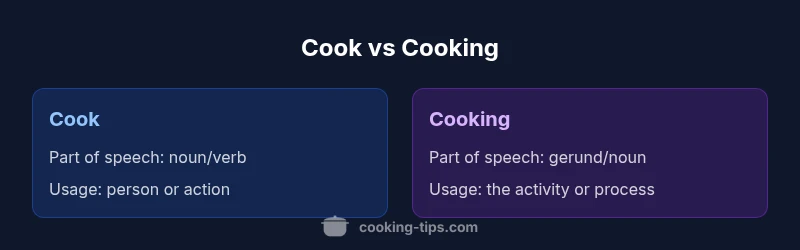
Cook is a noun or verb referring to a person who prepares food or to the act of preparing food; cooking is the gerund or noun form naming the activity itself. The key difference is function: cook denotes who or what is doing something, while cooking labels the process. This distinction helps avoid common grammar mistakes in recipes, menus, and instructional text.
What we mean by cook and cooking in everyday language
At a glance, the difference between cook and cooking is linguistic rather than semantic mystery. In everyday English, cook can function as a verb (to prepare food) or as a noun referring to a person who prepares meals. Cooking, by contrast, is the gerund or noun form that names the act of preparing food. This distinction matters in writing because it shifts who is performing an action and what is being described. According to Cooking Tips, mastering this simple distinction reduces ambiguity in menus, recipes, and instructional notes. The Cooking Tips team found that many learners and even experienced editors slip when moving from a simple sentence like 'The cook makes soup' to 'Cooking is easy' or 'I am cooking soup' in the same context. By focusing on function rather than form, you can decide which word best fits your sentence’s subject and tense. The rule is practical: if you’re naming a person or a concrete action, use cook; if you’re naming the activity itself, use cooking.
170
Comparison
| Feature | cook | cooking |
|---|---|---|
| Part of speech | Noun/verb (person or action) | Gerund/noun (the activity) |
| Main usage | Refs to a person who prepares food or the action of preparing food | Names the activity of preparing food as a process |
| Common sentence roles | Subject or object in sentences like 'The cook prepared dinner' or 'I cook daily' | Used as a subject or complement: 'Cooking is simple' |
| Frequency in writing | More common in speech and menu notes | More common in recipe instructions and educational materials |
| Common mistakes | Interchanging the words in present continuous without care | Confusing 'cooked' with 'cooking' when tense shifts |
| Tips for clarity | Choose 'cook' for people or direct actions; use 'cooking' when describing the activity | Pair with adjectives or nouns to specify context |
Benefits
- Clarifies whether you mean the person or the action
- Reduces ambiguity in recipes, menus, and educational text
- Supports precise communication in writing and editing
- Easy to apply with a simple rule of thumb
Cons
- Can be confusing for learners when contexts blur between noun and verb
- Overemphasis on form can slow natural writing in casual contexts
- Requires attention to tense and voice in longer sentences
Cook vs cooking: use the noun/verb form for people or actions; use 'cooking' for the activity and process.
In practice, treat 'cook' as flexible for the person or the act of preparing food, while 'cooking' names the ongoing process. This distinction improves clarity in recipes, menus, and instructional text, especially for learners and editors.
Quick Answers
What is the difference between cook and cooking?
Cook can be a noun or a verb referring to the person who prepares food or the act of preparing food. Cooking is the gerund or noun form naming the activity itself. The distinction hinges on whether you are talking about the person/action or the process.
Cook is a person or action; cooking is the activity. Use the noun/verb form for the subject and the gerund for the process.
Can 'cook' be used as a noun in everyday speech?
Yes. You can say 'The cook prepared the meal' to refer to a person, or you can say 'He is a cook' to identify someone who cooks as a profession or habit.
Yes, 'cook' works as a noun, like in 'The cook is tall.'
Is 'cooking' always the subject of a sentence?
Not always. 'Cooking' can function as the subject or as part of a compound verb phrase ('Cooking makes me tired'). It can also serve as a topic in sentences about activities.
'Cooking' can be the subject or part of a verb phrase, depending on the sentence.
When should I use 'cooking' in menus or recipes?
Use 'cooking' when you need to describe the activity or process (e.g., 'Cooking time: 20 minutes'). If you’re naming the person, use 'cook' (e.g., 'The cook will prepare the dish').
Use 'cooking' when talking about the process; use 'cook' for the person or action.
Are there regional differences in usage?
Some regions prefer simpler forms in casual writing, but the core grammar remains the same: 'cook' denotes the person or action; 'cooking' denotes the activity. In formal writing, follow standard grammar consistently.
Regional differences may affect phrasing, but the rule stays consistent.
Top Takeaways
- Use 'cook' for people or direct actions
- Use 'cooking' to name the activity or process
- Avoid swapping the terms in tense-sensitive contexts
- Check sentence role (subject vs activity) to decide usage
- Apply the rule consistently in recipes and menus
- Consider regional or stylistic preferences in long-form writing