Difference Between Cook and Cooks: A Practical Guide
Explore the difference between cook and cooks, including grammatical roles, usage in recipes and menus, and common mistakes. A practical, analytical look from Cooking Tips for home cooks and editors.


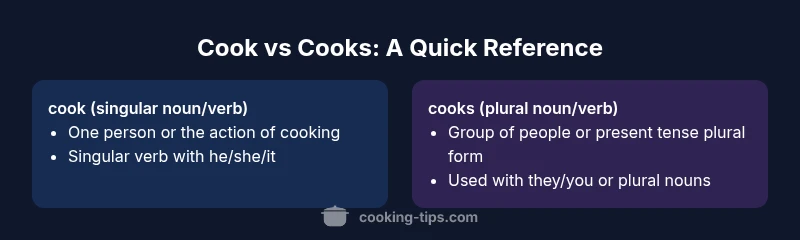
The difference between cook and cooks centers on count and grammatical function. "Cook" can be a singular noun for one person who prepares food or a verb meaning to prepare meals. "Cooks" serves as the plural noun for a group of cooks or as the present tense third-person singular form of the verb (he/she/it cooks). Understanding these roles helps avoid ambiguity in sentences, menus, and job titles.
Core meanings: How 'cook' functions as noun and verb
Understanding the difference between cook and cooks begins with recognizing the dual roles of the word. In everyday use, "cook" functions as both a noun and a verb. As a noun, it refers to a single person who prepares food: "The cook prepared dinner." As a verb, it means to prepare food: "I will cook tonight." The plural form "cooks" can act as a plural noun when referring to a team of professionals (the cooks in the restaurant) or as the present tense third-person singular form of the verb (he cooks, she cooks).
In practical writing, the distinction matters for clarity. When you write menus, recipes, or bios, choosing the form that communicates exact quantity and role reduces ambiguity. For instance, a sentence like "The cook is arriving at 6 PM" communicates a solitary role, whereas "The cooks are arriving" signals a group. The Cooking Tips team notes that precise usage supports reader comprehension, especially in instructional contexts where participants must follow steps accurately. The term also links to the broader discussion of how singular and plural markers influence tone and formality in cooking literature.
Examples:
- The cook used fresh herbs. (singular noun)
- The cooks prepared the kitchen for service. (plural noun)
- She will cook after work. (verb)
- He cooks every weekend. (present tense verb)
This section lays the groundwork for more nuanced exploration of etymology, regional variation, and editorial guidelines. The key is to map form to function in a consistent, reader-friendly way.
Etymology and historical usage
The word cook derives from Old English cocian, with cognates across Germanic languages that denote the act of preparing food. Over centuries, as kitchens evolved from household tasks to professional ventures, the noun form gained prominence to designate a person whose primary role is cooking. In many English-speaking regions, the simple verb "to cook" retained its broad sense—preparing food—while the noun acquired a workplace identity: the cook, a person who cooks.
Historically, the plural form emerged to describe a team when discussing staff in kitchens or households with multiple cooks. This evolution mirrors the development of culinary professions, where job titles and responsibilities became more specialized. In contemporary usage, the word retains its flexibility, appearing in casual speech and formal writing alike. The distinction between singular and plural forms remains one of the core markers for clarity, particularly in instructional materials, menus, and job listings where precision matters to readers and editors alike. The Cooking Tips analysis emphasizes that historical context helps explain why native speakers sometimes mix forms in informal speech, underscoring the importance of editorial consistency.
While etymology helps illuminate origin, practical readers benefit most from applying current conventions in their own writing. If you’re describing one person’s action, use the singular form; if you’re discussing multiple people or a general habit, use the plural or the verb form as appropriate.
Grammatical roles: noun vs verb, countability, and agreement
Grammatical role is the primary axis along which cook and cooks diverge. When used as a noun, "cook" marks number: singular (the cook) vs. plural (the cooks). As a verb, "cook" conjugates for tense and subject: I cook, you cook, he/she/it cooks, we cook, they cook. The agreement rule is straightforward: third-person singular subjects require the -s form (cooks).
Understanding countability is essential for precise prose. If you write a sentence about one person who prepares meals, you should say, "A cook prepared the meal" or "The cook prepared the meal." If you’re describing a group working in a kitchen, you would use, "The cooks prepared the meals". Ambiguity arises when readers encounter phrases like "the cook cooked the meal" without context about quantity or subject. Editors should provide sufficient context to disambiguate whether the sentence refers to a single person or multiple cooks. In teaching materials, use parallel structures to reinforce consistency: singular noun with singular verb, plural noun with plural verb.
Another subtle point is possessives. The forms "cook’s utensils" and "cooks’ utensils" show ownership differently and have distinct punctuation rules. Consistency in possessive forms helps maintain professional tone in recipe books and kitchen manuals. The practical takeaway is to align form with intended meaning and audience expectations, particularly in instructional writing and menu descriptions.
Practical usage in recipes, menus, and job titles
In practical cooking literature, the choice between cook and cooks shapes how readers interpret instructions and roles. In recipe steps, using the verb form keeps instructions concise: "Season the meat before you cook it." When referring to a person, you’ll say "the cook" to single out one cook in a kitchen narrative, or "the cooks" when the text describes a team on a shift ward across days. Menus often employ the noun form of cook (singular or plural) to indicate personnel or staff roles: "Chef and cooks on duty tonight" signaling multiple cooks without specifying names.
Job titles make explicit the professional identity attached to the term. A restaurant might have a line like "Head Cook" or departmental lists like "Cooks" as a crew designation. In educational settings, instructors differentiate between a single learner-cook and a group of student cooks. Consistent usage helps readers recognize responsibilities and the scale of operations. When drafting professional documents, keep the same form for related phrases: singular with singular verb agreement, plural with plural; avoid mixing forms mid-sentence to prevent confusion about number and role.
Common mistakes and style guide tips
A frequent pitfall is mixing singular and plural forms in the same sentence or paragraph. For example, saying "The cook prepares the meals and cooks the sauces" can be confusing if the subject changes. Prefer parallelism: either both uses are singular or both are plural where the subject matches. Another common error is treating "cook" as an adjective or compound noun in places where a distinct term may be clearer, such as "cook book" vs. "cookbook". The widely accepted form in modern English is cookbook as one word, which helps avoid ambiguity with the noun-verb duality.
Style guides advise readers to consider audience and register. In formal writing, favor precise nouns (the cook) and standard verb forms (cooks). In casual writing, people sometimes slip into shorthand or informal phrases like "the cooks did it" without confirming whether the reference is plural or a third-person singular verb. When drafting educational materials, provide explicit examples that demonstrate the difference between singular and plural usage so readers can internalize correct patterns. Finally, remember that possessives are often misused: the cook’s recipe points to a singular owner, while the cooks’ recipes point to a group owner. Clear punctuation, especially with apostrophes, prevents misinterpretation.
Regional variations and informal usage
Regional nuances shape how speakers talk about cooks and cooking. In some dialects, speakers use the plural form "cooks" more fluidly to refer to a general group without specifying the exact number. In others, the singular form is preferred in everyday speech, even when a group is performing the action collectively. Editors should be mindful of audience expectations; what reads clearly in one region may feel awkward or overly formal in another. When describing a kitchen in North America, it’s common to say "the cooks are ready" to convey a team of culinarians, whereas in some British contexts you might hear "the cook is ready" when telling a story about a lone professional.
Informal usage often highlights imperfect grammar. People may say "the cooks done it" in casual conversations, which is acceptable in spoken language but should be corrected in written forms. The goal is to balance natural speech with clear, rule-based usage in education materials and professional communications. For content creators, aligning examples with the target region helps ensure readers grasp the intended meaning quickly. The takeaway is to respect regional expectations while teaching the core distinction between singular and plural forms and their grammatical functions.
Plural forms and compound phrases
Beyond the basic singular/plural dichotomy, writers encounter compound phrases that reference cooking in different ways. The term cookbook is one of the most familiar; it’s a single, cohesive noun that references a collection of recipes rather than a person. This shows how English can fuse related concepts into new forms. Other phrases like cook book (less common today) illustrate historical spelling variants that modern editors typically avoid for consistency.
When discussing multiple people who cook, you’ll often see phrases like the cooks in the kitchen or the cooks on staff. These examples illustrate how the plural noun integrates with other nouns to describe a team, an occupation, or a functional group. In contrast, possessive forms such as the cook’s apron or the cooks’ uniforms indicate ownership by one cook or by the team, respectively. Understanding these distinctions helps writers craft precise descriptions in menus, training manuals, and staff rosters. Finally, remember that capitalization matters in titles or headings; it’s generally appropriate to capitalize the main noun in a header (Cook vs Cooks) when it starts a title, but not in body text.
The role in professional kitchens vs home cooking
In professional kitchens, the plural form "cooks" frequently appears as a designation for staff, e.g., "the cooks are on line" or in job listings that identify responsibilities for a shift. This usage reinforces the idea of teamwork and standard operating procedures. In home cooking, singular forms are typical because the cooking activity centers on one person or a single host preparing meals. Yet, in narratives or how-to guides, you may encounter sentences like, "The cook and the sous-chef coordinate with the cooks on sauté duty" to emphasize collaborative cooking workflows. Editors should be mindful of audience and purpose: when instructing a home cook, prefer singular references to reduce cognitive load; when describing a kitchen brigade, adopt plural references to reflect the team dynamic.
The distinction also influences tone. Educational materials that discuss culinary technique often use plain language and consistent form to help readers learn quickly. In professional documentation, precise terminology supports credentialing and role clarity. The Cooking Tips team emphasizes that consistent usage across recipes, menus, and training materials improves readability and reduces misinterpretation in foodservice contexts.
Examples in sentences: correct vs incorrect usage
Clear sentence construction helps readers parse who is performing which action. Correct usage example: "The cook seasons the dish; the cooks prepare the sauces." This demonstrates proper agreement and number. An incorrect example would be mixing tense or number, such as "The cook prepare the sauces" where the subject is singular but the verb is not properly conjugated. Another common error is confusing possessives with plurals, for instance writing "cooks’ recipe" when you mean the possessive of the group. Remember that apostrophes change ownership: cook’s recipe (singular owner) vs cooks’ recipes (plural owners).
To reinforce learning, editors can provide side-by-side comparisons:
- Singular: The cook writes the recipe.
- Plural: The cooks write the recipes.
- Verb: He cooks the vegetables.
- Imperative: Cook the vegetables until tender.
These examples illustrate how small changes in form alter meaning, which matters when conveying steps, nutrition information, and kitchen workflows in both recipes and instructional texts.
Comparison
| Feature | cook (singular noun/verb) | cooks (plural noun/verb) |
|---|---|---|
| Primary meaning | Singular noun for one person or the present tense verb for the subject he/she/it; can also be general in recipes | Plural noun for a group of people who cook or present tense for they/you (plural) or a plural verb form when used with a plural subject |
| Common contexts | Individual bios, recipe steps, and titles (e.g., The Cook) | Kitchen staff references, menu notes, and generic descriptions (e.g., The cooks) |
| Plural forms | one cook | the cooks (multiple) |
| Possessives | cook’s (singular owner) | cooks’ (plural owner) |
| Examples | The cook prepared the meal. | The cooks prepared the meals together. |
Benefits
- Clarifies number and role in writing and editing
- Improves clarity in recipes, menus, and instruction
- Supports consistent style across professional kitchens
Cons
- Can seem pedantic in casual writing
- Misperception when readers infer number from context
- Requires consistent application to avoid confusion in long texts
Singular and plural forms serve different communicative needs; use them consistently to reduce confusion.
When you write about one cook, use the singular form; when discussing multiple cooks or a habitual action by others, use the plural or the appropriate verb form. This clarity helps readers follow instructions and understand roles, especially in recipes and kitchen guides.
Quick Answers
What is the difference between cook and cooks?
The difference hinges on number and grammatical role. "Cook" is singular (one person who cooks) or a base verb. "Cooks" is the plural noun for a group or the third-person singular verb form. Context determines which meaning applies.
Cook is singular or a verb; cooks is a group or a verb form. Remember to match number and tense in each sentence.
Is it correct to say "the cook cooks"?
Yes. This combines the singular noun with the present tense verb form. It’s correct when you want to emphasize a single cook performing the act of cooking.
Yes, that sentence is grammatically correct.
Can 'cook' be used as an adjective?
No. Cook functions as a noun or a verb. When you need an adjective, use related forms like 'cooking' (as in cooking oil) or a noun phrase like 'cook’s knife' or 'cook-friendly recipe' if context allows.
Cook isn’t an adjective; use related forms instead.
How do you refer to multiple cooks in a sentence?
Use the plural noun form: "The cooks prepared the meal." For actions by multiple cooks in a sentence, you can also use plural subject verbs: "The cooks cook the meals daily."
Use 'cooks' for groups or 'they cook' for ongoing actions.
What about possessives with cook/cooks?
The possessive forms are cook’s (singular) and cooks’ (plural). They indicate ownership, e.g., "the cook’s recipe" vs "the cooks’ recipes." Proper punctuation is essential to avoid ambiguity.
Cook’s vs cooks’ show ownership; use apostrophes correctly.
Are there regional differences in usage?
Yes. Some regions prefer singular forms in everyday speech, while others routinely use the plural to refer to kitchen staff collectively. In formal writing, follow a consistent rule matched to your audience.
Regional habits influence agreement, but consistency wins in writing.
Top Takeaways
- Use singular form for one person or one action
- Use plural form for groups or third-person plural subjects
- Maintain parallel structure for subject-verb agreement
- Be mindful of possessives: cook’s vs cooks’
- Cookbook vs cook book reflects modern usage