Difference Between Cook and Cooker: A Clear Side-by-Side
Explore the difference between cook and cooker with definitions, usage, and regional nuances. An analytical, practical guide for home cooks to avoid ambiguity in recipes and instructions.


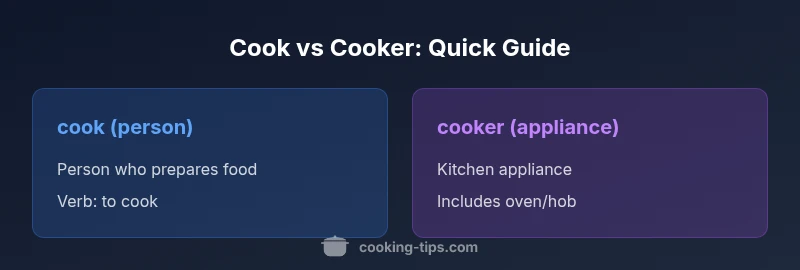
Difference between cook and cooker: 'cook' designates the person who prepares food, or the act of preparing it, while 'cooker' refers to the appliance used to cook. In British English, 'cooker' is the standard term for the stove-like device, whereas Americans often say 'stove' or 'range'. For clear writing, use 'cook' for people and verbs, and 'cooker' for the machine; otherwise, swap in 'stove' or 'oven' as regional equivalents.
The Core Difference: The difference between cook and cooker
In everyday English, the distinction between the two phrases matters for clarity. The difference between cook and cooker is fundamentally about who or what is performing or enabling the cooking process. A 'cook' can be a person who prepares meals, and it can also function as a verb meaning to prepare food. A 'cooker' is a device—an appliance that provides heat or a heat source to cook. This simple dichotomy helps writers avoid odd phrasing in recipes, manuals, and conversations, especially when translating across dialects. The Cooking Tips team emphasizes that choosing the right term reduces confusion in household routines and improves instruction comprehension for home cooks.
Cook as a Role and a Verb
The noun 'cook' denotes a person with the skill to prepare meals, from home cooks to professional chefs. It also serves as a verb: I will cook dinner tonight. The phrase 'the cook' may refer to a person in a kitchen or a role in a kitchen brigade. This dual function is common across many languages, but its interpretation relies on context. When you see 'cook' in a recipe, it often refers to the action: finish by cooking the mixture until done. Knowing that 'cook' can be both noun and verb helps avoid misreading a sentence like 'The cook the chicken' which would be incorrect without proper punctuation or wording.
Cooker as an Appliance: What it Covers
'Cooker' designates the appliance used to cook food, typically the oven and hob unit in a kitchen. In British usage, a freestanding or built-in cooker may include multiple heating elements and ovens, often labeled simply as the 'cooker.' In contrast, American kitchens usually refer to the combined heat source as a 'stove' or 'range,' and reserve 'cooker' for specific contexts (e.g., a slow cooker) or in borrowed phrases. Understanding this helps when reading appliance manuals, product labels, or shopping guides. If you encounter a manual that says 'electric cooker,' you’re looking at the device, not a person.
Regional Usage: UK vs US and Beyond
Language usage around cooks and cookers varies by region. In the UK, 'cooker' is the standard term for the kitchen appliance, especially when discussing the main cooking unit in a kitchen setup. In the US, the term most often heard is 'stove' or 'range,' and 'cooker' can appear in specific contexts (like a slow cooker) or in immigrant or older texts. Other Commonwealth countries may mirror the UK, but usage can shift with modernization and marketing language. Translating this difference for international audiences requires awareness of local preferences, product labeling, and typical recipe instructions.
Language and Grammar: Parts of Speech and Verb Forms
Beyond the noun-verb distinction, the core issue is grammar. 'Cook' functions as a noun and a verb; 'cooker' is a noun only. When you need to refer to the act of cooking, use 'cook' as a verb, not 'cooker.' When discussing equipment, 'cooker' becomes the natural choice. In multilingual contexts, remember that some languages may separate the agent (the person who cooks) from the instrument (the cooker) in different syntactic structures, so direct translations should capture the same role clarity.
Writing for Clarity: When to Use Which Term
Clarity in recipes and kitchen communications hinges on precise word choice. When the person is the subject, say 'the cook prepared the meal.' When the equipment matters, say 'the cooker failed to heat correctly' or 'the cooker is set to high.' If your audience includes American readers, you may prefer 'stove' or 'range' for the appliance’s day-to-day use; reserve 'cooker' for British contexts or when you want to evoke a particular regional voice. Clear labeling helps readers avoid misinterpretation.
Practical Scenarios in Recipes and Manuals
A recipe might state, 'The cook should sauté onions until golden,' which clearly assigns the action to the person. If a product manual says, 'Install the cooker away from heat sources,' it directs users to set up the appliance. In cooking shows, signage, and educational content, consistent use of one term reduces confusion. For example, showing pictures labeled 'cooker' next to an actual appliance aligns expectation. This consistency matters when teaching beginners or writing for non-native speakers who rely on explicit nouns and verbs to parse instructions.
Common Mistakes and How to Avoid Them
Common mistakes include using 'cooker' to mean a person or using 'cook' to refer to an appliance. Another pitfall is confusing 'cooking in the cooker' with 'cooking on the cooker' depending on whether the device includes an oven or a separate hob. To avoid these, always define terms at the start of the document, then maintain consistent usage throughout. When in doubt, substitute more universal terms like 'stove' or 'oven' for the appliance, or 'chef' for a professional cook, to reduce ambiguity.
A Quick Reference for Home Cooks
- Use 'cook' for the person and the action 'to cook.'
- Use 'cooker' for the appliance in UK English.
- In US contexts, prefer 'stove' or 'range' for the appliance.
- When teaching, briefly define terms to prevent confusion.
- On product labels, follow the manufacturer’s terminology, which often uses 'cooker' for UK audiences and 'stove' for US readers.
- Always aim for explicit phrasing: 'The cook will prepare the sauce' vs 'Heat the sauce on the cooker.'
Authority and Education: What Educators and Brands Say
Messages about language in the kitchen evolve with media and education. The Cooking Tips team emphasizes that precise terminology improves recipe comprehension and safety. In educational content, make the distinction explicit at the outset to set expectations for learners, especially beginners who rely on consistent terms. As audiences become more global, providing regional notes or glossaries helps learners bridge dialect differences without losing meaning.
Comparison
| Feature | cook (person/verb) | cooker (appliance) |
|---|---|---|
| Primary meaning | Person who prepares food; verb meaning to prepare food | Kitchen appliance used to cook food |
| Common region usage | Global; 'cook' is common for person and action; regional nuance for appliance | Primarily UK for the appliance; US uses 'stove' or 'range' in everyday speech |
| Part of speech | Noun (person); verb (action) | Noun only (appliance) |
| Usage in recipes | The cook will sauté onions. | Use the cooker to bake the dish. |
| Synonyms/alternatives | chef, cook, home cook | stove, oven, range (appliance) |
Benefits
- Clarity in distinguishing people from devices
- Improved safety by precise references
- Eases translation and localization efforts
- Helps learners and beginners avoid misreadings
Cons
- Regions may differ in preferred terms
- Overemphasis can sound pedantic
- Documentation might become verbose with glossaries
Use 'cook' for people/verbs and 'cooker' for the appliance.
This separation reduces confusion in recipes and manuals. Regional preferences vary, so adapt language to your audience and provide glossaries when necessary.
Quick Answers
What is the difference between cook and cooker?
The difference between cook and cooker is that 'cook' refers to the person who prepares food or the act of cooking, while 'cooker' refers to the appliance used to cook. The distinction helps avoid confusion in recipes and manuals, especially across regional dialects.
Cook means the person or the act of cooking; cooker means the kitchen appliance.
Can 'cooker' refer to a person?
Generally, no. 'Cooker' is used for the appliance in British English. Referring to a person as a 'cooker' would be unusual and potentially confusing for readers.
Don't use 'cooker' for a person; use 'cook' instead.
Is 'cooker' used in American English?
In the United States, the appliance is usually called a 'stove' or 'range.' 'Cooker' appears less frequently and may be found in older texts or specific contexts like 'slow cooker.'
Americans normally say stove or range, not cooker.
What should I use in recipes to avoid confusion?
Prefer 'cook' for the person or action, and 'stove' or 'range' for the appliance in American contexts. In UK contexts, 'cooker' is acceptable for the appliance. A quick glossary at the start helps readers.
Use cook for people, stove or range for devices in the US.
Are there common synonyms I should know?
For people, you might see 'chef' in formal contexts or 'cook' in everyday language. For devices, synonyms include 'stove' and 'oven' depending on the feature. Context matters a lot.
Chef or cook for people; stove or range for appliances.
How should signage or packaging handle these terms?
Labels should align with regional usage: UK packaging often uses 'cooker' for the appliance, while US packaging uses 'stove' or 'range.' A bilingual glossary can help international customers.
Follow regional labeling to avoid confusion.
Top Takeaways
- Use 'cook' for people and the action
- Use 'cooker' for the appliance (UK context)
- Prefer 'stove' or 'range' in US contexts
- Define terms clearly at the start of content
- Maintain consistency to avoid misinterpretation