How Much Cooked Broccoli Is a Serving? A Practical Guide
Learn the standard serving size for cooked broccoli, how cooking changes portions, and practical tips for measuring and planning broccoli-centered meals for everyday cooking.


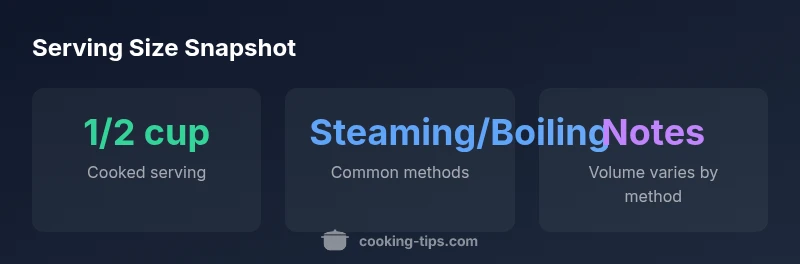
How much cooked broccoli is a serving? A typical serving of cooked broccoli is about 1/2 cup. For most meal plans, a half-cup portion provides a reasonable amount of vegetables toward daily goals without overshooting calories. Cooking method can affect volume, so use measuring cups or a kitchen scale when accuracy matters. When in doubt, start with 1/2 cup and adjust to taste and hunger.
Understanding Serving Sizes for Cooked Broccoli
According to Cooking Tips, a standard serving of cooked broccoli is about 1/2 cup. This portion fits most dietary guidelines and helps you track portions across meals. Serving sizes matter for nutrient intake and calories, especially when broccoli is paired with starches or proteins. Using 1/2 cup cooked broccoli as a baseline, you can adjust upward for larger appetites, or when broccoli is the main vegetable on the plate. Remember that cooking changes volume; measurement by cooked portion is often more reliable than counting florets or bowls. For home cooks, this approach provides a practical balance between ease and precision while keeping meals colorful and nutrient-dense.
How Cooking Affects Volume and Weight
Broccoli, like many vegetables, loses water and mass during cooking. The visible volume of florets can shrink as water evaporates and sugars caramelize. Because raw weight and cooked volume don't map one-to-one, it's best to measure after cooking if you're controlling portions. You may notice different results depending on whether you steam, boil, roast, or microwave. Roasting concentrates flavors and can feel more substantial per serving, while boiling may yield a more tender but less compact portion. Using a standard 1/2 cup cooked serving helps you compare across recipes and meals.
Aligning Serving Size with Dietary Goals
Broccoli provides fiber, vitamins C and K, folate, and other phytonutrients. A half-cup cooked serving fits well into daily vegetable targets for many adults. If your goal is to increase fiber intake, you might include a slightly larger portion—up to 1 cup cooked—depending on appetite and other foods in the dish. For those tracking macros, treat broccoli as a low-calorie, high-nutrient component that complements grains, beans, or lean proteins. Use serving guidelines as a flexible tool rather than a rigid rule.
Practical Ways to Measure Without a Scale
- Use a standard 1-cup measuring cup to scoop cooked broccoli; visually, a half-cup portion sits roughly at the halfway mark.
- For plate-planning, fill a small ramekin halfway or line up florets until you reach about 1/2 cup.
- If you do have a kitchen scale, weigh cooked broccoli at approximately 90 grams per 1/2 cup for precise tracking.
- When cooking in bulk, portion broccoli into freezer bags in 1/2-cup increments for quick meals.
Planning Meals Around Broccoli Servings
Consider broccoli as a versatile vegetable that pairs with many cuisines. For a balanced plate, aim for at least one cooked vegetable per meal, with broccoli serving as one component. A typical dinner might include a 1/2 cup broccoli alongside a palm-sized portion of lean protein and a small serving of whole grains. If you’re feeding kids, offer a slightly smaller or larger portion depending on their appetite; flexibility is key to sustainable eating.
Common Mistakes and How to Fix Them
- Overestimating: Assuming one cup of broccoli equals a single serving; many nutrition databases use 1/2 cup cooked as the standard.
- Under-seasoning: A bland broccoli side can lead you to double portions; season with lemon, garlic, or herbs to boost satisfaction without excessive calories.
- Not cooking evenly: Cut broccoli into uniform florets; uneven pieces lead to inconsistent portions.
- Ignoring total plate: A serving is just one part of the meal; count servings across all vegetables to meet daily targets.
Cook methods and typical cooked serving sizes for broccoli
| Cook Method | Serving Size (Cooked) | Notes |
|---|---|---|
| Steaming | 1/2 cup | Tender texture, quick cook time |
| Boiling | 1/2 cup | Water loss may vary by batch |
| Roasting | 1/2 cup | Flavor concentrated, chewy edges |
Quick Answers
What counts as a serving of cooked broccoli?
A serving is typically 1/2 cup cooked broccoli; this baseline is common across nutrition databases and meal plans. Adjust based on appetite and overall daily targets.
A half-cup is the standard starting point for a serving, adjustable by appetite.
Does chopping size matter for serving size?
Serving size is measured by volume, not the number of pieces. Smaller pieces can fill a cup more quickly, so measure with cups or a scale for accuracy.
Measure by volume, not by piece count.
How does cooking method affect the serving size?
Steaming and boiling can reduce volume more than roasting due to water loss. Use 1/2 cup cooked as a standard, but adjust based on method and recipe.
Different methods change volume; measure cooked broccoli to stay on track.
Can I serve broccoli as a main dish?
Broccoli can be the star of a dish, but a typical serving as a side is 1/2 cup cooked. For a main, you might use up to 1 cup cooked depending on the recipe.
It can be a main, but plan servings accordingly.
How many servings can I get from a single bunch of broccoli?
A bunch varies in size; plan for 1/2 cup cooked per person per meal and adjust based on appetite and other sides.
Plan servings by people, not by bunches.
What about frozen broccoli?
Frozen broccoli follows the same serving size guidelines; cook until tender-crisp and measure the cooked portions.
Same serving, different prep.
“A practical serving size for broccoli helps home cooks plan nutritious meals without guesswork. It should be a flexible guideline that adjusts with appetite and recipe context.”
Top Takeaways
- Start with 1/2 cup cooked broccoli per serving.
- Cooking method affects volume; measure cooked portions for accuracy.
- Use measuring cups or a scale for precise tracking.
- Pair broccoli with protein and grains for a balanced meal.
- Treat serving size as guidance, not a rigid rule.