How Much Rice to Cook: A Practical Guide
Master how much rice to cook for any meal with reliable ratios for white, brown, and specialty varieties. Learn stovetop, rice cooker, and pressure cooker methods plus tips for scaling, rinsing, and meal prep.


In this guide, you’ll learn how much rice to cook for various servings, and how to measure, rinse, and simmer for fluffy results. We cover common rice varieties, water-to-rice ratios, and how to adjust for personal texture preferences. You'll find stovetop, rice cooker, and pressure cooker methods explained clearly.
What affects how much rice to cook
Deciding how much rice to cook starts with the dinner plan itself. The question "how much rice to cook" isn't universal; it depends on the people you feed, the other dishes, and whether you want leftovers. According to Cooking Tips, a standard starting point for many home kitchens is to translate meals into rice portions that can be their own side or a main. The type of rice matters; long-grain white rice behaves differently from brown rice, which absorbs more water and takes longer to soften. Age of the grain, the soaking time, and even altitude can subtly shift the final yield. Virtual kitchen experiments show that even two cooks following the same recipe can produce different results if they measure differently or vary the heat. The goal is to understand the baseline and then tune from there. For most weeknight meals, you’ll be balancing the rice count with proteins, vegetables, and starches to create a satisfying plate. When you know the rule of thumb, you can confidently scale up or down.
What affects how much rice to cook
Factors that influence how much rice to cook include: the number of people, appetite variation, whether the rice will be a side or main component, and the other dishes planned for the meal. The grain type matters: white long-grain rice often yields a lighter texture with a firm bite, while brown rice is heartier and absorbs more water. Rice that has been soaked may cook more quickly and evenly, reducing the risk of undercooked centers. Altitude can slightly alter boil and evaporation rates, requiring small adjustments to water and simmer time. Finally, the cooking vessel and heat source affect moisture retention—larger pots may need a touch more water to maintain even simmering. These factors combine to form a practical starting point that you can personalize for your kitchen.
Measuring and rinsing for accuracy
Measuring rice accurately is the foundation of consistent results. The most reliable approach varies by household: some chefs prefer a kitchen scale for precise weight, others use a standard 1-cup measuring cup. Rinsing rice removes surface starch and helps prevent excessive stickiness. Rinse under cold running water until the water runs clear, then drain completely before cooking. Soaking white rice is optional, but for brown rice or certain varieties, a 20–30 minute soak can improve texture and shorten cooking time. After cooking, rest the rice for 5–10 minutes with the lid on to let steam distribute evenly. Fluff gently with a fork to separate grains without breaking them. These small steps make a big difference in achieving fluffy, evenly cooked rice.
Cooking methods compared: stovetop, rice cooker, pressure cooker
Different appliances yield slightly different textures. On the stovetop, rice benefits from a gentle simmer and a tight lid to trap steam. A rice cooker offers convenience and consistent results with minimal attention, though devices vary in sophistication. A pressure cooker or an Instant Pot can cook rice quickly, but texture may differ slightly from traditional methods. Regardless of method, the core principle is accurate measurement, appropriate water-to-rice ratios for the variety, and controlled heat. This section expands on how to adapt the ratios and process to your equipment and desired texture.
Scaling rice for meal planning
If you need to feed more people or reduce leftovers, scale both rice and water proportionally. A practical rule is to multiply both the rice and the water by the same factor. For example, doubling a 1:2 white rice ratio means 2 cups rice with 4 cups water. When scaling, also consider pot size and evaporation: larger quantities may need a slightly longer simmer time and a gentle boil to prevent scorching. Scaling thoughtfully helps you keep portions consistent and minimizes waste, which is especially important for weekly meal prepping.
Common mistakes and fixes
Mushy rice typically results from too much water or overcooking; undercooked or crunchy centers point to insufficient simmer time or too little water. For fluffy, separate grains, avoid lifting the lid during cooking and resist the urge to stir vigorously, which can release starch and make rice gluey. If your pot boils too hard, reduce heat and maintain a gentle simmer. Salt is optional but can enhance flavor; if using it, add salt to taste in the cooking water. Finally, let the rice rest after cooking to allow moisture to distribute evenly. These fixes help achieve consistent, restaurant-quality results at home.
Meal prep and make-ahead tips
Cook extra rice and refrigerate within two hours of cooking to maintain safety and texture. Cooked rice can be refrigerated for up to 4 days or frozen for up to 2 months. Reheat with a splash of water to reintroduce moisture, then fluff with a fork. If you plan to reheat often, consider making a larger batch of a single variety and pairing it with different proteins and vegetables to keep meals interesting throughout the week.
Quick reference cheat sheet
- White long-grain: 1 cup rice to 2 cups water (stovetop) for fluffy texture.
- Brown rice: 1 cup rice to 2.5–3 cups water; longer simmer.
- Basmati/jasmine: 1 cup rice to 1.5–2 cups water depending on desired softness.
- Use rinsed rice for better texture; rest 5–10 minutes after cooking.
- If using a rice cooker, follow the device’s recommended ratios for the variety.
Tools & Materials
- Rice (variety of choice)(White, brown, basmati, jasmine; rinse before cooking)
- Water or stock(Measured to match the rice variety)
- Measuring cup or kitchen scale(Precise measurement helps consistency)
- Fine-mesh sieve(Rinse rice under running water)
- Heavy-bottomed pot with lid(Good heat distribution and a tight lid)
- Rice cooker (optional)(If using, use manufacturer’s ratios)
- Timer or clock(Track simmer and rest times)
- Fork or rice paddle(Gently fluff after cooking)
- Thermometer (optional)(Not necessary for rice but helpful for testing safety in tricky kitchens)
Steps
Estimated time: 25-35 minutes
- 1
Measure rice
Use a standard cup to measure the desired amount of rice; rinsing begins here to remove surface starch. For even results, level the rice in the cup and transfer to a bowl.
Tip: Weighing the rice with a scale improves precision for large batches. - 2
Rinse thoroughly
Place rice in a sieve and rinse under cold running water until the water runs clear. Drain well to remove excess surface starch that can make rice gummy.
Tip: Rinsing removes extra starch without washing away the nutrients in fortified rices. - 3
Add to pot with water
Transfer rinsed rice to a pot and add the appropriate amount of water for the variety. Add a pinch of salt if desired.
Tip: Keep the water-to-rice ratio consistent to ensure predictable texture. - 4
Bring to a boil
Place the pot on medium-high heat until the water boils, then reduce to a gentle simmer with the lid on.
Tip: A rapid boil can cause uneven cooking and foaming. - 5
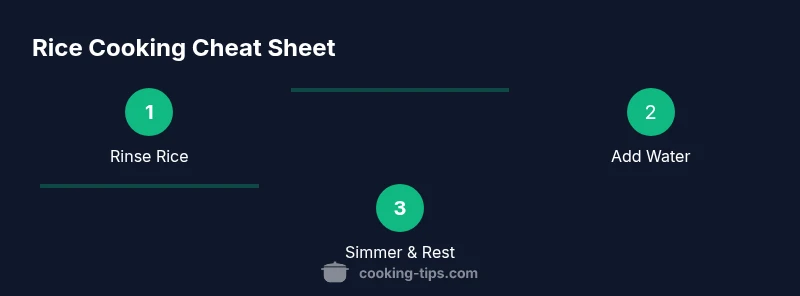
Simmer and rest
Simmer gently for the recommended time, then turn off the heat and let the pot sit, still covered, for 5–10 minutes to finish steaming.
Tip: Rest time allows moisture to redistribute and yields fluffier grains. - 6
Fluff and serve
Remove lid, gently fluff with a fork to separate grains, and taste for texture before serving.
Tip: Fluffing prevents clumping and keeps grains separate.
Quick Answers
Can I cook rice without rinsing it first?
Rinsing removes surface starch and helps prevent gummy rice. While not strictly required for every variety, rinsing generally improves texture for most rice types.
Rinsing helps rice cook more evenly and taste better. It's a quick step that improves texture for most varieties.
What's the best water ratio for brown rice?
Brown rice typically needs more water than white rice due to its bran layer. A common starting point is about 2.5 cups water per 1 cup brown rice, then adjust to your texture preference.
Brown rice needs more water; start around two and a half cups water per cup of rice and adjust as you like.
Can I use stock instead of water?
Yes. Using vegetable or chicken stock adds flavor. Be mindful of sodium levels and adjust salt accordingly.
Stock can boost flavor, but mind the salt content and seasoning.
How long should I rest the rice after cooking?
Rest the rice off the heat with the lid on for 5–10 minutes. This allows moisture to equalize and grains to firm up.
Let it rest for 5–10 minutes to finish steaming and improve texture.
What if my rice is mushy?
Mushy rice usually means too much water or overcooking. Next time, reduce the water by ¼ cup per cup of rice and monitor simmering.
If it’s mushy, cut back on water and simmer a bit less next time.
Is a rice cooker better than stovetop?
Rice cookers are convenient and consistent for many varieties, but a well-managed stovetop method gives you subtle control over texture. Choose based on your workflow.
Rice cookers are convenient; stovetops offer more control if you’re cooking by feel.
Watch Video
Top Takeaways
- Measure and rinse rice accurately to start right.
- White and brown rice have different water needs; adjust accordingly.
- Resting the cooked rice yields fluffier grains.
- Choose the right method (stovetop, rice cooker, pressure cooker) based on your tools.
- Scale rice and water proportionally when cooking for more people.