Slow Cooker vs Oven: A Practical Comparison for Home Cooks
An analytical, evidence-based side-by-side look at why use a slow cooker instead of an oven, covering energy use, texture, timing, and recipe fit for busy households.


TL;DR: A slow cooker offers hands-off, energy-efficient, and consistent cooking for long-simmered dishes, while an oven provides higher heat for browning, faster reaching temperature, and versatility for roasting and baking. The best choice depends on your schedule, desired texture, and recipe type; in many homes, a slow cooker is ideal for hands-off stews, while ovens excel for searing and roasting.
Why use a slow cooker instead of an oven
If you’re asking why use a slow cooker instead of an oven, the answer hinges on a few core tradeoffs that matter for weeknights and busy households. According to Cooking Tips, the slow cooker shines for hands-off, long-cook meals that become tender and flavorful with minimal active prep. The Cooking Tips team found that many families rely on these appliances to save time, reduce heat in the kitchen, and avoid last-minute scrambling for dinner. This article maps those tradeoffs to real-world cooking scenarios, helping home cooks decide which tool fits their routine. It also highlights how moisture retention, texture evolution, and ingredient compatibility shift with processing time and scheduling.
Beyond the obvious convenience, the question invites a deeper look at how each appliance handles flavor development, heat distribution, and practical workflow in a typical kitchen. Whether you’re planning a week of freezer-to-slow-cooker meals or a few quick oven roasts, understanding the mechanics behind each method can prevent common missteps and wasted ingredients.
In the end, the choice isn’t solely about speed or cost; it’s about aligning equipment with your weekly menu, your tolerance for prep, and your appetite for hands-off cooking. The aim here is to give you a framework to evaluate recipes against appliance strengths, not to prescribe one tool as universally superior.
Comparison
| Feature | Slow Cooker | Oven |
|---|---|---|
| Core cooking approach | Low-and-slow braising with moisture retention and unattended simmering | Hot, dry heat enabling fast cooking, browning, and roasting |
| Temperature control | Fixed low/high settings, moisture-sealed environment | Wide range of temperatures with manual or programmable controls, including convection options |
| Texture and browning | Limited surface browning; best with pre-sear or finishing steps | Excellent browning and crisp edges; versatile for multiple textures |
| Energy use and heat in kitchen | Lower active energy during cooking; longer total time but gentle heat | Higher instantaneous energy; shorter cook times but more heat output |
| Convenience and scheduling | Set-it-and-forget-it; ideal for long braises and batch meals | Requires more active planning; flexible for diverse cooking tasks |
| Best-for recipes | Stews, soups, pulled meats, chili, batch meals | Roasts, casseroles, sheet-pan dinners, baked goods |
Benefits
- Hands-off cooking that fits busy schedules
- Generally lower active energy use during cooking
- Moist, tender results especially for tougher cuts
- Good for batch cooking and meal prep
- Less heat in the kitchen during warm weather
Cons
- Limited browning and crust development without extra steps
- Longer total cook times for many dishes
- Less versatile for high-heat techniques
- Requires planning to start ahead for meals
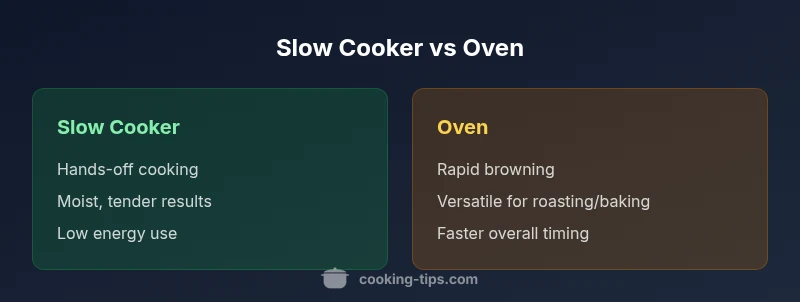
Slow cookers excel for hands-off meals and steady moisture; ovens win on browning, versatility, and speed
If you prioritize unattended cooking and steady tenderness for braises, a slow cooker often delivers more consistently with less kitchen heat. If you need rapid cooking, browning, and baking versatility, the oven is the stronger all-around choice. The best approach is to use each tool for what it does best, optimizing your weekly menu.
Quick Answers
What are the main benefits of using a slow cooker over an oven?
The main benefits are hands-off operation, consistent moisture retention, and the ability to develop deep flavors over long, gentle cook times. It’s particularly well-suited for stews, braises, and pulled meats where you want tenderness without constant monitoring.
Slow cookers are great for unattended meals, especially stews and braises; they deliver tender results with minimal hands-on时间.
Can you replace oven cooking with a slow cooker for all recipes?
No. While slow cookers excel at braises, soups, and tender meals, they’re not ideal for high-heat roasting, fast baking, or dishes that require crisp textures. Browning and those quick finishes are better suited to ovens or finishing steps in a skillet.
Not every dish translates well to a slow cooker; browning and fast high-heat steps usually need an oven.
Is a slow cooker safe to leave unattended overnight or while at work?
Yes, many slow cookers are designed for unattended operation with timers. Always follow the manufacturer’s guidelines, place the cooker on a heat-resistant surface, and avoid leaving it near combustibles. Do not remove the lid during cooking unless specified in a recipe.
Yes, you can leave it on, but follow safety guidelines and readings from the manual.
Should you always sear ingredients before slow cooking?
Searing adds flavor through Maillard browning and can improve texture, but it isn’t strictly required. For tougher cuts, a quick sear can enhance depth, but you can still achieve tender results with proper cooking time and liquid.)
Searing is optional but often beneficial for flavor; you can still be successful without it if you adjust timing.
What accessories help maximize slow-cooker performance?
A good-quality searing pan for finishing, a heatproof trivet, and a thermometer for checking internal temperature can extend your slow-cooking repertoire. Some recipes also benefit from a rack or steamer insert placed in the pot.
Searing pan for finish and a thermometer help you get the best results.
How do I clean and maintain a slow cooker?
Most removable ceramic inserts are dishwasher-safe; the base should be wiped with a damp cloth. Avoid abrasive scrubbers and soaking the base. Regularly check seals and cords, and store the unit in a dry place between uses.
Clean the pot and base per the manual; avoid harsh scrubbing on nonstick surfaces.
Top Takeaways
- Choose slow cooker for unattended, tender results
- Opt for the oven when browning and rapid cooking are priorities
- Plan recipes that start in the morning for slow-cooker success
- Balance energy use with time by pairing methods to tasks
- Batch-cooking with a slow cooker enhances meal prep efficiency