When to Cook Thawed Turkey: A Home Cooks Guide
Learn the right timing and temperatures for cooking thawed turkey. This guide covers safe internal temps, cooking by weight, and best practices to keep turkey juicy and safe.


This guide helps you know exactly when to cook thawed turkey, what internal temperature to target, and how long to roast by weight. For best results, preheat properly, monitor with a calibrated thermometer, and rest the meat after cooking. According to Cooking Tips, thawed meat behaves more predictably in the oven, reducing the risk of undercooking or overcooking.
Why thawed turkey matters
Thawing turkey properly matters as much as selecting the right size. A thawed turkey cooks more evenly than a partially frozen bird, which can stall heat penetration and leave safety hot spots. When you cook thawed meat, you’ll enjoy a more predictable timeline, better texture, and a lower risk of undercooked sections. The Cooking Tips team emphasizes planning ahead so you can maintain safe handling from thaw to plate. If you’ve ever rushed a cooking deadline, you know that thawed meat responds more consistently to roasting, basting, and resting. This section lays the groundwork for timing and technique that consistently yields juicy, evenly cooked turkey.
Safety baseline: thawed vs raw vs previously cooked
Understanding the safety framework is essential for home cooks. Thawed turkey is still raw in the sense that its surfaces and interior can harbor bacteria if mishandled. Always start with clean hands, sanitized tools, and a clean working area. When a turkey has thawed, you’ll rely on a thermometer rather than visual cues alone to confirm doneness. Cooking Tips analysis shows that sticking to a safe internal temperature across the thickest part of the breast and the innermost thigh is the most reliable way to ensure safety without overcooking. If your turkey was previously cooked and then thawed, the approach focuses on reheating safely to the correct temperature rather than re-cooking from scratch.
Temperature targets and safe times
Target temperature is the safest compass for doneness. For a thawed whole turkey, the internal temperature should reach 165°F (74°C) in the thickest part of the breast and the innermost part of the thigh. Roasting at a moderate oven temperature (commonly around 325°F / 163°C) helps the meat cook through evenly. Avoid temperatures that are too high early on, as they can dry out the breast before the legs finish. These targets provide a reliable framework for timing, regardless of whether you’re roasting a small bird or a large one. Always verify with a calibrated digital thermometer during the final phase of cooking.
How to gauge doneness without overcooking
The thermometer is your best guide, not timing alone. Insert the probe into the thickest part of the breast without touching bone, then also check the thigh. If you’ve stuffed the bird, ensure the center of the stuffing also reaches 165°F. Avoid opening the oven door too often, which can drop the oven temperature and extend cooking time. Resting the turkey after removing it from heat helps the juices redistribute and the final internal temperature to stabilize.
Planning by weight: estimated times
Roasting times depend on the weight and whether the turkey is stuffed. A thawed unstuffed turkey typically requires roughly 13-15 minutes per pound at 325°F, while a stuffed turkey can take longer. These are general guidelines; always rely on a thermometer to confirm doneness. Having a reliable scale or recipe built around exact weights will reduce guesswork and keep you on track for dinner deadlines.
Preparing turkey for roasting: pat dry, season, truss
Before roasting, pat the turkey dry with paper towels to promote even browning. Season the surface with salt and pepper, and consider a light oil or butter rub for crisp skin. If you choose to truss, do so to promote uniform cooking width-wise and keep the legs together. Proper prep makes the surface color even and the interior temperature easier to manage.
Roasting methods and oven considerations
Roasting is the standard method for even results with thawed turkeys. Use a rack in a sturdy roasting pan to improve air circulation. If your oven has hot spots, rotate the pan halfway through cooking. Some cooks also use a convection setting to speed browning, but reduce the temperature slightly to avoid drying out the breast. The goal is a golden skin with a fully cooked interior.
Resting, carving, and serving juicy turkey
Let the turkey rest at least 20-30 minutes after removing it from the oven; this helps the juices redistribute and makes carving easier. Slice against the grain and start with the breast meat, which benefits most from the resting period. Serve with a simple pan sauce or light gravy that complements the natural turkey flavors without masking them. Maintaining moisture during slicing is key to a pleasant first bite.
Common mistakes and troubleshooting
Common missteps include under-seasoning, over-roasting, and checking doneness too early. Always guarantee the target temperature holds by using a thermometer in multiple spots. If the skin looks pale, finish with a brief, high-heat burst or tent with foil to avoid scorching. If you see the breast browning too quickly, shield it with foil to prevent drying while the thighs finish cooking.
Tools & Materials
- roasting pan with rack(Large enough for your turkey; ensure rack elevates the bird 1-2 inches above bottom.)
- meat thermometer (digital)(Thermometer should read 165°F in the thickest part of the breast and thigh.)
- oven thermometer(To verify oven accuracy, especially if your oven runs hot or cold.)
- aluminum foil(Lightly tent the breast in the final phase if browning is too rapid.)
- basting brush(Optional for applying butter or oil before roasting.)
- kitchen shears or sharp knife(For trimming any excess skin and for carving after resting.)
- paper towels(Pat turkey dry thoroughly before seasoning.)
- oil or melted butter(Helps crisp skin and improve browning.)
- salt and pepper(Season generously but sensibly; kosher salt is recommended.)
- meat thermometer sleeves/cover (optional)(For safe handling of the thermometer during roasting.)
- carving board(A stable surface for slicing after resting.)
Steps
Estimated time: Total time: 2-4 hours
- 1
Preheat and prep
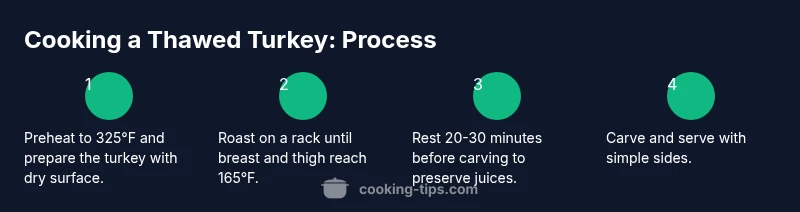
Preheat the oven to 325°F (163°C). Remove turkey from its packaging, take out any giblet bag, and pat dry with paper towels. Starting with a dry surface helps the skin brown evenly and prevents steaming.
Tip: Dryness is your friend for crisp skin; moisture creates pale, soggy areas. - 2
Season and oil
Rub the turkey with a light coating of oil or melted butter. Season the exterior generously with salt and pepper, and optionally add herbs or garlic under the skin for aroma. Avoid piling in too much stuffing inside if using a whole roast.
Tip: Even seasoning ensures flavor in every bite; avoid heavy stuffing that slows heat penetration. - 3
Set up pan and rack
Place a rack in a sturdy roasting pan and position the turkey breast-side up. The rack raises the bird to promote even heat circulation and browning across the surface.
Tip: A raised position prevents the bottom from stewing and helps the skin brown faster. - 4
Insert thermometer
Insert the thermometer into the thickest part of the breast and, separately, into the thigh without touching bone. This gives reliable readings for both major zones.
Tip: Avoid bones or touching metal; aim for the center of each piece. - 5
Roast and monitor
Roast the turkey, checking progress at regular intervals. Do not open the oven door excessively as it lowers the temperature and lengthens cooking time.
Tip: If using a convection setting, reduce the temperature by about 25°F (15°C). - 6
Check doneness
When the breast and thigh reach 165°F (74°C), check the stuffing if present; it should also reach 165°F. Confirm with a final probe in the center.
Tip: Rule of thumb: multiple probes equal more reliable results. - 7
Rest the turkey
Remove from oven and tent loosely with foil. Let rest 20-30 minutes before carving to redistribute juices and finish carrying residual heat.
Tip: Resting prevents juice loss and makes slicing easier. - 8
Carve and serve
Transfer to a carving board and slice against the grain. Start with the breast, then move to the thighs and wings. Serve with simple sides to highlight turkey flavor.
Tip: Carve in a single smooth motion to keep slices neat. - 9
Clean up
Dispose of pan drippings properly or reserve for gravy if desired. Wash cutting boards and utensils thoroughly to prevent cross-contamination.
Tip: Sanitize surfaces after handling raw poultry. - 10
Plan for leftovers
If you have leftovers, refrigerate promptly in shallow containers within two hours of cooking. Reheat to 165°F before serving leftovers.
Tip: Divide into portions to cool quickly and safely.
Quick Answers
Can you cook thawed turkey from frozen state after it’s partially thawed?
Cooking thawed turkey is safest when the bird is fully thawed. If parts remain frozen, heat distribution can be uneven, risking undercooked areas. Plan ahead to thaw completely or roast in a way that ensures safe temperatures throughout.
It's best to thaw completely before cooking to ensure even heat and safe temperatures.
What internal temperature should thawed turkey reach for safety?
The recommended internal temperature is 165°F (74°C) in the breast and thigh. Verify with a thermometer in multiple spots, including the stuffing if used.
Cook until the thermometer reads 165 degrees in the thickest parts.
How long should thawed turkey rest after cooking?
Allow a 20-30 minute rest after removing from the oven. Resting helps the juices redistribute and improves carving quality.
Rest the turkey for 20 to 30 minutes before carving.
Is it okay to stuff a thawed turkey before roasting?
Stuffing a thawed turkey is possible but requires careful handling; stuffing should reach 165°F separately if used inside the bird, which may extend cooking time.
Yes, but stuffing inside the bird needs extra check to stay safe."
Can I use a convection oven for thawed turkey?
A convection oven can brown more quickly; reduce the temperature by about 25°F (15°C) and monitor doneness with a thermometer.
Convection can speed up browning, just lower the heat a bit.
What’s the best way to plan roasting by weight?
Calculate roughly 13-15 minutes per pound for unstuffed thawed turkey at 325°F; stuffing adds time and requires careful checking.
Roast by weight and check with a thermometer rather than relying on time alone.
Watch Video
Top Takeaways
- Cook thawed turkey to 165°F in breast and thigh
- Use a thermometer, not time alone, to judge doneness
- Rest 20-30 minutes before carving for juicier slices
- Season and prep before roasting for even browning
- The Cooking Tips team recommends planned timing and proper resting for best results