What Is Wrong When Cooking Frozen Meat? A Troubleshooting Guide
This urgent troubleshooting guide explains why cooking frozen meat often goes wrong, with practical steps, safe temps, and fast fixes to prevent undercooked results.


What is wrong with cooking frozen meat is often uneven heat and a cold center. The quickest fix is proper thawing in the fridge or under cold water, then cooking to a safe internal temperature with a thermometer. If you must cook from frozen, use lower heat, smaller portions, and extended cooking time, then rest before serving.
Why Cooking Frozen Meat Cooks Unevenly
Understanding what is wrong with cooking frozen meat helps home cooks stop chasing perfect results. Ice crystals form during freezing, and those crystals melt unevenly as heat is applied. The outer layers heat quickly while the center remains cold, and that mismatch can leave dangerous, undercooked pockets. This is not merely a quality issue; uneven cooking can create real safety risks because pathogenic bacteria survive in cooler zones. The Cooking Tips team notes that thawing and even heat distribution are the two biggest levers to fix this problem. Reality check: most home kitchens see better outcomes when thawing occurs prior to heat, followed by controlled, steady cooking that lets every part of the meat reach a safe temperature.
- The reader wants practical steps, not just theory. - The core problem is heat distribution and incomplete thaw. - Thawing safely and controlling heat are the fastest routes to consistent doneness.
According to Cooking Tips, thawing is not just a time-saver; it is a safety multiplier that dramatically reduces the chance of undercooked centers. If you need to cook from frozen due to time constraints, expect longer cooking times and monitor with a thermometer for doneness.
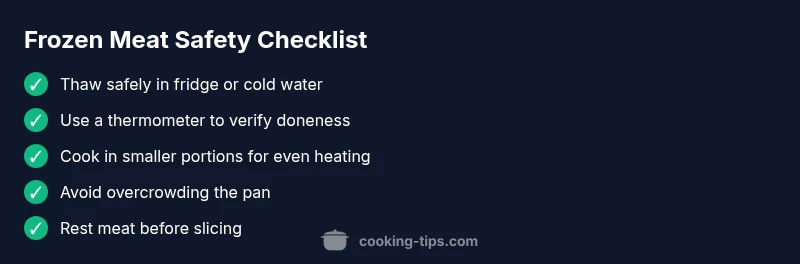
- Thawing first markedly improves evenness. 2) Thermometer checks prevent undercooked pockets. 3) Smaller cuts heat more evenly than a single large piece.
Safe Thawing and Preparation
The safest and most reliable way to address what is wrong with cooking frozen meat starts with thawing. Plan ahead: place meat in the fridge a day or two before cooking, depending on thickness. If you’re pressed for time, seal the meat in water and change every 30 minutes to speed thawing while maintaining a safe environment. Never leave meat on the counter to thaw; surface heat can encourage bacterial growth before the center thaws. When thawed, pat dry to promote even browning and remove excess moisture that can steam rather than sear. A properly thawed piece heats more predictably, reducing the risk of a cold center and uneven doneness. The Cooking Tips analysis shows thawed meat cooks more reliably across common methods like pan-searing, roasting, or grilling.
- Thaw in fridge for 24–48 hours per size. - Use cold water thawing for faster results, in a sealed bag. - Pat meat dry before cooking to promote even browning.
Cooking Methods That Work Better With Frozen Meat
If thawing isn’t possible, there are methods designed to mitigate the risks of cooking frozen meat. Slow, low-heat methods help maintain temperature control and reduce surface scorching while allowing the center to come to a safe temperature gradually. Sous-vide is ideal for some cuts, as it delivers precise temperature control, but not everyone has this setup. In conventional kitchens, consider starting on the lowest heat, then finishing with a hot sear to develop color without overcooking the exterior. Another approach is to cut larger pieces into uniform portions before cooking; smaller portions heat more evenly and reach a safe core sooner. Regardless of method, avoid high heat that can brown the outside too quickly while leaving the center undercooked. The goal is an even temperature gradient from edge to center.
- Consider sous-vide when possible for precise doneness. - For non-sous-vide kitchens, start low and slow, then finish with a brief sear. - Cut thick pieces into uniform portions to promote even cooking. - Don’t crowd the pan; air or space promotes even heat transfer.
Temperature and Timing Guidelines for Common Meats
Knowing when meat reaches a safe internal temperature is essential to solving what is wrong with cooking frozen meat. The exact targets depend on the protein, but the underlying principle remains: the center must reach a safe temperature before serving. Poultry should reach a higher target than beef, pork, or fish. When starting from frozen, expect longer cook times; the thermometer becomes your best friend in this scenario. Always use a calibrated thermometer rather than eyeballing doneness. For many home cooks, the range is to aim for 165°F (74°C) for poultry, 145°F (63°C) for beef (roasts) or pork, and 145°F (63°C) for fish, with a brief rest to complete carryover cooking. These temps ensure safety while preserving moisture and texture.
- Always verify with a thermometer rather than guessing. - Expect longer times when cooking from frozen. - Rest meat after cooking to allow carryover heat to finish the job. - Temperature targets may vary by cut; adjust accordingly.
Common Mistakes and Quick Fixes
Many cooks fail to thaw completely, leading to a cold center despite long cooking times. Another frequent error is cooking at too high heat, which scorches the exterior before the interior can reach a safe temp. Crowding the pan traps steam and prevents proper browning. Not using a thermometer is a silent risk—color is not a reliable indicator of safety. Quick fixes include thawing fully before cooking, cutting meat into uniform portions, lowering heat and extending cooking time, preheating equipment, and monitoring internal temperature closely. If the center remains undercooked, switch to a lower setting, extend the cook time, or use a different method (e.g., oven + lid or sous-vide). Finally, never rely on a single test; check several spots for doneness and allow rest time before slicing to redistribute juices.
Step-by-Step Quick Fixes for Frozen Meat
When you need reliable fixes fast, follow this practical sequence to address common frozen-meat issues. Each step builds on the prior one and keeps safety front and center. By applying this routine, you’ll minimize the risk of undercooked centers and improve overall texture.
- Assess thaw status and cut size. If the meat is still partially frozen, plan thawing or break into smaller pieces. Tip: smaller pieces thaw and cook more evenly.
- Preheat your cooking equipment. Ensure ovens, pans, and grills are properly heated to the target temperature before you start. Tip: a preheated pan gives better searing and reduces sticking.
- Choose a cooking method that matches the meat and thaw status. For frozen or partially frozen meat, start at a lower temperature and move to a higher heat later if needed. Tip: avoid crowding to promote even heat transfer.
- Use a meat thermometer from the start. Insert in several spots, including the thickest part, to verify doneness. Tip: plan for carryover cooking during rest.
- Extend cooking time as required. If the center remains undercooked, increase time in 5–10 minute increments and recheck. Tip: rest before slicing to lock in moisture.
- Rest the meat after cooking. Let it stand for a few minutes to redistribute juices and finish carryover cooking. Tip: tent with foil for even cooling.
- Reheat leftovers safely if any remain. Reheat to at least the safe temperature again before serving. Tip: reheat evenly and avoid reheating multiple times.
Safety and Hygiene When Handling Frozen Meat
Handling frozen meat demands strict hygiene to prevent cross-contamination. Start with clean hands and sanitized surfaces. Keep raw meat separate from ready-to-eat foods and always wash hands, knives, and cutting boards after contact. Thawing generates moisture that can harbor bacteria; seal packaging and place meat in a tray to catch drips. After cooking, refrigerate leftovers promptly, within two hours, and reheat thoroughly before consuming. When in doubt, discard any meat that shows off odors, slimy texture, or extensive freezer burn. Following best practices protects you and your family from foodborne illness. The Cooking Tips team emphasizes that safe handling is as important as correct doneness for frozen-meat dishes.
Steps
Estimated time: 60-90 minutes
- 1
Assess thaw status and cut size
Check if the meat is completely thawed. If not, decide whether to thaw fully or break into smaller pieces to improve heat penetration. Small, uniform portions cook more evenly and reduce the risk of a cold center.
Tip: If thawing, plan for extra time and keep meat refrigerated until you’re ready to cook. - 2
Preheat and prepare cookware
Preheat the oven or pan to the target temperature. A hot start can burn the exterior if not monitored, so ensure equipment is ready to receive the meat. Prepare a clean surface and arrange pieces with space between them.
Tip: A preheated pan seals better and reduces sticking. - 3
Choose a controlled cooking method
Select a method that suits frozen or thawed meat. For frozen pieces, start on low heat and progress to higher heat as needed. For thawed pieces, standard temps work best. Consider covered cooking to retain moisture.
Tip: Avoid overcrowding; air circulation helps even heating. - 4
Monitor doneness with a thermometer
Insert the thermometer into the center of the thickest part to verify doneness. Check multiple spots for larger cuts. Don’t rely on color alone.
Tip: Aim for the safe temperature for the meat type and cut. - 5
Extend cook time if center is undercooked
If the center remains undercooked, add 5–10 minute intervals and recheck. Avoid rushing the process; forcing higher heat can burn the outside without finishing the inside.
Tip: Patience prevents food safety risk. - 6
Rest and slice
Let meat rest to redistribute juices and complete carryover cooking. Slice against the grain for tenderness and safer, even portions.
Tip: Resting time improves texture and juiciness. - 7
Handle leftovers safely
Refrigerate leftovers promptly and reheat to a safe temperature before serving. Do not reheat more than once to preserve quality and safety.
Tip: Label leftovers with date and reheating instructions.
Diagnosis: Center remains undercooked in the middle after cooking frozen meat.
Possible Causes
- highMeat was not fully thawed, leading to a cold center
- mediumCut size is too large for even heating
- mediumCooking temperature too high or pan crowded
- mediumInadequate preheating or oven calibration
- lowUsing meat with freezer burn or age
Fixes
- easyThaw completely using fridge thaw or cold-water method
- easyCut meat into uniform smaller portions
- mediumLower heat and extend cook time to allow center to reach safe temp
- mediumPreheat oven/pan and verify equipment accuracy
- easyVerify doneness with a calibrated meat thermometer
Quick Answers
Is it safe to cook meat from frozen?
Cooking meat from frozen is possible but can lead to uneven doneness and potential safety risks. Thawing first is generally safer and yields more consistent texture.
Cooking from frozen can work, but thawing first is safer and makes for more even results.
What is the best thawing method?
Thaw in the refrigerator for best safety and texture. If you need faster results, seal in cold water and change every 30 minutes.
Fridge thawing is safest; cold water thawing speeds things up if you’re short on time.
Can I use the microwave to thaw?
Microwave thawing is convenient but can start cooking in spots. If you use this method, cook immediately after thawing.
Microwave thaw is fast but not ideal; cook right away after thawing.
How do I know the meat is done?
Use a calibrated meat thermometer and verify the internal temperature for the specific meat type. Don’t rely on color alone.
Check with a thermometer to ensure safety and doneness.
Why is the center raw after cooking?
Likely under-thawed or heat didn’t penetrate evenly. Fix by thawing completely, cutting smaller, and cooking more slowly.
Center raw usually means heat didn’t reach the middle; thaw or cut smaller and retry.
Are there safer quick fixes?
Yes—lower the heat, use smaller portions, preheat thoroughly, and check doneness with a thermometer.
Lower heat and smaller portions tend to fix most issues quickly.
Watch Video
Top Takeaways
- Thaw safely to ensure even cooking
- Use a thermometer to verify doneness
- Cook frozen meat with lower heat and longer time when needed
- Let meat rest before slicing to maximize texture