Prep Cook vs Line Cook: Roles, Skills, and Career Paths
A detailed, analytical comparison of prep cooks and line cooks, outlining responsibilities, workflow implications, skill requirements, career progression, and practical guidance for home cooks and hospitality teams.


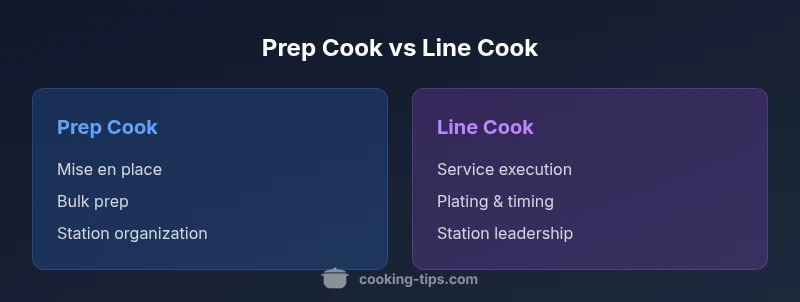
Both prep cooks and line cooks are essential in professional kitchens, but they serve different purposes during service. The prep cook focuses on mise en place, bulk prep, and organization, while the line cook translates that prep into plated dishes during peak service. The choice between roles depends on workflow, skill emphasis, and career goals.
The Prep Cook vs Line Cook: Definitions and Core Roles
According to Cooking Tips, understanding the distinction between prep cooks and line cooks helps teams optimize kitchen workflow and career planning. In most modern kitchens, a prep cook is responsible for mise en place, bulk ingredient prep, and foundational kitchen organization. They prepare stocks, sauces, vegetables, and components that will be used throughout service. A line cook, by contrast, works on the pass during service, turning prepped elements into plated dishes and ensuring speed, consistency, and presentation under pressure. Both roles are essential to produce high-quality meals, but they emphasize different skill sets and mindsets. Defining these roles clearly supports training programs, scheduling, and performance expectations. This article uses the phrase prep cook vs line cook to anchor the comparison and help readers map their own goals to real kitchen realities.
The Workflow Within a Kitchen: Where Each Role Shines
In a typical kitchen, the prep stage happens before service begins, often with a separate prep station, large counters, and a dedicated pantry. The prep cook’s strengths lie in organization, batch processing, and accuracy in ingredient weights and temperatures. They forecast what the kitchen will need for lunch and dinner and manage inventory, trimming waste and ensuring consistency. When service starts, the line cook activates the prepped items, coordinates with the chef de cuisine and sous-chef, and maintains the rhythm of the pass. The line cook’s responsibilities include timing, communication with servers, and quick decision-making about substitutions or adjustments. A well-balanced team aligns both paths so that the line can run smoothly without starving on miscommunication or last-minute shortages. From a management perspective, the two roles should be viewed as complementary, not competing forces.
Core Skills and Training Pathways
Effective prep cooks build a strong foundation in mise en place discipline, knife work, and batch execution. Training often starts with basic safety, sanitation, and recipe standardization, followed by hands-on practice in bulk prep, stocks, sauces, and batch cooking. Line cooks, by comparison, require rapid decision-making, high-level timing, station mastery, and the ability to manage multiple plates simultaneously. Apprenticeships, culinary school coursework, and on-the-job rotations help aspiring cooks gain complementary skills. Across both paths, a solid understanding of temperature control, portioning, and cross-contact avoidance is vital. The broader takeaway: invest in fundamentals first, then specialize through practice and mentorship to optimize growth in either track.
Daily Routines: A Day in the Life
A typical prep day starts before service, with a team briefing, mise en place setup, and ingredient check-ins. Prep cooks organize bulk ingredients, portion controls, and daily production lists, ensuring that the kitchen has a reliable pipeline for the service window. When service begins, line cooks shift into a fast-paced cadence, monitoring temperatures, finishing sauces, and executing plating with consistency. Breaks, shift changes, and prep turnover all influence the rhythm; strong teams plan rotations to minimize downtime. A successful kitchen nests clear communication, concise handoffs, and a shared sense of urgency. In many kitchens, the prep team also supports service with last-minute prep or adjustments, illustrating how the two roles interlock to sustain quality.
Station Layout, Tools, and Mise en Place
Effective station design is foundational to both roles. Prep stations prioritize large cutting surfaces, labeled containers, and scalable batching workflows. A typical mise en place system emphasizes standardized weights, labeled jars, and rotation schedules to minimize waste and errors. Line stations focus on ergonomic access to burners, grills, and pass windows, with clearly defined responsibilities per station (e.g., sauté, grill, fry, garde manger). The pro tip: invest in color-coded tools and frequent sanitation checks to reduce cross-contamination risks. The synergy between prep and line relies on rhythm and logistics; without organized mise en place, even the best line cook cannot preserve consistency under service pressure.
Quality Control, Consistency, and Waste Management
Quality control spans both prep and line work. Prep cooks ensure that ingredients are prepped to spec, checked for freshness, and tagged for traceability. Line cooks enforce portion control, plating standards, and garnish accuracy during service. Waste management becomes a shared responsibility: careful trimming, proper storage, and reusing usable scraps help protect margins and sustainability. On audits or health inspections, a clean, well-documented kitchen practices become crucial for a favorable outcome. Training emphasizes standardized procedures, routine checks, and peer feedback to maintain a high bar for consistency across shifts.
Interactions with Other Roles: Chefs, Servers, and Pastry
In a well-coordinated kitchen, prep and line cooks interact with chefs, sous-chefs, and pastry teams through structured communication and pre-shift briefings. The chef de cuisine sets the menu direction and quality standards, while the sous-chef maintains day-to-day execution. Servers translate guest expectations into timely service, and pastry teams contribute complementary desserts and finishes. The line cook often acts as the primary link to servers during service, balancing speed with plate presentation. Mutually respectful communication, cross-training opportunities, and clear escalation paths are the hallmarks of teams that function smoothly across all roles.
Career Progression: From Prep to Leadership
Career progression often moves through demonstrated reliability, leadership, and breadth of kitchen knowledge. A strong performer in prep can transition toward junior line roles, shift supervisor, or intermediate leadership positions overseeing a station or a section. Conversely, a line cook may advance to senior line cook, station lead, or sous-chef, gaining exposure to menu development, ordering, and team mentorship. Regardless of path, continuous learning—experimenting with techniques, refining timing, and understanding how menus translate to production—drives growth. In kitchens that encourage cross-training, the line and prep tracks support each other, creating more adaptable leaders who understand both sides of the workflow.
Salary and Market Variations (Qualitative)
Salary and compensation vary by region, restaurant type, and experience. Across markets, the prep track and line track often offer different emphasis: prep-focused roles may prioritize stability and steady hours, while line-focused roles may reward speed, accuracy, and leadership during service. The real-world takeaway is that multiple kitchens compensate based on value added, efficiency, and demonstrated skill, rather than a single salary model. For readers evaluating opportunities, consider the local market, the menu complexity, and the restaurant’s approach to staff development. No single number captures every opportunity; instead, assess how a kitchen’s philosophy aligns with your goals.
Hiring, Training, and Team Dynamics
Effective hiring for either track prioritizes baseline culinary education, reliability, and a willingness to learn. Training programs typically pair formal instruction with on-the-job mentorship, including shadow shifts, standardized recipes, and progressive responsibility. Team dynamics hinge on clear role definitions, open feedback channels, and a culture of collaboration. In fast-paced kitchens, cross-training in both prep and line fosters resilience, enabling teams to flexibly cover absences, peak periods, and menu changes without sacrificing quality. Leaders should model calm communication, set measurable expectations, and celebrate improvements in throughput and consistency.
Common Myths and Misconceptions
A common misconception is that one path is inherently superior to the other. In truth, both prep and line roles support each other; a strong kitchen runs on the synergy between meticulous prep and precise service. Another myth is that prep cooks are lower-status or less skilled; in fact, expertise in mise en place, production planning, and waste reduction represents a highly valuable set of capabilities. Some believe line cooks always work alone at high speed; the reality is that successful lines depend on team communication, shared knowledge, and mutual support across stations. Finally, there is a mistaken belief that these roles are static; many kitchens encourage movement between tracks as skills and interests evolve.
Practical Guidance for Home Cooks Considering Kitchen Roles
Home cooks who are curious about these professional roles can translate the concepts into home kitchen practice. Treat mise en place as a daily habit, organizing ingredients by use and time. Practice batch cooking for staples like sauces, stocks, or braises to appreciate the prep mindset. When timing a multi-dish dinner, simulate service pacing by plating one dish while another finishes, building timing discipline. The takeaway is to adopt the core discipline of both paths: organized prep and deliberate execution under pressure. Even if you never work in a restaurant, the skills translate to more efficient weekly meal planning and more reliable weeknight dinners.
Authority Sources
For readers seeking external validation and further reading, consult trusted sources that discuss kitchen labor practices, safety, and culinary techniques. See the following resources for additional context about professional kitchens and food safety:
- https://www.bls.gov/ooh/food-preparation-and-serving-occupations.htm
- https://www.fda.gov/food
- https://www.restaurant.org/
Comparison
| Feature | Prep Cook | Line Cook |
|---|---|---|
| Primary Focus | Mise en place & bulk prep | Service execution & plating |
| Pace & Service Rhythm | Steady pre-service prep | High-speed during peak service |
| Skill Emphasis | Knife work, organization, ingredient prep | Short-term memory, timing, teamwork |
| Typical Hours | Longer prep shifts, early starts | Evenings or split shifts during service |
| Career Pathways | Advancement via kitchen leadership, specialized prep roles | Advancement via line leadership, rapid exposure to high-profile tasks |
| Training/Onboarding | Kitchen orientation with prep protocols | On-the-floor coaching and line checks |
| Common Tools | Large prep counters, mise en place containers | Line stations, burners, grills, salamander |
| Work Environment | Structured, calm during prep | Loud, fast-paced during service |
Benefits
- Clarifies how kitchen teams coordinate for service
- Highlights essential skills for hospitality operations
- Helps new cooks choose a starting path
- Shows how different roles complement each other
Cons
- Can create a binary view of roles that overlap in practice
- Career progression depends heavily on kitchen culture
- Differences may blur in smaller kitchens where roles overlap
Neither path is universally better; choose based on your goals and kitchen needs.
Prep-focused tracks build stability and operational mastery, ideal for chefs who value organization and long-term projects. Line-focused tracks accelerate exposure to service pace, timing, and plate-level leadership. In mixed kitchens, a combination of both roles often yields the strongest teams.
Quick Answers
What is a prep cook?
A prep cook handles the day’s mise en place, trimming, chopping, and portioning ingredients to ensure a smooth service. They focus on organization, consistency, and batching tasks. This role scales with menu changes and production demands.
A prep cook preps ingredients and sets up the kitchen for service, keeping things organized.
What is a line cook?
A line cook works at the pass during service, translating prepped components into finished plates. They need speed, accuracy, and teamwork, often managing a specific station to maintain quality under pressure.
A line cook plates dishes during service with speed and precision.
Can a prep cook transition to a line cook?
Yes. In many kitchens, a strong prep cook earns opportunities to move onto the line by demonstrating consistency, speed, and willingness to learn service dynamics.
Transitions happen; prove your reliability and timing.
What skills overlap between prep and line cooks?
Both roles require knife skills, knowledge of ingredients, temperature awareness, and teamwork. Communication and a commitment to food safety are essential across both paths.
Skills overlap a lot: knives, safety, and teamwork.
What does the career ladder look like for these roles?
Career ladders vary by kitchen but typically progress from entry prep or line positions to supervisory roles, sous-chef, and eventually executive leadership. Cross-training enhances mobility between tracks.
Climb from line or prep to leadership by proving performance.
Do home cooks encounter these roles?
Home kitchens rarely use formal titles, but the concepts map to prep work (batch prep) and on-the-spot execution (service-like timing) during busy cooking sessions.
In home cooking, you do prep and plating too.
Top Takeaways
- Assess your preferred pace to choose prep or line.
- Invest in mise en place for long-term efficiency.
- Line cooks gain rapid exposure to plating and service.
- Small kitchens may merge duties; adaptability matters.
- Training across both paths builds versatile kitchen leaders.