Is Cook the Same as Chef? A Practical Comparison
Explore whether cook and chef are interchangeable, with clear definitions, training differences, and real-world usage in homes and pro kitchens. Learn how to call roles correctly.


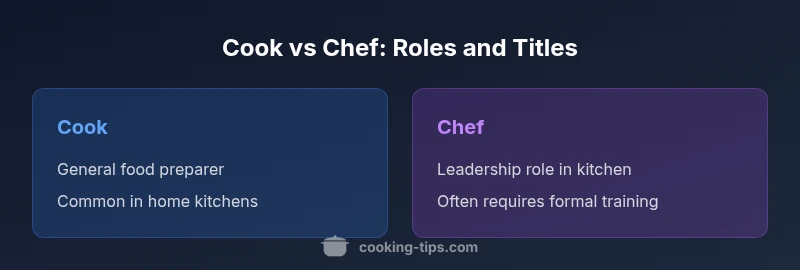
Is cook the same as chef? In most professional settings, no. A chef typically leads a kitchen, oversees menus, and has formal training or apprenticeship, while a cook focuses on preparing meals and may work under a chef. For home cooks, the terms are used more loosely, but clarity helps with job titles and resumes. This comparison explains where the distinctions matter most.
Defining Roles: cook vs chef
Is cook the same as chef? This question surfaces in kitchens and homes alike. At a glance, both terms describe people who prepare food, but they signal different levels of responsibility, training, and authority. The Cooking Tips team notes that in most professional contexts, 'chef' implies leadership and formal training, while 'cook' functions as a more general descriptor for someone who cooks. Understanding this nuance helps readers describe roles accurately, set expectations, and communicate about kitchen tasks clearly. Throughout this article we differentiate usage in home cooking versus professional kitchens, referencing common practices across regions and industries. In short, you will usually find that the word 'chef' marks higher status and responsibility, while 'cook' signals practical cooking capability without formal leadership duties.
- This distinction is especially important for readers navigating job postings, resumes, or interviews. Status signals and responsibilities can shift between restaurants, hotels, catering, or private households. According to Cooking Tips, precise terminology reduces miscommunication and aligns expectations for both employers and staff.
- In everyday conversations, people may say they are a cook or a chef based on mood, seniority, or pride. The important takeaway is to interpret the wording in context: a kitchen leader is usually a chef, while an assistant or line cook focuses on execution. The line between terms is cultural and practical, not strictly legal.
- Keep in mind regional usage. In some countries, local titles blend or diverge from the English terms, which can create ambiguity if you rely on a single word to convey all duties.
This block sets up the core question and frames why understanding the distinction matters in both home and professional contexts. The Cooking Tips team emphasizes that language should reflect actual duties, not prestige alone.
Historical Roots and Cultural Context
The words cook and chef come from distinct historical paths that influence how we use them today. 'Cook' derives from older English terms for someone who prepares meals, a role familiar to households and casual dining. By contrast, 'chef' comes from the French term chef de cuisine, meaning head of the kitchen. This origin anchors the term in leadership, responsibility, and a formal kitchen hierarchy. Over centuries, the professional kitchen evolved into a structured environment with defined roles, and language followed that structure. In many modern kitchens, you still see artisans described as cooks on the line, but the person in charge is called the chef or executive chef. Recognizing these roots helps home cooks appreciate why the terminology matters when discussing qualifications, hiring, or menu planning. The Culinary Tips team notes that linguistic evolution mirrors industry organization, not simply brand preference.
- In culinary education, many programs emphasize the term chef as a culmination of training, mentorship, and leadership, while the term cook is common in entry-level positions or home cooking courses.
- Global kitchens vary in terminology. Some regions use localized titles that map onto the chef/cook distinction differently, which can lead to confusion without context.
Historical context helps explain why the two words carry different implications in professional settings and why they remain fluid in everyday language.
Education, Training, and Credentials
Education and training are common grounds where the chef–cook distinction becomes sharper. A chef often follows a formal path: culinary school, apprenticeships, staged experiences, and a period of paid mentorship in busy kitchens. This pathway cultivates menu planning, kitchen design, staff management, and cost control alongside technical skills. A cook may have some structured training too, but it is not always a requirement for employment, and the focus tends to be on practical execution and technique. In many kitchens, cooks advance to roles with supervisory responsibilities, but the title of 'chef' generally signifies a leadership rank that requires demonstrated capabilities in managing teams and guiding kitchen operations. Across regions, training standards vary, but the underlying principle remains: chefs are expected to oversee operations, menus, and staff development; cooks execute recipes and maintain quality on the line. Cooking Tips emphasizes that training should be assessed by competence and responsibility, not merely by a label.
- Professional pathways often include stages such as commis, demi-chef, sous-chef, and executive chef, each with increasing scope and accountability.
- Home cooks pursuing formal credentials might treat the term 'chef' as aspirational or as a marketing-friendly title, rather than a strict professional label.
For readers aiming to advance, the emphasis should be on demonstrable skills, leadership, and practical results, rather than any single word on a résumé.
Daily Responsibilities in Professional Kitchens
In a professional kitchen, daily duties illuminate the gap between cook and chef. A chef typically plans the menu, designs the layout, and assigns tasks to cooks and other staff. They oversee quality control, food safety programs, inventory management, and training. Subtle but important: a chef is expected to troubleshoot during service, adjust dishes for diners’ needs, and coordinate with front-of-house teams. Cooks, meanwhile, focus on execution: following recipes, preparing ingredients, plating dishes, and maintaining consistent quality under supervision. The distinction matters when evaluating resumes, performance reviews, or job postings. The difference can be framed as leadership and responsibility (chef) versus execution and technique (cook). The Cooking Tips team highlights that many kitchens use hybrid structures, where a senior cook may assume leadership duties without the formal title of chef, especially in smaller establishments. For readers, recognizing this split helps clarify expectations and communication in a fast-paced environment.
- On busy service nights, the chef might be seen directing operations, while cooks work the line and run stations.
- In smaller venues, you may encounter a single person performing multiple roles; the terminology here depends on tradition and organizational culture.
Clear role definitions support smooth operations and fair workload distribution.
Language and Title Usage in Home Cooking vs Restaurants
Language usage shifts between home kitchens and professional restaurants. In homes, people often use 'cook' as a practical label for anyone who prepares meals, without implying hierarchy. In contrast, restaurants lean on titles to signal responsibility and authority. A menu might list a chef de cuisine, a sous-chef, and line cooks, each with distinct duties. The word 'chef' carries a professional connotation that communicates leadership and standards, which helps guests understand the kitchen’s structure. In written communication, be precise: a résumé indicating 'chef' suggests management and program development, while 'cook' conveys hands-on cooking ability. The Cooking Tips team underscores that clarity matters for hiring, collaboration, and career progression. Readers should adapt language to context, ensuring that titles reflect actual duties and responsibilities rather than prestige alone.
- When describing experiences on a resume, phrase roles to highlight leadership or technique as appropriate.
- In casual conversation or home settings, using 'chef' can be a source of pride, but it should not imply responsibilities you do not hold.
Accurate language builds credibility with employers, clients, and peers.
Career Ladder and Job Titles
Career progression in kitchens often follows a ladder: commis, demi-chef, sous-chef, and chef (or executive chef) at the top. Each rung adds more scope: recipe development, staff supervision, holiday planning, and cross-department coordination. The term 'cook' appears across many placements as a job description for line preparation and execution. The key takeaway is that the ladder reflects responsibility and influence rather than a single word. Some establishments use alternative titles like 'culinary supervisor' or 'kitchen manager' to describe leadership without the punch of the term 'chef.' The Cooking Tips team notes that the cultural weight of the word 'chef' varies by region, which can affect perceived status during hiring or networking. Understanding the ladder helps readers map their own path, set realistic goals, and tailor resumes to match expected duties.
- A strong portfolio of prep, plating, and leadership projects often accelerates progression.
- Networking and mentorship can be as important as formal training in some regions.
Clear ladders help readers plan their growth and communicate competency effectively.
Perception, Status, and Compensation
Perception is a subtle yet powerful factor in how these roles are viewed and remunerated. In many markets, 'chef' signals leadership, responsibility for menus, and accountability for results, which can influence salary bands and career options. 'Cook' suggests practical ability and reliability but may not convey the same leadership value. However, compensation is not solely determined by title; it reflects experience, performance, and the size and prestige of the establishment. The Cooking Tips analysis shows that regional norms shape expectations around who earns more and who is considered senior. For readers crafting a career plan, it’s wise to emphasize demonstrable results, leadership quality, and reliable skill sets rather than focusing strictly on the badge of the title. A kitchen is most effective when roles are defined by duties, not just by labels.
- Leadership experience, demonstrated consistency, and positive references often outweigh the exact title on a résumé.
- In private households or catering contexts, the lines blur again, and titles may be ceremonial rather than functional.
Understanding perception helps readers set strategies for advancement and communicate value clearly.
Is 'cook' a Formal Title? Edge Cases in Professional Settings
In most professional settings, 'cook' is a descriptive term rather than a formal title, especially in high-end kitchens where hierarchy is explicit. Some restaurants may use 'cook' on the payroll for specific line roles, while others reserve formal titles for those with supervisory duties. Private chefs, personal cooks, or caterers may use different labels that better reflect their responsibilities and client relationships. The careful use of titles matters for compensation, career branding, and professional credibility. The Cooking Tips team reminds readers to interpret titles with a critical eye: what the person actually does matters more than the word used to describe them. If you supervise others or oversee menus, a title like 'chef' aligns with duties; if you focus on execution alone, 'cook' can be accurate and practical.
- Some regions or independent venues may invent hybrid titles for marketing reasons, which should be understood in context.
- For job postings, emphasize responsibilities to avoid misinterpretation by applicants or recruiters.
Titles are tools for signaling duties; use them to match reality rather than convention.
Common Misconceptions and Edge Cases
Common misconceptions include assuming all chefs are trained chefs in a formal sense, or that every cook lacks leadership. In reality, many kitchens rely on skilled line cooks who take charge during service, and culinary programs often grant serious leadership training that culminates in sous-chef or chef de cuisine roles. Edge cases include personal-chef arrangements where the title may be 'chef' by branding, even if managerial duties are limited, or school meal programs where the hierarchy is flatter. The Cooking Tips team emphasizes that the line between cook and chef is often blurred by regional practices, restaurant size, and cultural expectations. readers should evaluate actual duties, responsibilities, and outcomes rather than relying on labels alone. When in doubt, describe the job by tasks rather than by a single word.
- In many kitchens, the most critical factor is the ability to deliver consistent quality under pressure.
- Resumes are strongest when they quantify impact, such as menu contributions, training, or cost management, regardless of title.
Edge cases remind readers that context drives meaning more than any label.
Practical Guidance for Readers: How to Talk About Roles and What to Call Someone
To communicate clearly about kitchen roles, start with duties. Use 'chef' where leadership, menu creation, and staff supervision are involved; use 'cook' for hands-on preparation and execution. On resumes or bios, emphasize leadership experience, menu development, and results to justify a 'chef' label. In a home setting, prioritize accuracy and practicality: describe what you cook, your technique, and any specializations. When discussing career goals, align language with the actual responsibilities you want to pursue, not just the prestige of a title. The Cooking Tips team encourages readers to be explicit: “Executive Chef” implies menu oversight and budget responsibility, while “Line Cook” highlights day-to-day cooking tasks. This clarity reduces miscommunication in interviews, hiring, and collaboration.
- Use action verbs that reflect duties: design, supervise, train, plate, scale, or cost.
- When in doubt, provide the range of duties and the scope of influence rather than a single word.
Clear communication supports better hiring, job satisfaction, and kitchen performance.
Synthesis: When the Terms Matter and When They Don’t
The terms cook and chef carry weight, but what truly matters is the scope of duties, leadership, and accountability. In professional kitchens, the difference between a chef and a cook often maps to responsibility: menu planning, staff management, and kitchen operations versus hands-on preparation and execution. In home cooking or casual settings, these terms blend, and the words are often used interchangeably. The key takeaway is to tailor language to the actual work performed and the audience. According to Cooking Tips, clarity beats tradition when describing roles to employers, clients, or collaborators. By focusing on duties, outcomes, and leadership rather than labels alone, readers can navigate careers with confidence and credibility.
Final note: Practical takeaway for readers
For readers seeking a practical synthesis, keep the distinction in professional settings and stay flexible at home. Understanding the history and current usage helps you communicate more effectively, whether you’re applying for a job, building a menu, or simply describing your own cooking journey. The Cooking Tips team hopes this comparison clarifies when to use cook versus chef and how to speak about kitchen roles with precision.
Key distinctions at a glance
- Chef equals leadership, menu oversight, and formal training; cook emphasizes hands-on cooking and execution.
- Training paths differ, but regional practice varies; always map terms to duties rather than titles alone.
- In home contexts, use language that reflects actual responsibilities for clear communication.
Comparison
| Feature | Cook | Chef |
|---|---|---|
| Definition | General food preparer; informal label | Formal leadership role in a kitchen; professional title |
| Typical Responsibilities | Execute recipes, prep ingredients, plate dishes | Menu planning, staff supervision, quality control, kitchen operations |
| Training Background | Variable; often informal or on-the-job | Culinary school, apprenticeships, formal mentorship |
| Work Setting | Home kitchens, casual eateries, some restaurants | Hotels, fine dining, large-volume kitchens |
| Career Path | Line roles, progression to sous-chef | Clear ladder to executive chef or head of kitchen |
| Public Perception | Casual, practical | Professional leadership and prestige |
| Common Titles | Line cook, prep cook (when used on payroll) | Executive chef, sous-chef, head chef |
Benefits
- Clarifies responsibilities for hiring and team structure
- Helps communicate leadership and oversight in menus
- Improves resumes by signaling scope of work
- Reduces ambiguity in job postings and interviews
Cons
- Regional variations can blur the distinction
- Overemphasis on title may discourage skilled workers
- Marketing-driven titles can misrepresent duties
Use precise terms based on actual duties; chef for leadership roles, cook for hands-on execution.
The distinction matters in professional settings to reflect leadership and responsibilities. The Cooking Tips team recommends aligning language with duties, while home contexts tolerate more flexibility. Clear terminology enhances hiring, collaboration, and career progression.
Quick Answers
What is the difference between a cook and a chef?
A cook typically performs hands-on food preparation and execution, while a chef leads a kitchen, designs menus, and oversees staff. Training and responsibility differentiate the two, though regional practices vary. This distinction matters for career paths and hiring.
A chef leads the kitchen and designs menus; a cook handles the cooking and prep on the line.
Can you become a chef without formal training?
Yes, some chefs rise through apprenticeships or on-the-job learning, though formal training often accelerates advancement and broadens leadership skills. Employers frequently value proven leadership and results over credentials alone.
Some chefs train on the job, but formal programs often help with leadership skills.
Is 'cook' ever a formal job title in kitchens?
In many professional settings, 'cook' is used descriptively rather than as a formal title. Some kitchens label line roles as cooks, but true leadership titles like sous-chef or chef de cuisine carry more responsibility.
Mostly not; 'cook' is usually a descriptive term, not a formal title.
Do home cooks call themselves chefs?
Home cooks sometimes use 'chef' as a badge of pride, even if they lack formal leadership duties. In casual contexts, the term is flexible, but in professional settings, accuracy matters.
Home cooks may call themselves chefs, but in work contexts, accuracy is key.
What does 'chef de cuisine' mean, and is it the same as 'chef'?
Chef de cuisine means head of the kitchen in French; it signals leadership similar to 'chef' but with a more specific job scope. In practice, it is a formal title used in many hotels and fine-dining houses.
Chef de cuisine is the head of the kitchen, similar to a chef, but with a precise role.
How should I describe my kitchen role on a resume?
Describe the actual duties: leadership, menu planning, staff supervision, or hands-on prep. Use a title that matches responsibilities to avoid misrepresentation.
Describe duties, not just a label. Lead with leadership or technique.
Top Takeaways
- Define roles by duties, not just titles
- Use 'chef' for leadership and menu oversight
- Use 'cook' for hands-on preparation and execution
- Adjust terminology to regional norms and context
- Highlight measurable outcomes on resumes