How to Put Cooked Chicken in the Fridge: Safe Storage Guide
Learn the safest, simplest method for refrigerating cooked chicken. Quick cooling, airtight packaging, and clear storage times keep leftovers delicious and safe to eat.


You will learn how to put cooked chicken in the fridge safely, covering quick cooling, airtight packaging, and proper storage times. You’ll need an airtight container or resealable bag, a clean cutting board, and a fridge set to 40°F (4°C) or below. The steps include cooling, packaging, labeling, and placing the chicken in the correct shelf to minimize contamination.
Why proper refrigeration of cooked chicken matters
Keeping cooked chicken safely in the fridge isn't just about avoiding waste; it's about preventing foodborne illness and preserving flavor. For home cooks, the basic rule is to refrigerate promptly, store in airtight packaging, and keep track of how long leftovers stay edible. If you're learning how to put cooked chicken in the fridge, you're not just chilling food—you’re reducing bacterial growth and maintaining moisture and texture. According to Cooking Tips, small changes in storage approach can dramatically extend quality. In this guide, we cover the why, the how, and the practical routines for a reliable fridge routine.
The safety science is straightforward: bacteria multiply rapidly between 40°F and 140°F (the so-called danger zone). Cooked chicken should never sit at room temperature for more than two hours, or one hour if the kitchen is very warm. When you transfer hot or warm chicken directly into the fridge, you risk raising the fridge temperature or compromising other foods. Instead, aim to cool the meat quickly and to a safe temperature before storage. Practical results come from planning: portion the chicken into shallow layers so heat can escape and moisture can escape evenly, and choose storage containers that seal tightly, preventing cross-contamination from other items. Throughout this article, you’ll find concrete steps, timing tips, and common-sense tricks that work in a busy kitchen. By treating leftovers with care, you can practically eliminate waste and enjoy safe, tasty chicken across multiple meals.
Safety and temperature basics
Temperature and timing are the backbone of safe storage. The refrigerator should be kept at 40°F (4°C) or lower to slow bacterial growth. After cooking, chicken should be cooled to 70°F (21°C) within two hours, and then to 40°F (4°C) or below as quickly as possible. This two–step cooling helps keep the texture and moisture intact while your fridge handles the final drop in temperature. For best results, divide large portions into shallow containers or spread the pieces in a single layer on a tray before chilling. Use a food thermometer if you want to verify the internal temperature of the pieces once they’re cold enough to start storing. If you plan to refrigerate multiple dishes, keep raw ingredients separate from cooked items to reduce cross-contact. Cooking Tips analysis shows that keeping a clean, organized fridge with labeled containers reduces guesswork and helps you track freshness more reliably.
Packaging options and container choices
Packaging is more than a seal; it’s a shield against moisture loss and odor transfer. For cooked chicken, airtight containers with a snug lid or high-quality zip-top bags are ideal. Glass or BPA-free plastic containers with a flat, shallow design cool more evenly than deep bowls. If you’re using bags, lay flat and squeeze out as much air as possible before sealing; label with the date. Leave a small headspace for expansion if the piece is still a bit warm. For short-term storage (3-4 days), portioning into 1- to 2-cup servings makes reheating easier and prevents opening and re-closing a single large container multiple times. Remember to remove any seasoning packets stuck to the chicken to avoid flavor changes later.
Placement, labeling, and reheating guidelines
Place the packed chicken on the middle shelf, not the door, where temperatures fluctuate most with door openings. Label each container with the date and portion size so you can track freshness at a glance. Plan your reheating around safety: heat to an internal temperature of 165°F (74°C) until steaming hot throughout, and discard any portions that have passed their safe window. Reheat only what you plan to eat in one sitting to minimize repeated cooling and warming, which degrades quality and increases risk. If you’re reheating from frozen, thaw in the fridge overnight or use a defrost cycle in the microwave, then reheat promptly. A good rule is to reheat leftovers once; otherwise, you may settle for uneven heating and dry meat.
Authority sources and common mistakes
This section references official guidelines and common errors to avoid. For authoritative, up-to-date food safety standards, consult resources such as the USDA’s Food Safety and Inspection Service on leftovers and reheating, the FDA’s food safety guidance for safe refrigerator storage, and the CDC’s food safety basics. Common mistakes include leaving chicken at room temperature too long, storing cooked chicken in deep containers that trap heat, failing to label dates, and refrigerating foods at temperatures that drift above 40°F. Another frequent issue is re-refrigerating leftovers after they have been reheated; this reduces quality and can invite contamination. By respecting time and temperature, you can keep chicken safe and tasty through multiple meals. See official sources: https://www.fsis.usda.gov/food-safety/safe-food-handling-and-preparation/leftovers-and-reheating, https://www.fda.gov/food-safety, https://www.cdc.gov/foodsafety/index.html
Quick-reference checklist for home cooks
- Refrigerate within two hours of cooking; aim for 40°F (4°C) or cooler.
- Use shallow containers to speed cooling and prevent uneven temperatures.
- Label with date and portion size; plan for 3-4 days of safe eating.
- Reheat to 165°F (74°C) and only reheat once per batch to maintain quality.
What to do if you’re unsure
If you’re unsure whether cooked chicken is still safe to eat, rely on the tests above: look for an off smell, slimy texture, and unusual color. When in doubt, discard the portion. It's better to waste a small amount than risk a foodborne illness.
Tools & Materials
- Airtight containers or resealable bags(Prefer shallow, flat designs for faster cooling)
- Cutting board(Clean and sanitize before slicing leftovers)
- Food thermometer(Optional for verifying reheating temperature)
- Permanent marker or labeling tape(Date and portion size)
- Ice bath or rapid-cooling tray(Optional method to cool large portions quickly)
Steps
Estimated time: 15-25 minutes
- 1
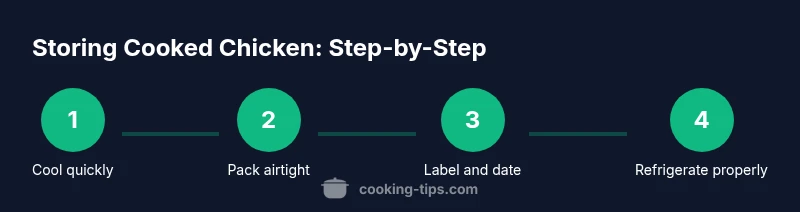
Cool the chicken quickly
Transfer portions to a shallow tray or small containers and spread evenly. If the chicken is still warm, aid cooling with a fan or a cool water bath on the tray's bottom. The goal is to drop from hot to below 40°C within 2 hours to minimize bacterial growth.
Tip: Cut larger pieces into smaller chunks to accelerate heat loss and even cooling. - 2
Choose airtight packaging
Move the cooled chicken into an airtight container or a sealed zip-top bag. Remove as much air as possible to limit oxidation and freezer burn if you’re planning to freeze later. Flat, compact bags stack neatly and chill evenly.
Tip: If using bags, lay them flat; freeze in a single layer before stacking. - 3
Label with date and portion
Always label with the date and the portion size. This makes it easy to rotate stock and ensures you discard items after their safe window.
Tip: Use a permanent marker for clear, legible dates; include 'reheat once' if applicable. - 4
Place in the fridge properly
Store containers on the middle shelf where the temperature is most stable, away from raw meats and strong-smelling foods to prevent cross-contact and flavor transfer.
Tip: Keep a consistent fridge temperature by avoiding frequent door openings during busy meal prep times. - 5
Plan reheating and consumption
When ready to eat, reheat to 165°F (74°C) until steaming hot, and eat within 3-4 days. Don’t reheat leftovers more than once.
Tip: Only reheat what you will consume in one sitting to preserve quality. - 6
Discard questionable leftovers
If you notice off smells, a slimy texture, or unusual color, discard the portion rather than risking foodborne illness.
Tip: Trust your senses; when in doubt, throw it out.
Quick Answers
How long can cooked chicken stay in the fridge?
Typically 3-4 days when stored properly in a refrigerator at 40°F (4°C).
Cooked chicken usually stays safe for three to four days in the fridge when kept at the right temperature.
Can I freeze cooked chicken instead of refrigerating?
Yes, cooked chicken freezes well for 2-6 months; thaw in the fridge overnight before reheating.
Yes. You can freeze cooked chicken for several months and thaw in the fridge before reheating.
Is it safe to leave cooked chicken out at room temperature overnight?
No. Discard if left out more than two hours (one hour if the environment is warm).
No—leftovers left out overnight should be discarded due to safety risk.
Should I wash cooked chicken before refrigerating?
No; washing cooked chicken can spread bacteria. Pat dry and refrigerate promptly.
No—do not wash cooked chicken; pat dry and place in the fridge.
What container works best for storing cooked chicken?
Airtight containers or resealable bags with a flat, shallow design are ideal for even cooling and easy stacking.
Use airtight containers or flat bags to store leftovers neatly.
How should I reheat leftovers safely?
Reheat to 165°F (74°C) until steaming hot throughout; only reheat what you plan to eat in one sitting.
Reheat leftovers to 165°F until hot all the way through, and don't reheat more than once.
Watch Video
Top Takeaways
- Cool quickly, then package airtight.
- Label with date and portion size.
- Store on a stable shelf away from raw foods.
- Reheat to 165°F and use within 3-4 days.