How Long to Cook Lasagna: A Practical Timing Guide
Learn for how long to cook lasagna with practical timing tips for ovens, pan sizes, and fillings. This guide covers no-boil noodles, meat vs veggie layers, and resting for perfect slices.


By the end of this guide you will know exactly how long to bake lasagna for a tender, cheesy result, with timing adjusted for pan size, oven type, and filling. Start with a basic bake at 350°F (175°C) for 45-60 minutes, covered, then uncover to finish until bubbling and the cheese is golden. Always rest 10-15 minutes before slicing.
for how long to cook lasagna
for how long to cook lasagna is a common sticking point for home cooks. Getting the timing right means tender noodles, velvety ricotta, and melted cheese that browns beautifully instead of drying out. According to Cooking Tips, timing is less about a fixed minute count and more about the interaction of ingredients, pan size, and oven performance. The Cooking Tips team found that starting with a standard bake and adjusting based on your setup yields reliable results. In this section we outline the baseline approach and the reasons behind it, so you can tune timing to your recipe.
Key factors that influence bake time
The bake time for lasagna depends on several variables that change from household to household. First, the type of noodles matters: traditional parboiled noodles behave differently from no-boil sheets, affecting moisture distribution and cooking needs. Second, fillings—whether meat, poultry, or vegetables—alter moisture content and required heat. Third, pan size and depth influence heat penetration; a shallow 9x13 pan reaches the center more quickly than a deeper casserole. Fourth, oven performance matters: convection ovens circulate air for faster, more even cooking, while conventional ovens rely on radiant heat. Finally, whether you cover the dish in the early stage or bake uncovered impacts browning and moisture retention. Keep these factors in mind when planning your bake.
Conventional vs convection ovens and pan sizes
In a conventional oven, a standard meat or cheese lasagna baked in a 9x13 inch dish typically bakes covered for about 45-60 minutes, then 10-15 minutes more uncovered to brown the cheese. If you use a smaller or deeper pan, plan slightly longer bake times; a shallow 8x8 inch pan may finish sooner but must be watched for edge scorching. Convection ovens can shorten bake times by roughly a third or more, depending on the model and dish height. When using convection, reduce the bake window by about 5-10 minutes and monitor carefully to avoid overcooking. Always verify that the center is heated through and the top is bubbling and lightly browned.
Ingredient and assembly impact on timing
Moisture in the filling significantly affects bake duration. A heavily sauced lasagna or one with extra ricotta may stay wetter inside, requiring longer heat to reach the center. Layer thickness also matters: thick stacks of sauce and cheese slow heat transfer; thin, even layers heat more quickly. If you’re using no-boil noodles, the dish often needs a longer final bake to hydrate the noodles fully. Letting the lasagna rest after baking is not optional—it allows the layers to set and prevents them from sliding apart when sliced, improving texture and portion control.
Signs of doneness and resting time
The simplest cue is the bubbling around the edges and a steady surface of melted cheese. The center should be hot to the touch; if you have a thermometer, aim for about 165°F (74°C) in the center when meat is included. Resting the lasagna for 10-15 minutes after removing it from the oven helps the filling reabsorb moisture and makes clean slicing easier. If the top browns too quickly, loosely tent the dish with foil to prevent scorching while the interior finishes cooking.
Common mistakes to avoid
One common error is removing the foil too early or too late; both can lead to a soggy center or overly dry edges. Another pitfall is overloading the pan with sauce and fillings, which disrupts heat distribution and extends the bake time. Skipping the resting period leads to runny slices that fall apart when plated. Finally, using noodles that aren’t adequately hydrated or pre-cooked can lengthen the total time and compromise texture. Careful assembly and timing yield the best results.
A practical start-to-finish formula you can trust
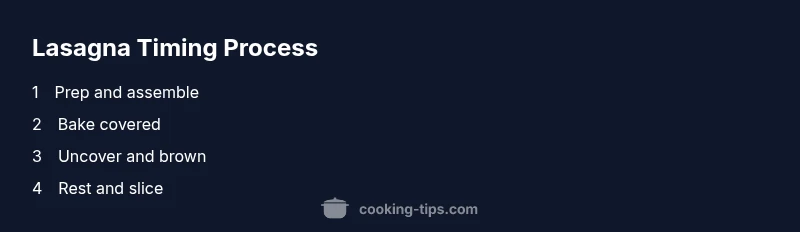
Here’s a simple framework you can apply to most lasagna recipes: bake covered at 350°F (175°C) for 45-60 minutes, uncover and bake 10-15 minutes more until bubbling and cheese is lightly browned, then rest 10-15 minutes before slicing. This approach balances moisture, texture, and aroma while accommodating common ingredient variations. If you’re unsure, start with the lower end of the time range and check for doneness using bubbling and center heat as your guide.
Tools & Materials
- 9x13 inch baking dish (or equivalent)(Deep enough for 3-4 lasagna layers; glass or ceramic recommended)
- Aluminum foil(Heavy-duty preferred for tight cover during bake)
- Oven-safe thermometer (optional)(To verify actual oven temperature and center doneness)
- Mixing bowls(For ricotta blend, sauces, and layering prep)
- Cheese grater(For mozzarella and parmesan before layering)
- Measuring cups and spoons(To portion sauces, cheeses, and seasonings accurately)
- Kitchen timer(Keeps bake and rest periods precise)
Steps
Estimated time: Total time: 60-90 minutes
- 1
Prep ingredients and preheat
Gather ingredients, preheat the oven to 350°F (175°C), and prepare your sauce and fillings. If using no-boil noodles, skip parboiling but ensure moisture is adequate in the sauce. This upfront prep helps ensure even cooking.
Tip: Have all components ready before assembly to prevent gaps in timing. - 2
Assemble the first layer
Spread a thin layer of sauce on the bottom of the dish to prevent sticking. Add a layer of noodles, followed by cheese filling and more sauce. Aim for even coverage without thick clumps.
Tip: Keep sauce at a workable consistency; overly thick sauce can create dense layers. - 3
Build additional layers
Continue layering in the order: sauce, noodles, filling, sauce. End with a final sauce layer and cheese on top. Maintain even thickness to promote uniform cooking.
Tip: Avoid overlapping edges; neat layers promote cleaner slices. - 4
Cover and bake
Seal the dish with foil to trap moisture and steam through the layers. Bake at 350°F (175°C) for 45-60 minutes depending on pan depth and filling moisture.
Tip: If your sauce is very thick or you used extra vegetables, expect the timer to push toward the longer end. - 5
Uncover and finish browning
Remove the foil and bake 10-15 minutes longer until the top is bubbling and lightly browned. This step develops color and aroma while ensuring center heat.
Tip: Rotate the dish halfway if your oven heats unevenly. - 6
Rest and serve
Let the lasagna rest at least 10-15 minutes before slicing. Resting helps the filling set and makes slices cleaner.
Tip: A sharp knife and a steady hand yield cleaner portions and presentation.
Quick Answers
How long should I bake lasagna in a conventional oven?
In a conventional oven, bake covered for about 45-60 minutes, then uncover for 10-15 minutes to finish browning. Rest 10-15 minutes before slicing.
Bake covered for 45 to 60 minutes, then uncover for 10 to 15 minutes. Let it rest before slicing.
Does no-boil lasagna require different timing?
No-boil noodles may require slightly longer bake time to hydrate fully. Start with the standard time and verify doneness by bubbling and center heat.
No-boil noodles can take a bit longer; start with the usual time and check the center.
Should I bake at a lower or higher temperature?
A moderate temperature like 350°F (175°C) provides sensible heat for even cooking. Higher temperatures risk uneven browning or dried edges.
350°F is a good baseline; higher temps can brown the top too quickly.
Can I assemble lasagna ahead of time and bake later?
Yes. Assemble and refrigerate before baking. You may need to add a few extra minutes for the dish to reach center doneness.
You can assemble ahead and refrigerate; bake longer if it's cold.
What’s the best way to know when lasagna is done?
Center should be hot and the surface bubbling; cheese will be browned. If you have a thermometer, aim for about 165°F (74°C) in the center if meat is included.
Look for bubbling edges, a hot center, and light browning on top.
Can lasagna be frozen and reheated?
Yes. You can freeze assembled or baked lasagna. Reheat until the center is hot and the dish is bubbling; you may need to increase bake time when starting from frozen.
Lasagna freezes well; reheat until hot in the center.
Watch Video
Top Takeaways
- Preheat accurately to set the bake from the start
- Cover during most of bake, then uncover to brown
- Rest before slicing to improve texture
- Adjust timing for pan size and noodle type
- Check center doneness and moisture before serving