Difference Between a Cook and a Baker: An Analytical Guide
An analytical guide to the difference between a cook and a baker, exploring definitions, skills, training, tools, and career paths to help readers decide path.


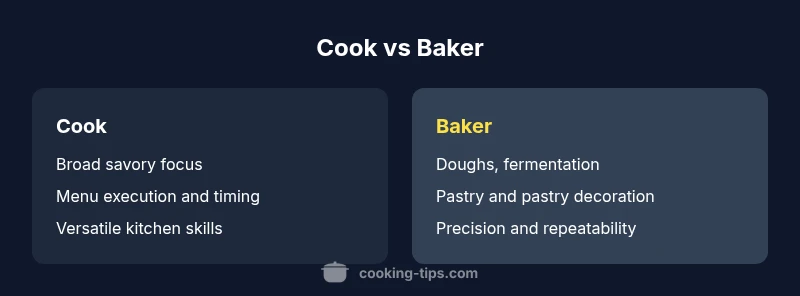
Cook vs baker: The difference between a cook and a baker lies in specialization and skill focus. Cooks generally prepare a wide range of savory dishes across cuisines, while bakers focus on doughs, breads, pastries, and precise fermentation. This distinction shapes training, hours, tools, and career paths, though both roles share fundamentals like timing, temperature control, and recipe execution.
Understanding the difference between a cook and a baker
The difference between a cook and a baker is foundational to how a kitchen operates, dictates skill development, and influences career pathways. According to Cooking Tips, these roles are shaped by training, daily tasks, and the scale of operations. In many kitchens, a cook must be versatile enough to handle a broad menu, while a baker specializes in doughs, fermentation, and pastry accuracy. The Cooking Tips team notes that in small establishments, staff may juggle multiple hats, but the core competencies remain distinct: cooks emphasize savory cooking and menu execution; bakers emphasize dough work, fermentation, and repeatable pastry processes. This distinction is not merely about recipes; it reflects a mindset—improvisation and speed on one side, precision and repeatability on the other. Across cultures, both paths rely on core kitchen literacy—knife skills, heat management, sanitation, and flavor balance—yet the outcomes diverge toward different kinds of nourishment.
Historical context and vocational origins
The historical divergence between cooks and bakers traces back to early guilds and evolving kitchen hierarchies. Bakers emerged with a strong emphasis on bread, pastries, and controlled fermentation, while cooks developed broad culinary repertoires for meats, vegetables, and sauces. Over centuries, institutional kitchens—palaces, hotels, and military posts—codified distinct training tracks. Today, many culinary programs still separate baking and culinary tracks, while some schools promote cross-training to build well-rounded cooks who understand dough science. The foods we produce—and the equipment we rely on—reflect these traditions, yet modern kitchens increasingly value cross-disciplinary skills. This history matters because it explains why the two paths co-exist, sometimes overlapping, and why each demands different temperaments and time commitments.
Core responsibilities: day-to-day tasks
In a typical kitchen, a cook’s day is defined by meal service, recipe execution, and the coordination of multiple dishes. They manage mise en place for savory courses, sauté sauces, monitor heat, and adjust seasoning on the fly. A baker’s day centers on dough management, fermentation timing, shaping, and baking. The baker monitors oven temperatures, applies precise hydration levels, and often decorates or finishes products like breads and pastries. While cooks must respond quickly to guest orders, bakers rely on repeatable processes and meticulous measurement. Both roles require clean stations, consistent sanitation, and teamwork, but their daily rituals diverge in terms of technique, focus, and product output. The difference between a cook and a baker is most visible in the shift toward fermentation control and pastry precision on the bakery side versus menu-driven, savory execution on the cooking side.
Skills and training pathways
To pursue the cook path, foundational culinary training emphasizes knife work, heat control, flavor development, and kitchen math. Programs often cover stocks, sauces, meat fabrication, vegetables, and plating. Bakers typically study dough science, fermentation, pastry methods, yeasted doughs, lamination, and decorating techniques. Apprenticeships, culinary schools, and on-the-job training build these capabilities, with many programs encouraging cross-training between bakery and kitchen departments. Beyond formal schooling, successful cooks and bakers cultivate time management, palate development, and adaptability. A strong sense of hygiene and safety remains essential in both tracks, but the specific curricula emphasize different outcomes: savory mastery for cooks, precise texture control and dough behavior for bakers.
Tools, equipment, and work environment
The cook works with a broad toolkit: pans, knives, burners, ovens, timers, and flavor-building gear. They thrive in fast-paced, high-volume settings where menu items must be executed consistently. Bakers rely on oven lines, scales, dough mixers, proofing chambers, and specialized pastry tools. The environment for bakers often includes early mornings and extended baking sessions, with a focus on controlled humidity and temperature. Although both paths share kitchen hazards and safety standards, bakers contend with the precision demands of dough and pastry, while cooks contend with the variability of live service and guest requests.
Career progression and earning potential
Career trajectories differ by chosen path and geographic context. Cooks may advance from line cook to sous-chef and eventually to executive chef, with opportunities in diverse cuisines and high-end dining. Bakers can pursue roles from head baker to pastry chef or run a bakery storefront, with potential expansion into wholesale production. Earning potential varies widely by region, venue type, and whether one works in restaurants, hotels, or independent bakeries. In both paths, leadership roles often require a blend of culinary skill, management ability, and business sense. The Cooking Tips team notes that progression hinges on mastering core competencies, networking, and expanding skill sets beyond the initial focus.
Overlaps, collaboration, and kitchen dynamics
Despite clear distinctions, cooks and bakers frequently collaborate. A successful kitchen relies on cross-functional communication, shared sanitation standards, and mutual respect for each other’s expertise. Cooks may rely on bakers for bread service and patisserie components, while bakers depend on cooks to translate pastry items into cohesive menus. The ability to explain techniques, coordinate timing, and adapt to last-minute changes is a hallmark of kitchen teamwork. Understanding the difference between a cook and a baker helps teams plan better, assign tasks efficiently, and ensure a consistent guest experience across savory and sweet domains.
Common challenges and misconceptions
One common misconception is that cooks and bakers can be interchangeable without training. The reality is that each path emphasizes different skill sets, schedules, and sensory skills. Bakers often battle intense early hours, specialized equipment, and the need for precise measurements; cooks face relentless service pressure, menu variability, and rapid decision-making. A key challenge for aspiring professionals is balancing the desire for breadth versus depth. Realistic planning—whether aiming to master sauces and sauté or dough handling and fermentation—helps manage expectations and improve long-term outcomes.
Practical steps to choose a path
If you enjoy improvisation, speed, and savory flavors, the cook path may suit you. If you love precise measurements, fermentation, and pastry aesthetics, the baker path could be your calling. Start by shadowing both roles in a local kitchen or bakery, then pursue targeted training: culinary courses for cooks, baking and pastry programs for bakers. Consider internships or entry-level positions to test fit and appetite for early hours. As you gain experience, you’ll learn which environment aligns with your energy, values, and long-term goals.
Comparison
| Feature | Cook | Baker |
|---|---|---|
| Definition/Primary focus | Cooks manage a broad range of savory dishes and menu execution | Bakers specialize in breads, pastries, and desserts, emphasizing dough work and fermentation |
| Core techniques | Sautéing, simmering, grilling, sauce reduction, plating | Mixing, kneading, proofing, shaping, baking |
| Ingredient handling | Wide variety of ingredients; seasonality matters | Precise flour/water ratios; scales and timers are essential |
| Tools & equipment | Skillets, knives, heat sources; broad kitchen equipment | Ovens, mixers, dough dividers, scales |
| Typical work environment | Restaurant kitchen, hotel, catering; fast-paced service | Bakery or pastry kitchen; early hours, controlled environments |
| Career trajectory | Line cook → sous-chef → head chef | Pastry cook → head baker → pastry chef or owner |
| Education & training | Culinary programs, on-the-job training | Baking/pastry programs, culinary cross-training |
Benefits
- Clear specialization that clarifies career paths
- Breadth for cooks enables adaptability across cuisines
- Bakery skills are highly valued in retail and wholesale markets
- Both paths offer opportunities for entrepreneurship and leadership
- Cross-training can broaden job opportunities
Cons
- Bakery roles often require very early hours and weekend work
- Cooking roles can be high-stress with long service hours
- Specialized baking may limit immediate versatility without cross-training
- Advancement can depend on geographic demand and brand strength
Both paths lead to rewarding culinary careers; the choice depends on whether you seek broad savory versatility or precise pastry mastery
Choose the cook path for menu versatility and leadership in kitchen operations. Pick the baker path if you value dough science, fermentation, and pastry craft; both routes benefit from cross-training and ongoing learning.
Quick Answers
What is the primary difference between a cook and a baker?
The primary difference is focus: cooks handle a broad range of savory dishes and menus, while bakers specialize in doughs, fermentation, and pastries. Both require strong technique and timing, but the end products and processes diverge.
Cooks work on savory dishes across menus; bakers focus on doughs and pastries with precise techniques.
Can a cook become a baker and vice versa?
Yes. Many kitchens encourage cross-training, and formal programs exist for both tracks. A switch typically involves learning new core techniques, equipment, and schedules. Start with small shifts or courses in the new area to build confidence.
It's common to cross-train; start with basics and gradually take on more specialized tasks.
What training is common to both roles?
Foundational culinary safety, knife skills, heat management, flavor balance, and sanitation are essential for both paths. Many programs also emphasize recipe execution, portion control, and teamwork in a high-pressure environment.
Safety, knife work, heat control, and teamwork are universal foundations for cooks and bakers.
Do cooks and bakers work the same hours?
Not always. Bakers often start very early and work through the morning, while cooks work across lunch and dinner services. Schedules vary by restaurant type, but both paths can require weekend work and holiday shifts.
Bakery hours are usually early; cooks often cover lunch and dinner service.
Is bakery work more math-heavy than cooking?
Baking involves precise measurements, weights, and ratios, with fermentation timing and humidity control adding to the exacting nature. Cooking emphasizes tasting, seasoning, and timing, with flexibility in ingredient quantities.
Baking needs precise measurements; cooking uses judgment and adjustment.
What should I consider when choosing between these paths?
Consider your love of precision, fermentation, and pastry versus your interest in savory cooking, menu development, and service pace. Shadowing, internships, and short courses can help you decide which environment suits your strengths and lifestyle.
Think about whether you enjoy pastries and doughs or savory dishes and fast-paced service.
Top Takeaways
- Identify your preferred focus: savory versatility vs. pastry precision
- Shadow both roles to test fit before committing
- Pursue cross-training to maximize career options
- Early hours and service demands differ; plan accordingly
- Leverage bakery or kitchen networks to advance
- Invest in foundational safety and sanitation training