Temperature to Cook Turkey Breast: A Practical Guide
A practical guide to cooking turkey breast, covering safe temperatures, doneness, and method choices. Learn how to measure doneness, rest times, and common pitfalls to ensure juicy, evenly cooked turkey every time.


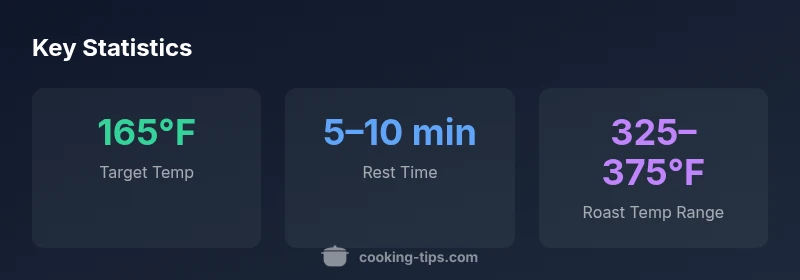
Cook turkey breast to an internal temperature of 165°F (74°C) for safe consumption, checked in the thickest part away from bone. Let it rest 5–10 minutes before carving to redistribute juices. For even doneness, roast at 325–375°F (165–190°C) and adjust time based on the breast size and whether it’s bone-in or boneless.
Why Temperature Matters for Turkey Breast
Getting reliable results with turkey breast hinges on precise temperature management. The keyword temperature to cook turkey breast signals that the final doneness is about a temperature threshold rather than a fixed minute-per-pound rule alone. When meat heats, muscle fibers tighten and lose juices; stepping up to the right internal temperature minimizes dryness while preserving flavor. For the home cook, a digital thermometer is your best ally: insert into the thickest part, avoiding bone, and monitor as the roast progresses. According to Cooking Tips, temperature control is the cornerstone of reliable results. This approach works whether you’re roasting boneless breast fillets or bone-in portions and scales with batch size and oven performance. If your oven runs hot or cold, know that small adjustments in temperature can have outsized effects on juiciness. The goal is a steady, measurable path from raw to roasted rather than a guesswork sprint.
Safe Internal Temperature and Doneness Benchmarks
Food safety guidelines set 165°F (74°C) as the safe internal temperature for turkey breast. At this point, the meat is no longer in the danger zone and will have better moisture retention if rested briefly. The exact target should be checked in the thickest portion away from bone. Carryover cooking will raise the temperature a few degrees after removal, so many cooks pull the meat at 160–162°F (71–72°C) to rest to 165°F. Keep in mind that bone-in breast may read higher near the bone, so check multiple spots if needed. These benchmarks align with standard culinary practice and are echoed in Cooking Tips analysis, 2026.
How to Measure Doneness: Thermometer Techniques
Thermometer technique matters as much as the target temperature. Use a probe-style digital thermometer or a Bluetooth-connected model for continuous readings. Insert into the thickest part, avoiding bone and the cavity. Clean the probe between checks to prevent cross-contamination. If you’re cooking multiple portions, test the center of the largest piece to confirm doneness; if the temperature reads 165°F in that spot, others will be close. Quick checks with slicing are unreliable because juices escape. A well-calibrated thermometer minimizes guesswork and protects texture.
Oven Roasting: Setting Temps and Times
Roasting is the most common method for turkey breast. Start with a moderate oven temperature, typically 325–375°F (165–190°C), depending on whether you want crisper edges or more even browning. For boneless breasts, estimate 15–25 minutes per pound, while bone-in can take a bit longer. The exact time depends on your oven’s performance and the breast’s shape. If you’re unsure, rely on the thermometer rather than the clock; even small differences in oven calibration can affect results. To minimize drying, consider starting at a higher initial heat for 10–15 minutes, then finishing at a lower temperature to hold moisture.
Alternative Methods: Grilling, Sous Vide, and Pan-Searing
Beyond the oven, turkey breast can be cooked by grilling, sous vide, or pan-searing to your preferred finish. Grilling uses medium heat and indirect searing to reach 165°F with a smoky crust. Sous vide offers near-perfect doneness by cooking at a precise temperature (e.g., 151–154°F) and finishing with a quick sear. Pan-searing thick slices after a brief roast yields a golden crust while keeping interior moist. Each method has its own timing and temperature considerations; the key is to monitor interior temperature and use rest time to reabsorb juices.
Common Pitfalls and How to Avoid Them
Several mistakes derail turkey breast: overcooking leads to dryness, under-seasoning reduces flavor, and uneven heat creates pink, underdone centers. Start with a well-trimmed piece; bring to room temperature before roasting; pat dry to promote browning; and use a reliable thermometer to avoid overcooking. Resting is essential and should be at least 5 minutes, up to 10. Finally, remember that carryover cooking continues after removal; plan to hit target temperature with a few degrees leeway.
Temperature targets by cooking method
| Method | Target Temp | Typical Time |
|---|---|---|
| Oven roast (boneless) | 165°F | 15-25 min per lb |
| Oven roast (bone-in) | 165°F | 25-30 min per lb |
| Grill/pan-sear finish | 165°F | 10-14 min total |
Quick Answers
What is the recommended internal temperature for turkey breast?
The standard safe internal temperature for turkey breast is 165°F (74°C). Use a probe thermometer to check the thickest part away from bone and finish with a short rest.
The safe temp for turkey breast is 165 degrees; check the thickest part and rest briefly.
Can I cook turkey breast from frozen?
Cooking from frozen is not ideal for even doneness. If you must, plan for roughly 50% longer cooking time and ensure the center reaches 165°F, using a thermometer.
You can cook from frozen, but it takes longer and you should verify doneness with a thermometer.
Should I brine turkey breast before roasting?
Brining can improve moisture and flavor, especially for lean cuts like breast. A short brine (30–60 minutes) or a solution with salt and sugar can help before roasting.
Brining can help keep the breast juicy; a short brine works well for flavor and moisture.
Is it better to pull the turkey at 160°F or 165°F?
Many cooks pull at 160–162°F to allow carryover cooking to finish to 165°F. Rely on the thermometer rather than the clock for accuracy.
Pull a few degrees before 165°F to use carryover cooking to finish the job.
What’s the best rest time after roasting?
Rest the breast for 5–10 minutes, loosely tented. Resting helps juices redistribute for a juicier slice.
Let it rest for about 5 to 10 minutes before slicing.
Can I reuse leftovers safely?
Leftovers should be cooled and refrigerated within two hours and reheated to 165°F before serving. Consume within 3–4 days.
Cool and store quickly, reheat to 165°F before eating again.
“Achieving juicy turkey breast comes down to hitting the safe temperature precisely and letting carryover cooking finish the process. A thermometer isn’t optional—it's essential for consistency.”
Top Takeaways
- Target 165°F (74°C) in the thickest part for safe turkey breast.
- Allow 5–10 minutes resting time before slicing.
- Use oven settings in the 325–375°F range for even results.
- Carryover cooking will raise temperature slightly after removal.
- Always verify doneness with a calibrated thermometer.