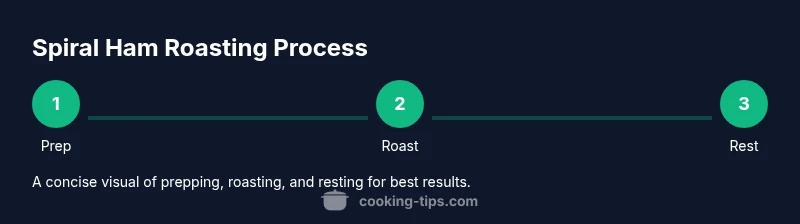
How Long to Cook a Spiral Ham: Timings, Temps, and Tips
Learn how long to cook a spiral ham for safe, juicy perfection. This guide covers weight-based timings, oven temps, resting, glazing, and smart tips from Cooking Tips to help home cooks nail the roast every time.


Learn exactly how long to cook a spiral ham to a safe, juicy finish. This quick answer covers typical weights, oven temperatures, and resting times, plus glaze options. Follow the tested timings below for dependable results in everyday cooking, with guidance from Cooking Tips. Whether you're preparing a holiday spread or a weeknight dinner, this snippet gives you a reliable target range and the steps to verify doneness.
Understanding spiral ham timing basics
Spiral ham refers to a fully cooked, boneless or semi-boneless ham that has been pre-sliced into a continuous spiral for easy serving. Because the ham is already cooked, the goal is to reheat evenly without drying the meat, and to glaze or finish with flavor just before serving. The quick takeaway is that you’re not starting from raw; you’re reheating while preserving juiciness. The Cooking Tips team emphasizes that timing should hinge on weight and oven temperature, not on raw-cooking charts alone. A typical strategy is to use a low and steady heat to warm through the center while the outer layers stay moist. Spiral ham’s many thin surfaces heat more rapidly than a center-cut roast, which is why gentle heat and covered roasting are recommended. Think in bands: per-pound targets, a protected interior, and a finish that adds glaze without overcooking.
When you plan, remember that equipment and pan size can shift timings by 10–20 minutes in either direction. If your ham is especially moist or has a sugar glaze already on it, you may notice faster browning on the exterior; cover with foil sooner to avoid burning.
What affects cook time: weight, glaze, and oven temperature
The biggest variable is weight. A typical spiral ham weighs 6 to 12 pounds. Heavier hams take longer to heat through to a safe serving temperature, while lighter ones finish sooner. Glaze can influence timing because sugars caramelize and brown surfaces quickly; if you glaze early, you may need to cover the pan to prevent scorching and re-check doneness. Oven temperature matters just as much as weight: a steady heat around 275–325°F promotes even reheating and moisture retention, whereas higher temps shorten total time but raise the risk of dry edges. If you’re using a convection oven, you may reduce the suggested time slightly because the circulating air speeds heat transfer. In practice, plan for longer times at the lower end of the range and shorter times at the higher end, and always verify doneness with a thermometer rather than by time alone.
Safe temperature guidelines and testing doneness
Because most spiral hams are sold fully cooked, your aim is reheating to a safe serving temperature rather than raw-cook temperatures. The recommended internal temperature target for reheated ham is 140–145°F (60–63°C), followed by a short rest that allows carryover heating to finish the job. If you glaze, do so during the last 15–20 minutes of cooking to avoid burning the sugars. Use an accurate instant-read thermometer inserted into the thickest part of the ham, away from any glaze or fat pockets. If you can’t measure with a thermometer, rely on visual cues: steaming-hot surface heat and a uniform color without gray, pinkish margins that indicate under-warmed meat. Always let the ham rest before carving to help juices redistribute.
Step-by-step roasting method (no glaze first)
Preheat your oven to 275–325°F (134–163°C). Place the ham on a rack in a shallow roasting pan, bone side down if applicable, and add a small amount of water or broth to the pan to maintain moisture. Tightly tent the ham with foil to trap steam and prevent surface drying. Roast until the internal temperature near the center reaches about 110–120°F (43–49°C). Remove the foil to expose the surface and brush with your glaze if using. Return to the oven and roast until the center hits 140–145°F (60–63°C). Remove from heat and let rest 15–20 minutes before carving to retain juiciness and improve slice integrity.
Resting and carving for best texture
Resting is critical: tented or loosely covered, let the ham rest off the heat for 15–20 minutes. This allows the juices to re-distribute, making slices easier to cut and more moist. For optimal presentation, carve across the grain in thin, even slices. If your spiral ham is heavily glazed, slice with a smooth, clean knife and wipe the blade occasionally to prevent glaze drag. Serve with sides that complement sweetness without overpowering the ham’s natural savor.
Food safety: leftovers and storage
After serving, refrigerate any leftovers within two hours of cooking. Slice or portion the meat, place in shallow containers, and store for up to 3–4 days. For longer storage, wrap tightly and freeze for 1–2 months. Reheat portions gently to avoid drying them out, using low heat and a bit of broth or water to reintroduce moisture. Reheating in the oven at a low temperature (275–300°F) is often the best approach for evenly warmed leftovers.
Quick-reference by weight and time ranges
Small to medium spiral hams (6–8 lb): about 1.5–2.5 hours of reheating at 275–315°F. Heavier hams (8–12 lb): about 2–3 hours. If you’re starting from a partially warmed state, reduce time by 15–30 minutes. Always confirm with a thermometer for accuracy, focusing on the thickest portion of the meat and avoiding glaze layers when measuring.
Troubleshooting common issues
If you notice dry edges or over-browning, shield the ham with foil and lower the oven temperature by 25°F. If the center remains underheated after the expected time, check your oven calibration with an oven thermometer and adjust heat accordingly. For heavy glaze, wait until the last 15–20 minutes to apply to prevent scorching. Ensure your ham has enough surface moisture by adding a small amount of liquid to the pan during reheating.
Flavor pairings and sides
Complement spiral ham with tangy and bright sides like cranberry relish, orange-glazed carrots, roasted Brussels sprouts, or a light parsley salad. A potato dish—mashed or roasted—balances the richness, while a sharp mustard or honey-mustard glaze can echo the glaze on the ham without clashing flavors. For extra aroma, finish with a light herb butter or citrus zest over the serving platter.
Tools & Materials
- Meat thermometer (instant-read)(Insert into the thickest part of the ham, away from glaze; target 140–145°F)
- Oven-safe roasting pan with rack(Allows even heat distribution and keeps meat above pooling juices)
- Aluminum foil(Tents the ham during roasting to prevent surface drying)
- Basting brush(For applying glaze evenly during the final phase)
- Measuring cup and whisk(Helpful for mixing glaze and catching any drippings)
- Glaze ingredients (optional)(Common options include brown sugar, maple syrup, honey, mustard, and citrus zest)
- Timer or smartphone(Keep track of resting and final checks)
Steps
Estimated time: Total time: 2 hours 15 minutes to 3 hours 45 minutes
- 1
Preheat and prep
Preheat your oven to 275–325°F. While it heats, place the ham on a rack in a shallow roasting pan and gather glaze if using. This ensures steady heat distribution from the start.
Tip: Low, steady heat reduces drying risk; avoid blasting with high heat at the beginning. - 2
Add moisture
Pour a small amount of water or broth into the pan to maintain moisture. The steam and liquid help keep the surface from drying as the ham heats.
Tip: Keep the liquid level modest—you’re not braising, just providing a moisture cushion. - 3
Tent the ham
Cover the ham tightly with foil to trap steam and heat evenly. This prevents the exterior from cooking too quickly while the interior catches up.
Tip: Foil should be smooth and snug; avoid gaps where heat could escape. - 4
Roast toward the middle
Roast until the inner temperature approaches 110–120°F. This stage is about warm-through, not finishing, to avoid overcooking the outer edges.
Tip: If your oven runs hot, check earlier to avoid overshoot. - 5
Finish with glaze
Remove foil, brush on glaze if desired, and return to the oven. Cook until the center reaches 140–145°F and the glaze is glossy and set.
Tip: Glaze late to prevent sugars from burning; watch closely in the final minutes. - 6
Rest before carving
Let the ham rest loosely tented for 15–20 minutes after removing from heat. Resting helps juices redistribute for juicier slices.
Tip: A longer rest can deepen flavor and improve slicing ease. - 7
Carve and serve
Slice across the grain for tender pieces. Jenly arrange the rounds for an attractive presentation and even portions.
Tip: Keep slices uniform to ensure even bite texture for guests. - 8
Reheat leftovers if needed
If reheating leftovers, use low heat with a splash of broth to preserve moisture. Avoid high heat that dries meat.
Tip: Plan small portions to avoid repeated reheating.
Quick Answers
What is the safe internal temperature for spiral ham?
Spiral ham should reach 140–145°F in the center, then rest to allow juices to redistribute. Always verify with a reliable thermometer.
Heat the ham to 140 to 145 degrees and let it rest before serving.
How long should I cook spiral ham per pound?
Plan for roughly 10–15 minutes per pound at a low, steady oven temperature, then finish with glaze if desired. Always check the thermometer rather than relying solely on time.
About ten to fifteen minutes per pound, then check temperature.
Should I glaze during cooking or after?
Glaze during the last 15–20 minutes of cooking to avoid burning sugars. If your glaze is sweet, keep an eye on browning and cover sooner if needed.
Glaze near the end to prevent scorching.
Can I cook spiral ham from frozen?
Thaw completely before roasting for even cooking. Cooking from frozen can lead to uneven heat and unsafe portions.
Avoid cooking from frozen; thaw first.
How long should I rest the ham after cooking?
Rest the ham for 15–20 minutes off the heat to let juices redistribute and improve slicing.
Let it rest 15 to 20 minutes before carving.
What should I do with leftovers?
Refrigerate leftovers within two hours and store for 3–4 days, or freeze for longer storage. Reheat gently with a splash of broth.
Store leftovers promptly and reheat gently.
Watch Video
Top Takeaways
- Plan around weight and temperature, not time alone.
- Use a thermometer to verify 140–145°F for safety and juiciness.
- Glaze late in cooking to avoid burning sugars.
- Rest 15–20 minutes before carving for best texture.
- Store leftovers promptly to maintain quality.