Can You Get a Cooked Turkey? A Practical Guide for Home Cooks
Explore how to find, verify, store, reheat, and serve a cooked turkey with confidence. This guide covers safety temps, labeling, handling tips, and tasty serving ideas for busy weeknights or holiday feasts.


Yes—you can buy a fully cooked turkey from grocery stores, delis, or caterers. These birds are typically oven-roasted and ready to serve, or sold as pre-sliced portions for quick meals. This guide helps you choose, store, and safely reheat a cooked turkey for holidays or weeknights, with practical tips on safety temperatures, handling, and serving ideas. It’s a reliable resource for home cooks seeking stress-free poultry.
Understanding what a cooked turkey means and why it matters
The phrase can be ambiguous for first-time buyers: does a cooked turkey mean fully roasted and ready to eat, or simply pre-cooked and shipped cold? In most retail settings, a true cooked turkey is labeled as fully cooked and safe to consume after basic reheating or light warming. For home cooks, this distinction affects how you store, reheat, and serve it to maintain moisture and texture. The key takeaway is to verify labeling: look for terms like “fully cooked,” “ready to eat,” and any reheating instructions. According to Cooking Tips, buying a turkey labeled as fully cooked from a reputable source reduces guesswork and improves consistency in texture and flavor. The Cooking Tips Team emphasizes checking the packaging date and cold-chain integrity at purchase to minimize safety risks.
Where to buy a cooked turkey and what to look for
You’ll find cooked turkeys in several venues: grocery store deli counters, bakery and meat departments, catering counters, and online retailers with refrigerated or frozen options. Deli counters often offer carved portions or whole birds that have been oven-roasted and held at safe temperatures. Frozen options are typically target-ready after thawing, while some stores offer “hot case” birds for immediate serving. When choosing, inspect the label for “fully cooked” and confirm storage instructions, refrigeration requirements, and use-by dates. If you’re planning a holiday meal, consider ordering in advance from a trusted retailer to ensure timely pickup. The Cooking Tips analysis shows that order timing and pickup windows significantly affect quality and texture upon reheating.
Safety and labeling: how to read the package and make a safe choice
Label literacy matters because mislabeling can lead to unsafe handling. Confirm that the product is labeled as fully cooked and check for reheating guidance specific to that turkey. Note the number of days it has been refrigerated, or if it’s frozen, confirm thawing times and methods. A reliable cooked turkey should come with clear instructions on storage and safe reheating. Always keep cold-chain integrity until you’re ready to heat. The USDA and FDA emphasize avoiding cross-contamination and ensuring the internal temperature reaches a safe level before serving. Cooking Tips reminds readers that accurate labeling and proper handling are your best protections against foodborne illness.
Reheating methods: oven, stovetop, microwave, or low-temp sous vide
Reheating a cooked turkey can be done by several routes, each with its own pros and tradeoffs. The oven method is traditional and tends to preserve moisture when done gently. Stovetop reheating is practical for slices or shredded meat, especially when you want quick results. Microwaving offers speed for smaller portions but can unevenly heat thicker sections, so rest periods and even distribution are essential. Sous vide at a low temperature can maintain tenderness for leftovers but requires equipment and time. The key is to heat to a safe internal temperature without overcooking, while adding a small amount of broth or pan drippings to help retain moisture.
Time and temperature: target internal temps and safe handling
The safe internal temperature for reheated poultry is 165°F (74°C) in the thickest portion. This standard comes from federal guidelines to kill potential pathogens. When reheating, avoid bringing the turkey to temperatures well above this point to prevent moisture loss and dryness. Use a probe thermometer to check multiple sites, especially near bones if present. Allow the meat to rest briefly after heating to help juices redistribute. If the turkey was previously frozen, ensure complete thawing before reheating to achieve even warmth. The Cooking Tips team highlights that gradual reheating preserves texture far better than blast heating.
Whole turkey vs. slices: optimizing texture and moisture
Whole reheating requires longer, gentler warming to prevent drying the exterior while the interior warms through. Slicing before reheating speeds up the process and improves evenness, but you’ll lose the presentation of a classic carved bird. A hybrid approach—slice into thick portions, reheat, then reassemble on a platter—often yields best moisture retention and visual appeal. Always baste or add moisture with broth or pan juices to keep the meat juicy. The expert guidance from Cooking Tips notes that moisture management is the single biggest factor in eating quality for leftovers and pre-cooked birds.
Carving, serving, and plate temperature: getting the best slice every time
Carving a warmed turkey needs a steady hand and a sharp knife. Let the meat rest after heating, then carve along the natural grain to preserve tenderness. Serve with warm gravy, pan drippings, or a light herb butter to boost flavor without masking the turkey’s natural flavors. Plate temperatures should be warm to maintain a pleasant dining experience. The Cooking Tips team recommends a quick 10–15 minute resting period for the carved portions to redistribute juices, ensuring every bite is moist and flavorful.
Tools & Materials
- Food thermometer (digital instant-read)(Aim for 165°F (74°C) in the thickest part of the meat)
- Roasting pan or large skillet(With a rack if reheating whole; add 1/4 cup of broth for moisture)
- Aluminum foil(Helps trap heat and moisture during reheating)
- Sharp carving knife and cutting board(For slicing after reheating; keeps portions even)
- Measuring cup or ladle(Useful for portioning pan juices or broth for moisture)
Steps
Estimated time: Total time: 90-180 minutes
- 1
Gather and inspect
Collect the cooked turkey, thermometer, pan, and gravy or broth. Inspect the packaging for fully cooked labeling and use-by dates. Confirm that refrigeration has been maintained and there are no off smells.
Tip: Always wash hands and sanitize surfaces after handling raw or cooked poultry. - 2
Preheat and prepare
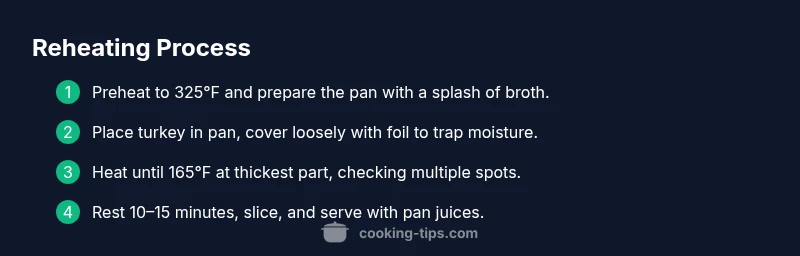
Preheat the oven to 325°F (163°C) for gentle reheating. Place the turkey in a roasting pan with a small amount of broth or pan drippings to keep it moist.
Tip: Cover loosely with foil to prevent surface drying while heat penetrates evenly. - 3
Heat gradually
Heat the turkey until the internal temperature reaches 165°F (74°C) at the thickest part. Check multiple spots if possible, especially near bones.
Tip: If reheating slices, arrange them in a single layer for even warming. - 4
Rest and test
Remove from heat and let the turkey rest for 10–15 minutes to redistribue juices. Recheck the temperature if you sliced into thick portions.
Tip: Resting improves juiciness and slicing quality. - 5
Carve and plate
Slice the meat against the grain and arrange on a warmed platter. Spoon any released juices over the slices or serve with warm gravy.
Tip: Keep slices shallow to maintain heat; heat gravy separately if needed. - 6
Store leftovers safely
If you don’t finish, store leftovers within two hours in shallow containers and refrigerate promptly. Reheat only once when served again.
Tip: Label containers with date and reheating instructions.
Quick Answers
Can you reheat a cooked turkey more than once?
No. Reheating poultry more than once increases the risk of bacterial growth and uneven heating. If you have leftovers, reheat to 165°F and only once before serving.
No, avoid reheating a cooked turkey more than once; reheat to a safe temperature and serve promptly.
What’s the best way to reheat a whole cooked turkey?
The oven method on a low to moderate temperature works best for a whole turkey, preserving moisture. Add broth and cover with foil to prevent drying, and use a thermometer to verify 165°F in the thickest section.
Reheat the whole bird in the oven at a gentle temperature with moisture and cover to keep it juicy.
Can I reheat slices in a microwave?
Yes, but microwave heating can heat unevenly. Arrange slices in a single layer, cover, and rotate or stir during heating. Check the internal temperature to reach 165°F.
Sliced turkey can be microwaved, but ensure even heating and a safe internal temperature.
How should I store cooked turkey leftovers?
Store leftovers in shallow containers within two hours of cooking. Refrigerate promptly and use within 3–4 days, or freeze for longer storage. Label with date and reheating instructions.
Store leftovers in shallow containers, refrigerate promptly, and label with date.
Is it safe to use turkey gravy from the store?
Store-bought gravy is safe if unopened and kept within the labeled shelf life; once opened, refrigerate and use promptly. Reheat gravy to a gentle simmer before serving.
Store-bought gravy is safe if stored properly; reheat to a gentle simmer.
Watch Video
Top Takeaways
- Reheat to 165°F for safety and moisture.
- Choose labeling that confirms 'fully cooked' before purchase.
- Slice before reheating for faster, more even warming.
- Rest meat 10–15 minutes after heating to lock in juices.