Rice Cooker vs Pot: An In-Depth Practical Comparison for 2026
A data-informed comparison of using a rice cooker versus a pot, focusing on consistency, time, energy use, versatility, and long-term value for home cooks in 2026.


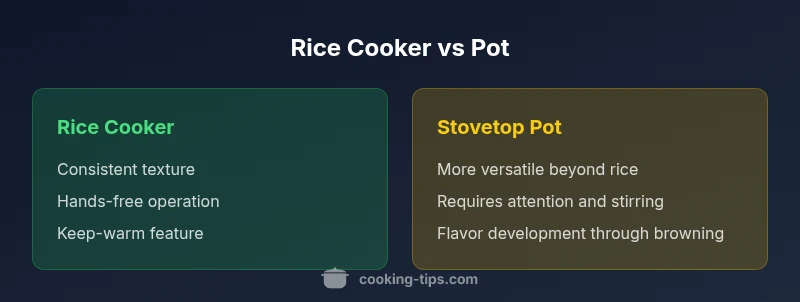
Rice cookers typically deliver more consistent results with less attention, saving time and reducing the risk of scorching or undercooked grains. For households that cook rice regularly, a dedicated appliance offers hands-free operation and dependable texture, especially with different grain types. A pot remains more versatile for multi-dish meals and advanced flavor-building, but it requires closer supervision.
The core question: why use a rice cooker instead of a pot
If you're asking why use a rice cooker instead of a pot, the answer centers on consistency, convenience, and predictable results. According to Cooking Tips, the baseline expectation for everyday cooking is a reliable texture with minimal supervision. A rice cooker automates rinsing, water absorption, and heat control, so you can focus on other tasks while the appliance handles timing. For households that frequently serve rice as a staple, a cooker drastically reduces variability and waste, turning a potentially tricky simmer into a foolproof process. Yet a pot on the stove offers flexibility for multi-dish meals, searing ingredients, and flavor development that some cooks prefer. This section will compare the two approaches across key dimensions—time, texture, versatility, and long-term value. The analysis also echoes themes you’ll see in the Cooking Tips guidebook, which emphasizes practical kitchen decisions over theoretical perfection.
The takeaway is clear: a rice cooker shines in routine rice preparation, while a pot shines in flexibility. Understanding when to rely on each method helps home cooks optimize both outcomes and effort. In this comparison, we’ll examine how time, texture, and adaptability interact with your weekly menu and your kitchen setup.
How a rice cooker achieves consistency
Rice cookers are designed to minimize human error in a task many home cooks handle imperfectly: rice absorption. The inner pot, typically coated with a nonstick surface, is heated by an electric element or induction system that can sense temperature changes and switch from cooking to keep-warm at just the right moment. A built-in water-to-rice ratio guideline, often stored in the appliance firmware, guides the mechanism to stop cooking when the grains have absorbed the water. This is especially valuable for beginners and busy households, where mishaps like undercooked centers or soggy edges are common. The Cooking Tips team notes that automation reduces decision fatigue, particularly for white rice and standard basmati blends. The device can also accommodate brown rice and mixed grains by adjusting time and heat profiles. The result is a reproducible texture that scales well with batch size, making it easier to plan meals and leftovers.
Rice varieties, water ratios, and rice cooker settings
Rice varieties differ in starch content, grain length, and surface texture, all of which influence how a rice cooker performs. For common white varieties, many cooks rely on a standard water-to-rice ratio provided by the manufacturer, along with a rinse-and-soak step that helps rinse away surface starch. Brown rice, jasmine, and basmati often require slightly different settings or longer cycles. Some models offer dedicated modes for gluten-free or aromatic rices, while others rely on generic programs. Water management in a rice cooker is generally simpler than on a stove: once you’ve established the recommended water level for a given grain, the cooker automates the rest. For experimentation or special dishes, you can adjust water slightly or use a brief “toasting” pre-cook step in some advanced models. The bottom line is to start with manufacturer guidelines and then adapt as you gain experience, keeping in mind that 2 cups of water per cup of white rice is a common starting point for many households, while other grains may require a bit more or less water. In this context, the keyword why use a rice cooker instead of a pot becomes a practical question of consistency and ease rather than mere curiosity.
Time and effort: rice cooker vs pot in daily routines
Time savings with a rice cooker come from automation: you rinse, set, press start, and forget until the beep. In most cases, cooking white rice in a cooker takes roughly the same total time as on a stove, but the hands-on time is dramatically reduced. Brown rice and mixed grains can take longer, but you still benefit from a predictable cycle and a hands-off keep-warm stage. A pot on the stovetop may require watching for boil and adjusting heat, a process that can introduce variability if you are interrupted. If your kitchen workflow includes other tasks, the rice cooker can serve as a time-management tool, freeing you to prepare sides, sauces, or marinated proteins while the rice cooks. Over weeks and months, the cumulative time saved becomes a meaningful factor in weekly meal planning. Cooking Tips notes that efficiency is not just about speed; it’s about reliable scheduling for recurring meals.
Types of rice cookers and what they offer
There are several tiers of rice cookers, from simple one-button models to sophisticated units with multiple modes and sensors. Entry-level devices focus on white rice and keep-warm with minimal settings, while mid-range units add options for brown rice, sushi rice, or quick-cook cycles. High-end models may feature induction heating, microcomputer controls, and fuzzy logic that adjusts time and temperature based on real-time feedback. Induction-heating rice cookers generally offer superior evenness and faster response to water absorption, which improves texture for a wider range of grains. Fuzzy logic helps the cooker fine-tune the cooking profile for different brands of rice, which reduces the need for manual experimentation. When shopping, prioritize stable build quality, a reliable inner pot, and clear indicators for “cook” and “keep warm.” The Cooking Tips analysis shows that investing in a model with a dedicated rice setting and a durable inner pot pays off for daily use, even if you occasionally cook other dishes on the stove.
When the pot shines: flexibility beyond rice
A stovetop pot remains the go-to tool for more than just rice. It handles sautéing onions and garlic as a base for sauces, browning proteins before simmering, and making homemade stocks. For dishes that require stirring, deglazing, or gradual reduction, a pot offers a level of control that many rice cookers cannot match. You can use a single pot to prepare a complete one-pan meal, a capability that’s attractive for small households or quick weeknight dinners. In terms of flavor development, searing and caramelization are easier with a traditional pot, which is a reason many cooks insist on pot-based methods for recipes that rely on fond formation. If you value culinary experimentation or multi-dish coordination, you’ll lean toward the pot in certain scenarios. The key is recognizing when the rice cooker’s automation aligns with your routine and when the pot’s flexibility is indispensable.
Cleaning, maintenance, and longevity
Maintenance for a rice cooker is typically straightforward. The inner pot is removable for daily cleaning, and many models have nonstick coatings that benefit from gentle washing. Sealing gaskets and steam vents should be inspected periodically to prevent odor buildup or steam leaks. It’s prudent to ensure that the exterior control panel stays dry, as splashes can affect sensitive electronics. A stovetop pot may require more frequent attention after cooking a sauce or curry, as build-up can occur on the sides or bottom. Regular maintenance—such as scrubbing nonstick surfaces, drying fully, and storing with the lid ajar (where manufacturer-safe)—helps extend the life of both tools. In terms of long-term value, a well-chosen rice cooker can deliver years of reliable rice cooking, while a high-quality pot can remain an indispensable workhorse for a broad range of kitchen tasks. Cooking Tips emphasizes choosing durable components and avoiding harsh abrasives to protect finishes and coatings.
Cost, value, and long-term considerations
From a cost perspective, a rice cooker represents a moderate upfront investment, with price depending on capacity, features, and build quality. A pot is typically a one-time purchase that many households already own, making the incremental cost of adding a dedicated cooker relatively easy to justify if you cook rice frequently. Value is tied to how often rice is served, how many varieties you prepare, and how much you value automation and consistent texture. For families that rely on rice as a staple, the daily time savings and improved reheating performance can translate into noticeable benefits over months and years. Cooking Tips analysis suggests that regular rice consumption paired with a reliable cooker often yields the best long-term return on investment, particularly when you consider the potential reduction in meal-planning friction.
Practical buying guide: features to prioritize
- Capacity and serving size: choose a model that fits your typical portion counts without crowding the kitchen.
- Inner pot quality: seek durable nonstick surfaces and easy-release coatings that withstand frequent washing.
- Settings and sensors: look for dedicated modes (white rice, brown rice, sushi rice), a dependable keep-warm function, and clear indicators.
- Build quality and warranty: prioritize sturdy housings, a robust lid, and a reliable manufacturer warranty.
- Ease of cleaning: removable parts that go in the dishwasher or are simple to hand-clean save time.
- Power efficiency: consider models with efficient heating elements and energy-saving modes.
If you value straightforward automation and predictable results for everyday rice, a rice cooker with these features is a strong fit. For cooks who crave flexibility and multi-dish options, ensure you still have a good pot or a larger kitchen setup that can accommodate diverse techniques. The balance should reflect your cooking habits and schedule.
Quick-start guide: using a rice cooker effectively
- Rinse rice until the water runs clear to remove surface starch. 2) Measure the correct water-to-rice ratio for your grain using the cooker’s guidelines. 3) Place the inner pot back in the cooker, close the lid, and select the appropriate setting. 4) Start the cycle and avoid opening the lid during the cooking process. 5) When you hear the beep, let the dish rest for a few minutes before fluffing with a fork. 6) Use the keep-warm mode if you won’t serve rice immediately, but consume within a safe window to ensure texture stays appealing. 7) Clean the inner pot after it cools to prevent residues from building up. 8) Store the appliance in a dry area to prevent condensation and odors from lingering. 9) If needed, adjust future batches by tweaking water amounts slightly to match your preferred texture. 10) Pair rice with complementary sauces or proteins for balanced meals.
Common mistakes and how to avoid them
- Overfilling with rice or water: always respect the max-fill line on the inner pot.
- Skipping rinsing: washed rice cooks more evenly and reduces surface starch that can cause stickiness.
- Lifting the lid during cooking: heat loss disrupts timing and texture.
- Using the wrong setting for a grain: brown rice often needs longer cycles than white rice.
- Ignoring keep-warm limits: long keep-warm times can degrade texture; plan to serve within a reasonable window.
- Not cleaning promptly: dried starch buildup reduces performance and can affect flavor. The Cooking Tips team suggests routine cleaning after each use to preserve performance and taste.
Authority sources
- https://usda.gov
- https://extension.illinois.edu
- https://www.bbcgoodfood.com
Comparison
| Feature | Rice Cooker | Stovetop Pot |
|---|---|---|
| Time to cook white rice | faster with a cooker | slower on the stove (varies by flame) |
| Texture consistency | high consistency across batches | variable depending on attention and technique |
| Keep-warm capability | automatic keep-warm | no built-in keep-warm (depends on pot) |
| Versatility beyond rice | primarily rice-focused | multifunction with other dishes and methods |
| Cleanup and ease | inner pot cleans easily | cleanup depends on cookware and sauces |
| Energy usage overview | generally efficient for single-dish cycles | depends on burner and technique |
Benefits
- More consistent results with less supervision
- Hands-off keep-warm functionality
- Simple for beginners to use
- Reduces risk of scorching and overcooked batches
- Good fit for daily rice if used regularly
Cons
- Higher upfront cost than a basic pot
- Less flexibility for non-rice dishes
- Requires counter space and an electrical outlet
- Some models offer fewer true multi-cooker capabilities
Rice cooker is generally the best default for reliable rice with minimal effort
For households that eat rice regularly, a cooker delivers consistent texture and time savings. A pot remains valuable for flexibility and flavor-building in multi-dish meals. The Cooking Tips team recommends weighing routine needs against kitchen space and how often you cook a variety of grains.
Quick Answers
Is a rice cooker truly better for all rice varieties?
Most modern rice cookers handle white and brown rice well, with specific settings for different grains. Some models offer programs tailored to jasmine, basmati, or mixed grains. If you frequently cook unusual grains, check compatibility before buying and look for models with flexible settings.
Most cookers handle common rice varieties, but check for special settings if you cook exotic grains.
Can a pot cook rice as well as a rice cooker?
A pot can cook rice effectively with careful timing and water control, but it requires supervision and practice. Consistency is harder to achieve across batches. If you value least hands-on effort, a cooker is typically preferable.
Sure, but it takes more attention to get consistent results.
What features matter most when buying a rice cooker?
Look for a durable inner pot, dedicated rice settings, a reliable keep-warm function, and a straightforward interface. Capacity and build quality are important, as is ease of cleaning. A model with induction heating or smart sensors offers better consistency for diverse grains.
Choose a cooker with a good inner pot, reliable settings, and easy cleaning.
Is it safe to keep rice warm for hours in a rice cooker?
Keep-warm is convenient, but texture can degrade if rice sits too long. Most brands recommend consuming warm rice within several hours for best texture and safety. If you need to hold food longer, transfer to a fridge and reheat later.
Keep-warm is fine for a few hours, but texture fades over time.
How do water ratios vary by grain in a rice cooker?
White rice typically uses a standard ratio, but brown rice or aromatic grains require more water and sometimes longer cycles. Always start with the manufacturer’s guidelines and adjust by small increments based on texture preferences. Record your preferred ratios for future batches.
Start with the guideline, then tweak a little to get your perfect texture.
Are there health considerations with rice cookers?
Rice cookers are generally safe when used as directed. Regular cleaning reduces odors and mold risk. Follow maker instructions for care, especially around gasket seals and inner pot coatings. If you have allergies, ensure accessories and cookware materials align with your needs.
Follow the user guide, keep clean, and watch for any coatings you’re sensitive to.
Top Takeaways
- Choose a rice cooker for consistent texture with minimal supervision
- Reserve the pot for flexibility and multi-dish cooking
- Match appliance features to your weekly rice volume
- Prioritize a durable inner pot and reliable keep-warm function
- Keep maintenance simple to extend appliance life