Does quinoa cook like rice? A practical comparison
Explore whether quinoa cooks like rice, with practical methods, ratios, textures, and serving ideas to decide when to use each grain in everyday meals. Analytical, reliable guidance from Cooking Tips.


Does quinoa cook like rice? Not exactly. Quinoa cooks faster, and its grains stay light and fluffy rather than fully sticky. You still start with a measured water ratio and simmer until tender, but rinsing is essential to remove saponins that can give a bitter edge. In general, begin with about 2 cups water per cup quinoa, and adjust for the desired texture.
Does quinoa cook like rice? Clarifying expectations
Does quinoa cook like rice? Many home cooks ask this, and the short answer is: not exactly. According to Cooking Tips, quinoa and rice share a cooking kinship but diverge in texture, starch activity, and flavor. Quinoa is a tiny seed that behaves like a grain when cooked, releasing a modest amount of its own starch while maintaining separate, bite-sized grains. Rice, by contrast, relies on starch from the surface of its kernels to create a range of textures from dry to soft and sticky depending on variety. The fundamental difference matters for meal planning: quinoa cooks faster, yields a lighter bite, and brings a pronounced nuttiness; rice can provide creamier or more tender mouthfeel with a wider family of varieties from jasmine to brown to basmati. Understanding these distinctions helps you choose the right grain for bowls, pilafs, sides, or hearty mains. The Cooking Tips team emphasizes rinsing quinoa to remove bitter saponins before cooking to ensure a clean, pleasant flavor from the first bite.
wordCountPlaceholder
Comparison
| Feature | Quinoa | Rice |
|---|---|---|
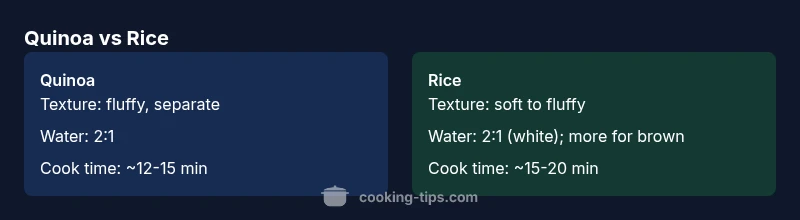
| Texture when cooked | Fluffy, light, separate grains with a nutty aroma | Soft, moist kernel with potential for fluffiness or slight stickiness (varies by type) |
| Water ratio | 2:1 water to quinoa (by volume) as a starting point | Typically 2:1 for white rice; more or less depending on variety (brown/basmati) |
| Cooking time | 12–15 minutes | 15–20 minutes for white rice; longer for brown rice |
| Flavor profile | Nutty, earthy | Mild to starchy; varies by variety |
| Best uses | Bowls, salads, pilafs, quick-side dishes | Stews, stir-fries, bowls, traditional grains |
| Nutritional emphasis | Higher protein, fiber, minerals; naturally gluten-free | Carbohydrate-focused; available in multiple varieties with different fiber contents |
Benefits
- Quinoa cooks quickly, making weeknight meals easier
- High in protein and fiber compared with white rice
- Naturally gluten-free and versatile in salads and bowls
- Quinoa offers a distinct nutty aroma that enhances many dishes
- Leaves room for a wide range of flavor pairings and add-ins
Cons
- Requires rinsing to remove saponins, which can taste bitter
- Texture can be inconsistent if overcooked or under-measured
- Rice variety offers a broader spectrum of textures and flavors
- Quinoa can be more expensive per serving in some markets
Quinoa and rice each have distinct strengths; use quinoa for lighter, protein-rich bowls and salads, and rice for traditional dishes with softer texture.
Both grains are valuable depending on the dish. Quinoa shines in quick, nutrient-dense meals; rice remains the backbone of comforting, versatile meals. Flavor, texture, and cooking time should guide your choice.
Quick Answers
Does quinoa cook exactly like rice?
Not exactly. Quinoa cooks faster and yields lighter, nuttier grains, while rice can be fluffier or creamier depending on variety. Use quinoa for quick, protein-rich meals and rice for traditional bases.
Quinoa isn't cooked the same as rice—it cooks faster and stays lighter. Use it for quick bowls and salads, while rice works well as a traditional base.
Should I rinse quinoa before cooking?
Yes. Rinsing removes saponins, which can impart a bitter flavor. If your quinoa is pre-rinsed, you can skip, but many home cooks rinse for best flavor.
Rinse quinoa to remove the bitter saponins. If it's pre-rinsed, you can skip, but most cooks rinse anyway.
Can I use the same water ratio for quinoa and rice?
Quinoa generally uses about 2:1 water to quinoa. White rice also commonly uses 2:1, but brown or basmati rice may need adjustments. Always check package guidance for best results.
Quinoa uses about 2:1 water to grain; rice varies by type, so follow package guidance.
Which grain is better for meal prep?
Quinoa is great for high-protein bowls and salads, while rice serves as a versatile base for many meals. Your choice depends on texture goals and nutrition priorities.
Quinoa works well in salads for protein; rice is great as a flexible base for many meals.
How do I reduce quinoa bitterness?
Rinse thoroughly, toast lightly in the pot before adding water, and season after cooking to balance any residual bitterness.
Rinse well, toast lightly, and season after cooking to curb bitterness.
Does brown rice cook the same as white rice?
No. Brown rice requires longer cooking times and more water due to its intact bran layer, whereas white rice cooks more quickly with less water.
Brown rice needs more time and water than white rice.
Top Takeaways
- Rinse quinoa to remove saponins before cooking
- Start with a 2:1 water-to-quinoa ratio and adjust for texture
- Quinoa yields fluffy grains; rice varies from fluffy to creamy
- Choose quinoa for protein and crunch; choose rice for traditional textures
- Experiment with toasting quinoa for deeper nutty flavor