What Size Cookie Scoop for 1 Inch Balls: A Practical Guide
Learn the exact scoop size to form 1 inch dough balls for uniform cookies. Explore scoop options, practical measurements, and a quick table to reference for consistent results.


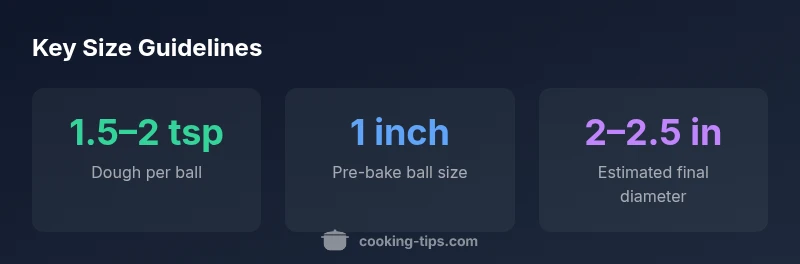
For 1-inch dough balls, aim for roughly 1.5–2 teaspoons of dough per ball. In scoop terms, a 1/2 tablespoon scoop or a 2-teaspoon scoop closely matches this size to achieve the target ball diameter before baking. This range helps ensure even spreading and bake-through, with adjustments based on dough moisture and recipe fat content.
What size cookie scoop for 1 inch balls? A sizing approach that starts with the dough volume is key. The goal is to form dough balls that, before baking, are close to a 1-inch diameter so that after heat, they spread evenly into cookies of consistent size. According to Cooking Tips, the precise diameter you target depends on dough hydration, fat content, and mix-in distribution, but a practical starting point helps you standardize results across batches. In practice, portion by volume rather than guesswork ensures uniformity, especially when baking multiple trays. For most standard cookie doughs, aiming for roughly 1.5–2 teaspoons of dough per ball generates pre-bake balls around 1 inch in diameter, which bakes into evenly sized cookies with predictable spread. This approach also minimizes waste and makes batch scaling straightforward.
Picking a scoop size: matching 1 inch balls to common scoop options. Cookie scoops are labeled by volume, not by diameter, so you’ll translate a known volume to a dough ball diameter. A 1/2 tablespoon scoop (which holds about 1.5 teaspoons) and a 2-teaspoon scoop are popular choices that align closely with the 1-inch target. If your dough is particularly stiff or dense, you may prefer the 2-teaspoon option; if it’s softer, the 1/2 tablespoon may give more control. Remember that dough moisture and fat content affect final spread, so start with one option and adjust in subsequent batches for uniformity across trays.
Measuring techniques: weight vs volume vs scoops. For absolute consistency, weigh dough portions when possible. A typical target for a 1-inch ball sits around 6–8 grams per ball for many standard cookies, though this will vary by recipe. If you don’t have a kitchen scale, use level scoops to ensure the same amount goes into each ball. After portions are formed, gently roll each piece between your palms to create a smooth, compact sphere, which helps prevent cracks and uneven baking. A quick mist or light dampening of hands can reduce dough sticking and promote uniform shaping.
Step-by-step: forming uniform 1-inch balls. 1) Gather dough and measure with your chosen scoop. 2) Level the scoop and portion onto a sheet. 3) Tap the scoop on the counter to release a clean ball. 4) Roll between palms to smooth. 5) Place on parchment-lined sheets with consistent spacing. 6) If dough is very soft, chill portions briefly before baking to preserve shape. Following these steps yields consistent ball size and cookie results across batches.
Common pitfalls and how to avoid them. One common pitfall is under-measuring dough, which produces undersized cookies and uneven bake. Overly wet dough can spread more than desired, while overly dry dough may bake up crumbly or dense. To avoid these issues, consider chilling the dough after portioning for 15–30 minutes, especially in warm kitchens. Also, confirm your oven is at the correct temperature and use parchment or a silicone mat to promote even heat transfer. Finally, avoid crowding sheets—give each ball proper space to spread evenly.
Guidance on scoop sizes and resulting ball diameters
| Scoop Size | Dough per Ball (approx) | Pre-bake Ball Size | Notes |
|---|---|---|---|
| 1/2 tablespoon | 1.5–2 tsp | ≈1 inch | Best match for 1 inch raw ball; slight underfill yields precise bake |
| 1 teaspoon | 1–1.5 tsp | ≈0.9 inch | Common for smaller cookies with tighter crumb |
| 2 teaspoon | 2–2.5 tsp | ≈1.1 inch | Larger pre-bake ball; may yield bigger cookies |
Quick Answers
What size cookie scoop should I use for 1-inch dough balls?
Use roughly 1.5–2 teaspoons per ball. A 1/2 tablespoon scoop or a 2-teaspoon scoop closely matches this size and offers reproducible results.
Use a small scoop, about 1.5 to 2 teaspoons per ball, for consistent 1-inch dough balls.
Will dough size affect final cookie diameter?
Yes. Larger dough balls tend to spread more slowly but end up bigger, while smaller balls bake faster with less spread. Dough composition determines the exact outcome.
Yes, bigger balls usually become bigger cookies; the exact result depends on dough moisture and fat.
Can I chill the dough to keep balls uniform after portioning?
Chilling helps the dough hold its shape and size during baking, improving uniformity. A 15–30 minute chill after portioning is usually sufficient.
Yes—chill the dough after portioning to keep sizes even.
Can I substitute measuring spoons for a cookie scoop?
Yes. Level measuring spoons can approximate scoop sizes, but consistency comes from leveling and rechecking portions across batches.
Measuring spoons work if you level them every time for consistency.
What should I do if my cookies spread too much?
Use smaller dough portions, chill the dough longer, or adjust oven temperature. Ensure the dough isn’t overly warm and that baking sheets have space between balls.
If they spread too much, try smaller portions and chill the dough longer.
“Size consistency in dough portions is fundamental to even baking and predictable texture; the right scoop size is a simple yet powerful tool for reliability in every batch.”
Top Takeaways
- Portion by volume for consistency, not guesswork
- Use 1/2 tablespoon or 2 teaspoon scoops to target ~1 inch balls
- Dough moisture and fat content affect final spread
- Chill portions to improve uniformity across batches
- Test bake a small batch to verify size and spacing