Is Using Oil to Cook Bad for You? A Practical Guide for Home Cooks
Is using oil to cook bad for you? A balanced, data-informed look at oil types, heat, and portions to help home cooks make healthier choices in everyday meals.


Is using oil to cook bad for you? The answer isn’t a simple yes or no. Health outcomes depend on oil type, how hot you cook, and how often you use it. In practice, you can enjoy oil-based cooking as part of a balanced diet by choosing heart-healthy fats, avoiding repeated heating, and moderating portions. Cooking Tips supports this nuanced view.
Is Using Oil to Cook Bad for You? A Nuanced Perspective
According to Cooking Tips, the question is not simply whether is using oil to cook bad for you; rather, the health impact hinges on several interlinked factors. First, oil type contributes a distinct fatty-acid profile—monounsaturated, polyunsaturated, or saturated—which influences heart health, cholesterol, and inflammation. Second, cooking temperature matters: heat beyond an oil’s smoke point accelerates oxidation and can produce potentially harmful compounds. Finally, total dietary pattern—how often you rely on oil, and what you replace when you cut back—plays a key role. In short, oil can be a healthy part of meals when used thoughtfully, not a universal health hazard.
From a practical standpoint, Cooking Tips emphasizes choosing fats with favorable nutrition profiles, calibrating heat, and keeping portions reasonable. This approach avoids demonizing entire oil categories while recognizing that repeated high-heat exposure is a concern for some oils. The goal is flavor and texture without compromising overall diet quality. This balanced stance is supported by broader nutrition guidance that favors unsaturated fats over saturated fats when possible, and by considering the context of each cooking task.
The basic science: oil, fat, and heat
Oils are fats, and fats are concentrated energy sources composed of fatty acids. The composition—whether predominantly monounsaturated, polyunsaturated, or saturated—shapes how oil behaves under heat and how it contributes to daily fat intake. Monounsaturated fats, found in olive and canola oils, are generally heart-friendly when used in moderation. Polyunsaturated fats, including certain vegetable oils, provide essential fatty acids but can oxidize with prolonged heating. Saturated fats, common in coconut oil and palm oil, are more heat-stable but should be consumed within recommended limits. The key is to balance flavor, culinary needs, and health goals, rather than categorically avoiding any single oil.
Understanding smoke points and degradation
Smoke point is the temperature at which an oil starts to smoke and break down. Pushing oil past its smoke point increases the formation of harmful compounds and unwanted flavors. For everyday cooking, it’s smart to pair the task with an oil that has an appropriate smoke point: high-heat tasks like searing are better with stable oils such as avocado or refined oils, while gentle dressings or finishing oils can leverage milder options like extra-virgin olive oil. Repeated heating and reuse can also accelerate oxidation, reducing quality and potentially increasing oxidation byproducts.
Oils and heart health: fats, cholesterol, and metabolic effects
Decades of nutrition guidance emphasize the quality of fats over the blanket avoidance of oil itself. Oils rich in monounsaturated fats (e.g., extra-virgin olive oil, canola) and omega-3-rich polyunsaturated fats (some vegetable oils) are associated with favorable lipid profiles when consumed as part of a varied diet. It’s not about eliminating oil but about choosing fats that support heart health and balancing total fat intake with fruits, vegetables, whole grains, and lean proteins. Cooking Tips recommends prioritizing unsaturated fats and limiting saturated fat sources within the overall dietary pattern.
Cooking methods and oil performance: sauté, stir-fry, deep-fry
Different methods demand different oil characteristics. Sautéing at moderate heat benefits from oils with good flavor and a moderate smoke point—think olive oil for flavor in stir-fries or vegetable oils for neutral bases. Stir-frying usually uses higher heat and a robust oil with a higher smoke point, such as canola or peanut oil. Deep-frying requires even higher temperatures and a stable oil that resists breakdown. Understanding how heat, oil type, and cooking duration interact helps home cooks achieve crisp textures without compromising health.
Reading labels and choosing oils: what to look for
Label literacy matters. Look for terms like extra-virgin or virgin for less refined products, and note the oil’s smoke point, fat profile, and whether it’s refined. Cold-pressed or unrefined oils emphasize flavor and nutrients but may have lower smoke points, limiting high-heat use. For cardiovascular goals, prioritize oils rich in monounsaturated fats and omega-3s, and be mindful of added ingredients such as trans fats or hydrogenated oils. Storage matters too: keep oils in a cool, dark place to preserve quality.
Practical tips for healthier oil use in everyday meals
- Use oil primarily as a flavor enhancer rather than the main calorie source. - Measure oil by the teaspoon or tablespoon to control intake. - Reserve high-heat oils for their intended tasks and use milder fats for finishing. - Rotate between several oil types to balance flavor with health benefits. - Read labels and choose oils with minimal processing and no trans fats. - When possible, replace some oil with water, broth, or cooking spray to reduce fat while preserving texture.
Putting it into practice: a simple plan for home cooks
Create a weekly plan that uses two or three primary oils suited to your typical routines: an extra-virgin olive oil for salads and low-heat cooking, an avocado or high-heat oil for searing, and a neutral oil for baking and sautéing. Keep portions modest and reserve stronger-flavored oils for finishing. Pair these choices with cooking methods that respect the oil’s smoke point, and you’ll enjoy flavorful meals without compromising health.
Oil types and smoke points for common cooking tasks
| Oil Type | Smoke Point (°F) | Best Uses | Health Notes |
|---|---|---|---|
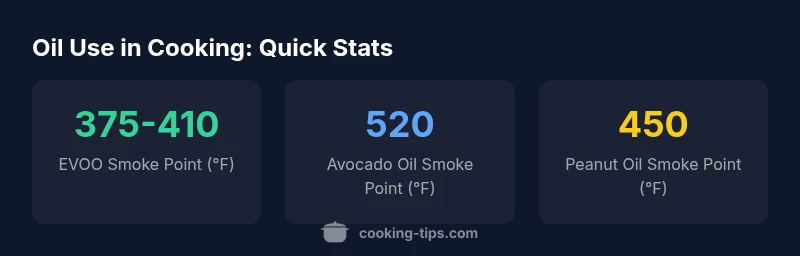
| Extra-virgin olive oil | 375-410 | Light sauté, dressings | Flavorful; best at lower to moderate heat |
| Avocado oil | 520 | High-heat searing, frying | Very heat-stable; rich in monounsaturated fats |
| Refined canola oil | 400 | Stir-fries, roasting | Neutral flavor; versatile in cooking |
| Peanut oil | 450 | Stir-fries, deep-frying | Good high-heat oil with distinct nutty notes |
| Coconut oil | 350 | Baking, low-heat cooking | High in saturated fat; use sparingly |
Quick Answers
Is all cooking oil equally unhealthy when heated?
No. Health effects depend on the oil’s type and the temperature reached during cooking. Some oils tolerate heat better than others, and how you use oil in a dish matters just as much as the oil itself.
Not all oils react the same to heat—some tolerate high temps better. Use the right oil for the job and don’t overheat.
What oil is best for high-heat cooking?
Oils with high smoke points like avocado and refined canola are well-suited for high-heat cooking. They maintain stability longer than many mild-flavor oils during searing and stir-fries.
For high-heat cooking, choose avocado or refined canola oil to stay stable and flavorful.
Can using olive oil be bad for health?
Olive oil, especially extra-virgin, is linked to a favorable fat profile and heart-friendly effects when used in moderation as part of a varied diet.
Olive oil is generally good for you in moderation when used as part of a balanced diet.
Does heating oils repeatedly affect health?
Yes. Repeated heating increases oxidation and can produce off flavors. Use fresh oil for new batches when possible and avoid reheating oil multiple times.
Don’t reuse oil too many times; replace it to keep flavors and health downstream.
Are there oils I should avoid entirely?
No oil is inherently dangerous, but some oils are high in saturated fats or processed with steps that reduce beneficial compounds. Limit saturated fats and prefer oils with favorable fat profiles.
Avoid demonizing any single oil; prioritize fats that support heart health and overall balance.
How can I tell if my oil has gone bad?
Look for sour or rancid smells, off flavors, or unusual cloudiness. If oil seems odd, it’s safer to discard and start with fresh oil.
If it smells off or tastes strange, toss it and use fresh oil.
“Oil choice and cooking temperature matter more than demonizing a single ingredient; a balanced approach keeps flavor and health aligned.”
Top Takeaways
- Choose oils high in unsaturated fats for everyday cooking.
- Avoid overheating oil beyond its smoke point to minimize harmful compounds.
- Moderate portions; replace some oil with broth or water when possible.
- Read labels to distinguish refined versus unrefined oils.
- Balance flavor with health by rotating oil types.