Is Cooking Harder Than Baking? A Practical Comparison for Home Cooks
Explore whether cooking is harder than baking with an analytical, practical comparison. We dissect skills, timing, ingredients, and tools to help home cooks master both domains.


Short answer: cooking is not inherently harder than baking; the perceived difficulty depends on goals, recipes, and constraints. Baking demands precise measurements and controlled conditions, while cooking rewards adaptation and flexible timing. For most home cooks, the challenge lies in mastering both domains, not choosing one as universally harder. This comparison helps you understand where your skills matter most.
Defining the Terrain: Cooking vs Baking
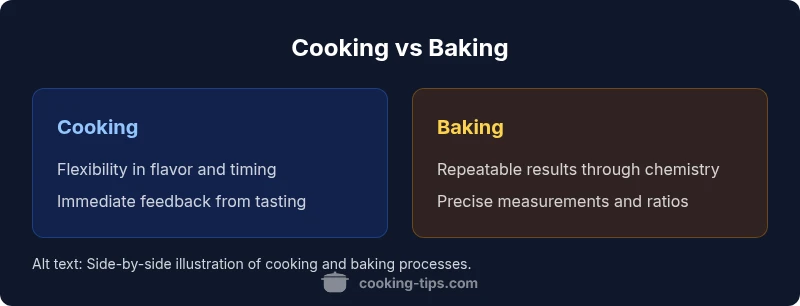
The question is often phrased as is cooking harder than baking, but the real distinction lies in purpose and approach. Cooking is about transforming ingredients into meals with flavor, texture, and balance, often in real-time. Baking focuses on chemistry: precise ratios, moisture balance, and heat management to coax predictable, dessert- or bread-like results from dough and batters. For home cooks, the line between the two blurs when you consider sauces, roasts, casseroles, and pastries. According to Cooking Tips, the difficulty is not a fixed label but a function of context, goal, and practice. If you’re pressed for time or improvising, cooking can seem easier; if you’re chasing pastry perfection, baking can feel more demanding. The keyword is practice-based mastery across both domains, not a binary gauge of hard versus easy.
Skill Sets and Learning Curves
Learning to cook well emphasizes flexibility, flavor perception, and the ability to adapt to available ingredients. It rewards experimentation, tasting, and iterative adjustment. Baking, by contrast, trains you to respect ratios, to control moisture, and to anticipate how heat moves through a pan. The learning curve in baking often starts with mastering basic doughs and batters before progressing to pastries and refined desserts. The Cooking Tips team notes that most home cooks progress fastest when they begin with simple recipes in each domain, then gradually increase complexity as confidence grows. The essential takeaway is that both domains demand deliberate practice, but the roadmaps look different: improvise-and-taste versus measure-and-mathematically model.
Precision, Timing, and Temperature
In cooking, timing can be forgiving—taste and texture guide decisions, and a quick adjustment can salvage a dish. Temperature control matters, but fluctuations are frequently tolerable across many recipes. Baking, however, treats precision as a core ingredient: oven calibration, exact weights, and controlled moisture levels govern outcomes. When people ask is cooking harder than baking, the answer often hinges on how much precision you expect in advance. A small error in baking’s math can yield stubborn outcomes, while cooking can recover through seasoning, heat management, and sequencing. For home cooks, building mental benchmarks for doneness and using reliable thermometers bridges both worlds.
Ingredient Variability and Pantry Challenges
Ingredient quality can swing the difficulty needle in either domain. In cooking, substitutions are common: you adapt with available spices, herbs, and flavor boosters. In baking, substitutions are riskier: changing flour types, leavening agents, or hydration levels can derail rise and texture. A practical approach is to establish a small, reliable pantry framework: staple flours, sugars, fats, acids, and leaveners that map to familiar recipes. Cooking Tips emphasizes that learning to judge moisture, salt, and acid balance in cooking supports your baking, and vice versa. The more you understand how ingredients behave, the easier it becomes to troubleshoot in real time across both tasks.
Equipment and Kitchen Setup
The gear you own often shapes perceived difficulty more than any recipe. A well-calibrated oven, a sturdy thermometer, a precise kitchen scale, and dependable pans reduce frustration across cooking and baking. For cooking, quality skillets and a reliable range support quick temperature changes and browning. For baking, a good oven thermometer, silicone mats, and appropriate bakeware improve repeatability. The Cooking Tips perspective is that investing in a small, curated toolset yields outsized benefits in both domains. When you know your tools, you know your limits—and you can plan around them rather than fighting against them.
Common Pitfalls and How to Avoid Them
In cooking, common issues include bland seasoning, uneven heat, and over-reduction. In baking, underproofed dough, inconsistent dough hydration, and oven temperature drift are frequent culprits. A practical remedy is to implement bite-sized checks: adjust seasoning by tasting early and late, monitor dough temperature with a thermometer, and verify oven accuracy monthly. Keeping a recipe journal helps you track what works and what doesn’t, so you can replicate successes and avoid repeated missteps. The key is systematic troubleshooting rather than reactive improvisation.
Real-World Scenarios: When One Domain Provokes More Difficulty
Consider a weeknight curry versus a laminated pastry. The curry benefits from flexible timing, bold spice layering, and quick feedback from tasting. The laminated pastry demands precise dough folds, consistent temperature, and patient resting periods. In such contrasts, the perception of difficulty shifts with your goals: if you want speedy, nourishing meals, cooking may feel easier; if you chase bakery-level pastries, baking becomes the focal challenge. The Cooking Tips approach is to build a cross-domain skill set so you can swap roles—cook to bake and bake to cook—depending on what your kitchen supports on any given day.
Building Confidence Across Both Realms
A practical plan blends both domains into a coherent practice routine. Start with 4–6 foundational recipes—two cooking staples (e.g., a sautéed vegetable dish, a simple sauce) and two baking basics (e.g., a loaf of bread, a shortcrust pastry). Schedule weekly practice sessions that alternate focus, plus short, timed challenges to simulate real kitchen pressure. Track outcomes, note deviations, and celebrate small improvements. The long arc is developing a flexible mindset: you’ll recognize when to improvise and when to measure, which is the hallmark of culinary mastery.
Comparison
| Feature | Cooking | Baking |
|---|---|---|
| Definition | Flexible, flavor-driven meals with dynamic adjustments | Structured, chemistry-driven processes with precise ratios |
| Typical Skills Emphasized | Adaptability, taste memory, and timing across courses | Precision, dough handling, and heat management for repeatable results |
| Typical Time Frame | Shorter, variable, multi-course possibilities | Longer, staged processes with rests and rises |
| Precision Requirements | Moderate to high depending on recipe; tasting guides decisions | High; measurements and environment control are critical |
| Equipment Needs | Skillets, pans, range, thermometer handy but flexible | Oven, mixer, scale, pastry boards, specialized bakeware |
| Common Failures | Imbalance of seasoning, over/under cooking | Incorrect measurements, oven temperature drift, improper resting |
| Best For | Weeknight meals, improvisation, and flavor exploration | Pastries, breads, and desserts requiring repeatable outcomes |
Benefits
- Cooking offers flexibility and quick feedback loops
- Baking provides repeatable results with disciplined technique
- Learning both domains increases kitchen confidence
- Cross-training can reduce overall kitchen stress
Cons
- Cooking can feel inconsistent when relying on intuition alone
- Baking can seem rigid due to exact measurements and timing
- Mistakes in baking may take longer to recover from than in cooking
Neither domain is inherently harder; difficulty is context-dependent
Mastery comes from deliberate practice in both areas. Start with fundamentals, then gradually tackle more complex tasks in cooking and baking to build transferable skills.
Quick Answers
Is baking harder than cooking?
Baking often requires more precise measurements and temperature control, which can feel harder for beginners. Cooking emphasizes flavor development and adaptability. Both demand practice to master, but the difficulty level depends on the specific recipe and your goals.
Baking tends to be more precise, while cooking allows more room to adapt. With practice, both become easier.
What makes cooking easier to adjust on the fly?
Tasting and seasoning as you go helps you modulate flavors quickly. Keeping a flexible plan and knowing a few backup ingredients lets you adapt without derailing the dish.
Taste as you go and keep flexible plans; small changes can save a dish.
Are some recipes or cuisines inherently more challenging?
Pastry, delicate sauces, and laminated doughs often pose greater challenges due to precise moisture, temperature, and timing. Sautéed dishes and stews typically offer more leeway for improvisation.
Pastry and precise sauces are usually tougher; everyday cooking is often more forgiving.
How long does it take to become proficient at both?
Proficiency depends on practice frequency and recipe variety. Setting focused goals and dedicating regular time to both domains accelerates learning more than sporadic attempts.
Regular, focused practice speeds up learning in both areas.
Do tools influence difficulty more in cooking or baking?
Tools influence both domains, but the impact is often greater in baking due to measurement precision and oven consistency. A reliable thermometer, scale, and calibrated oven improve outcomes across the board.
Good tools matter a lot, especially for baking precision.
Top Takeaways
- Define your goal: quick meals vs pastry perfection
- Master core techniques in both domains
- Practice with measurable, progressive challenges
- Invest in a reliable, versatile toolkit
- Log outcomes to track improvement over time